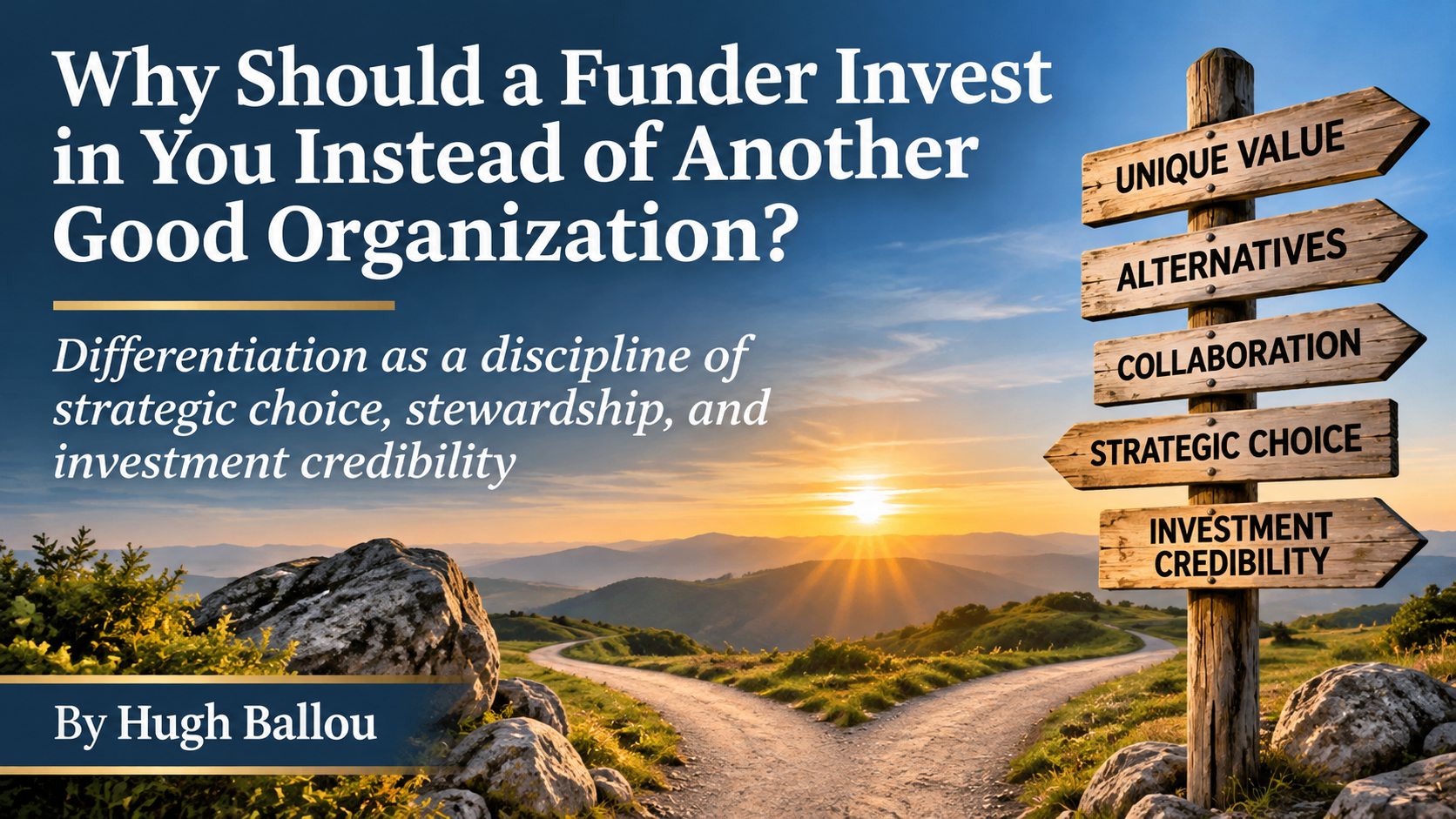
Why Should a Funder Invest in You Instead of Another Good Organization?
Differentiation as a discipline of strategic choice, stewardship, and investment credibility
By Hugh Ballou
Here is an uncomfortable executive question: if several credible organizations are addressing the same issue, why should a funder invest in yours?
 Be our guestYour next big opportunity could be in a room you're not in.Meet CEOs, founders and owners at a reception in your city or online. Your first event is on us.Request my guest seat →
That question can feel awkward because nonprofit leaders do not want to sound competitive, dismissive, or self-important. Most leaders know that social problems are too large for one organization to solve alone. They respect peers in the field and often depend on them as partners.
But avoiding the question does not make it disappear. A serious funder still has to decide where to place limited resources. The funder is evaluating not only whether the mission is worthy, but whether this organization is a particularly credible vehicle for producing the intended change.
Differentiation, therefore, is not about attacking competitors or claiming exclusive ownership of a social problem. It is about understanding the landscape well enough to explain the distinctive contribution your organization is positioned to make.
Understand the Alternatives Before You Describe Your Value
Executive teams often know their own programs in great detail while knowing surprisingly little about the alternatives available to the people they serve.
Those alternatives may include other nonprofits, public agencies, congregations, schools, informal community networks, commercial providers, self-help resources, or simply doing nothing. From the funder’s perspective, these are all part of the investment landscape.
If leadership cannot explain what else exists, where those alternatives are strong, and where meaningful gaps remain, it becomes difficult to make a disciplined case for investment.
Understanding alternatives is not a marketing exercise. It is a strategic responsibility. It helps leaders see duplication, underserved populations, ineffective pathways, collaboration opportunities, and places where the organization should not expand because another provider is already doing the work well.
Unique Value Is Your Distinctive Contribution
Unique value is not a slogan. It is the organization’s distinctive contribution to a defined problem.
That contribution may come from doing something differently, especially well, more accessibly, more efficiently, with greater trust, with stronger evidence, or in a way that fills a gap others are not designed to fill.
For one organization, unique value may be geographic access. For another, it may be a specialized population, a trusted delivery model, unusual expertise, integration across services, or a partnership structure that reaches people others cannot reach.
The point is not to prove that no one else could possibly do the work. The point is to show why this organization has a meaningful and credible role in the larger solution.
Why Generic Funding Language Weakens Confidence
When leaders have not done this strategic work, funding language becomes generic.
The mission is worthy. The need is urgent. The stories are compelling. The leaders are committed. But the funder still cannot tell why this organization is the right vehicle for investment rather than one of several equally worthy options.
That gap often appears in familiar phrases: ‘We are passionate about our mission.’ ‘We serve an important need.’ ‘Our community depends on us.’ All of those statements may be true, but none of them explains strategic distinctiveness.
A fundable organization should be able to connect the problem to the gap in the current landscape, then connect that gap to the organization’s particular contribution.
Strategic Choice Includes What You Will Not Do
Differentiation requires choice.
Organizations weaken their identity when they try to be all things to all people. A new grant opportunity appears, a donor expresses interest, or a board member proposes a new program, and the organization stretches beyond its strongest contribution.
Executives need the discipline to say not only what the organization will do, but also what it will not do.
That is not a sign of limited ambition. It is stewardship. Resources are finite. Leadership attention is finite. Staff capacity is finite. Strategic focus protects the organization’s ability to deliver on the work it is best positioned to do.
Collaboration Can Make Your Distinctiveness Stronger
Collaboration and differentiation are not opposites. In fact, the two can reinforce one another.
An organization that clearly understands its distinctive contribution is better able to identify where partners should lead, where referrals make sense, where shared infrastructure is useful, and where duplication should be avoided.
Collaboration allows each organization to concentrate on its strongest contribution rather than building every capability internally.
For funders, this can be a powerful signal. It shows that leadership is not protecting organizational territory at the expense of the mission. It is designing the strongest overall pathway to impact.
Use the Executive Comparison Test
A practical way to test your investment case is to walk through six questions in sequence:
- Problem: What specific problem are we trying to change?
- Available alternatives: What other credible responses already exist?
- Gap: What need, population, access point, capability, or result is still insufficiently addressed?
- Distinctive contribution: What are we especially well positioned to contribute?
- Collaboration role: Where should we lead, partner, refer, or support rather than duplicate?
- Intended impact: What change should occur because our distinctive contribution is added to the larger ecosystem?
When leaders can answer these questions coherently, the investment case becomes much stronger. The funder can see not only that the organization is doing good work, but why its role matters within the broader field.
That is the kind of clarity that strengthens strategic choice, governance, partnership decisions, and funder confidence.
The Executive Test
Before the next major funding conversation, ask your executive team and board to answer one question without referring to the proposal:
Can a serious funder explain why your organization is needed in addition to the other good organizations already working on the issue?
If the answer is not yet clear, the next task is not better fundraising language. It is better strategic clarity.
Map the major alternatives in your field. Identify the meaningful gap. Then write one sentence explaining the distinctive contribution your organization is positioned to make.
That sentence will not only improve your funding case. It can sharpen program choices, strengthen partnerships, focus board conversations, and help leaders steward resources around the contribution that matters most.
Primary Action: Map the major alternatives in your field and write one sentence explaining the distinctive contribution your organization is positioned to make.
This article is part of a series developed from Hugh Ballou’s book, Creating a Fundable Nonprofit: Building the Organizational Condition That Creates Funder Confidence. Learn more at NonprofitFundability.org.
Opinions expressed by C-Suite Network contributors are their own.
 The Boardroom Needs the Ground: By Mark Madrid
 How Fractional Executives can Help Your Company Thrive: Key FactsBy Paul Whitley
 Do Not Cut 25% of Your Workforce YetBy Mahesh M. Thakur
 C-Suite TV · 22 minProject Calm: Johnny C. Taylor Jr. on Leadership, Culture, and the Future of Work
 C-Suite Radio · Leadership Without Losing Your Soul: Master Communication & Management Skills To Boost Productivity, Teamwork & Ease Overwhelm380 Stop Doing All the Thinking: 4 Leadership Communication Skills That Get Your Team Solving Problems
 Chairman's Corner · Jeffrey HayzlettYour Best Performer Might Be Your Biggest Problem. And It’s Contagious.
Meet the founders, CEOs and operators behind stories like this one. Next reception: NYC Executive Reception, Tue, Nov 24.
Attend as a guestMembership: $100/mo →