The quick take:
- Harvard Business School researchers tracked nearly 60,000 front-line workers. The ones who got fired for things like harassment and fraud were often among the fastest workers on the team.
- Their behavior spread. People on teams with more toxic coworkers were far more likely to get fired for misconduct themselves.
- Why it matters now: it’s year-end review season, and the warning signs show up long before the damage does.
Want to know who is most likely to get fired for breaking the rules?
The person who swears the rules should never be broken.
That’s not my opinion. It’s one of the strangest findings from a Harvard Business School study of what the researchers called “toxic workers.” And it explains why so many owners keep the wrong person way too long.
 Be our guestYour next big opportunity could be in a room you're not in.Meet CEOs, founders and owners at a reception in your city or online. Your first event is on us.Request my guest seat →
What they actually studied
Dylan Minor of Harvard Business School and Michael Housman, an analytics executive at a hiring-software company, looked at nearly 60,000 front-line workers at 11 companies over three years. These were sales and customer service jobs in retail, financial services and health care.
They defined “toxic” narrowly. Not annoying. Not grumpy. Toxic meant fired for serious misconduct: harassment, violence, fraud, falsifying documents. That was about 1 in 20 workers.
Then they looked at what those people were like before they blew up.
They were faster. They weren’t better.
Here’s the trap. The toxic workers got their work done faster than average, the paper found. But the quality of their work wasn’t any better.
That’s how they hide. On the scoreboard, they look like your stars. Speed is easy to see. What they’re doing to the people around them isn’t.
Every owner knows this person. Hits the number. Customers love them. Half the team would rather eat glass than sit in a meeting with them. And you look the other way, because the numbers are the numbers.
Then it spreads
This is the part that should scare you.
The researchers measured how many toxic coworkers each person had around them. The more toxic people on a team, the more likely everyone else was to end up fired for misconduct too. In one of their models, a modest increase in exposure nearly doubled the odds.
Bad behavior isn’t just tolerated on those teams. It’s learned.
Minor’s advice for managers when a toxic worker has been on a team for a while: “They’ve been potentially contaminated. Put the yellow suit on.”
Now the math, in plain English
The study put a price on two kinds of hires in these jobs.
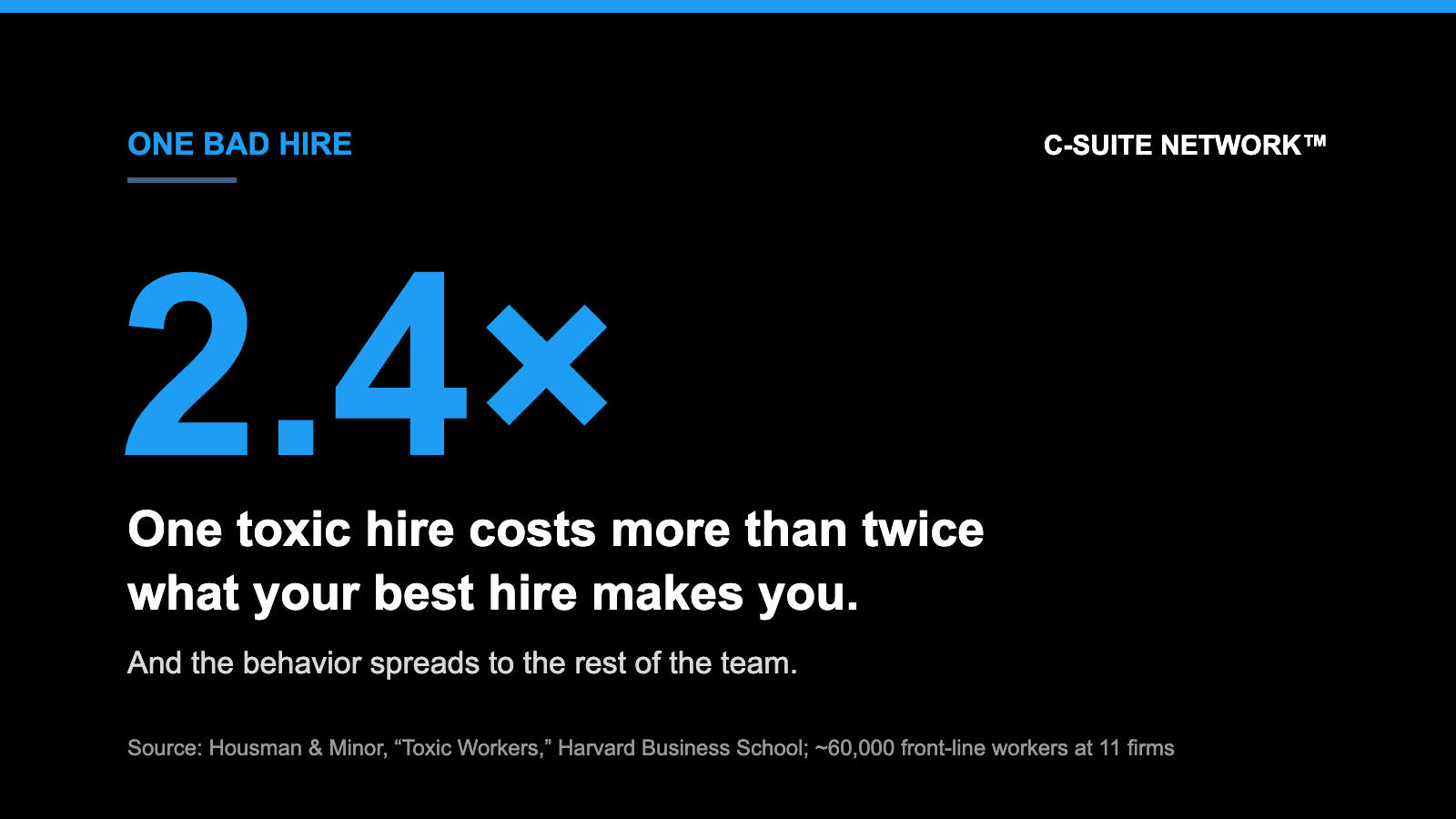
A superstar, someone in the top 1% for productivity, was worth at most about $5,303 a year. That sounds small because these are hourly jobs, and the researchers measured it as what you’d pay to hire extra people to match that output.
A toxic worker cost at least $12,489. That number is only the cost of replacing the good coworkers who quit because of them. It doesn’t count lawsuits, fines or the hit to everyone else’s morale.
So in the same jobs, one toxic hire cost about 2.4 times what the very best hire brought in. Your dollar amounts will be bigger. The lesson isn’t different.
The three warning signs
The most useful part of the study is what predicted toxic behavior before anyone got hired.
1. Overconfidence. Applicants rated their own skills, like typing speed, before they were tested. The ones who overrated themselves were more likely to turn toxic. “If you’re overconfident, you think you’re less likely to be caught,” Minor said.
2. Selfishness. People who showed little concern for others were more likely to steal and bully.
3. Claiming the rules should never be broken. The applicants who insisted on it were the ones more likely to get fired for breaking them. “To say the rules should never be broken isn’t completely forthright and honest,” Minor said. Everybody bends a rule sometime. The people who say they never do aren’t being straight with you.
Tension is good. Toxic isn’t.
I’ve always said a leader’s job is to create tension. Push people from the center of the stage to the edge. Healthy debate makes a business better.
But tension is about ideas. Toxic is about people. One makes the team sharper. The other makes the team smaller.
I want big dogs on my team. But a big dog who bites everybody in the yard isn’t helping you win. And mood beats culture every day. One person can set the mood for an entire office, and now we know it’s contagious.
Your people know it, too. In a 2026 iHire survey, 47.6% of U.S. workers said they have quit a job because of a toxic workplace, and 79.1% of those who lived through it blamed leadership, according to the report. They don’t blame the jerk. They blame the boss who kept the jerk.
Don’t get comfortable because nobody is quitting right now. Quit rates are near historic lows. Your good people may just be waiting.
What to do about it
1. Score how, not just how much. If reviews and bonuses only count the number, you are paying people to get it any way they can.
2. Test for it before you hire. Ask candidates to rate their own skills, then test them. Ask, “Is it ever OK to break a rule?” The honest answer is “Yes, sometimes, and here’s when.” Watch out for the person who says never.
3. Watch the people next to them. It spreads. Look at who has started acting like your problem person, and who has gone quiet.
4. Say it to their face, once. I believe in radical transparency and in second chances. Name the specific behavior, set a short deadline and real consequences, and keep your word.
5. If it doesn’t change, move fast. Every month you wait, it spreads to someone else.
A superstar who breaks your team isn’t a superstar. They’re a very expensive vacancy.
Before Your Next Meeting
- Who on our team hits the number but leaves damage behind, and what is it really costing us?
- Has anyone started acting like them, or gone quiet around them?
- Do our reviews and bonuses reward how people work, or only what they close?
 The Boardroom Needs the Ground: By Mark Madrid
 How Fractional Executives can Help Your Company Thrive: Key FactsBy Paul Whitley
 Do Not Cut 25% of Your Workforce YetBy Mahesh M. Thakur
 C-Suite TV · 22 minProject Calm: Johnny C. Taylor Jr. on Leadership, Culture, and the Future of Work
 C-Suite Radio · Leadership Without Losing Your Soul: Master Communication & Management Skills To Boost Productivity, Teamwork & Ease Overwhelm380 Stop Doing All the Thinking: 4 Leadership Communication Skills That Get Your Team Solving Problems
Meet the founders, CEOs and operators behind stories like this one. Next reception: NYC Executive Reception, Tue, Nov 24.
Attend as a guestMembership: $100/mo →