The quick take:
- 84% of small business owners delayed, reduced or went without their own pay at some point in the past year. Among owners with employees, 69% went without so their staff could be paid.
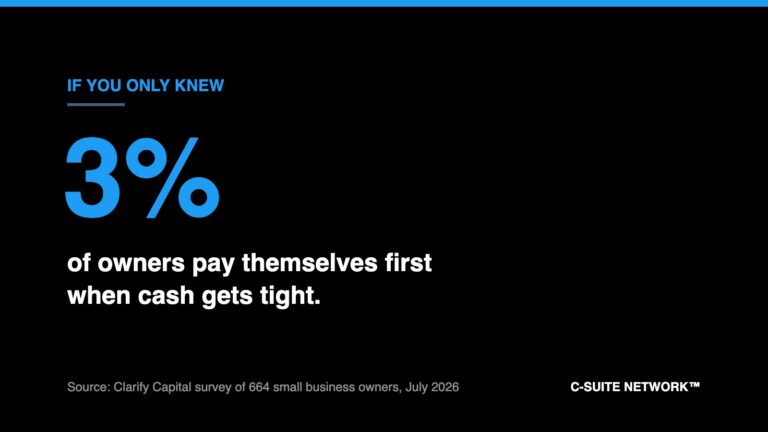
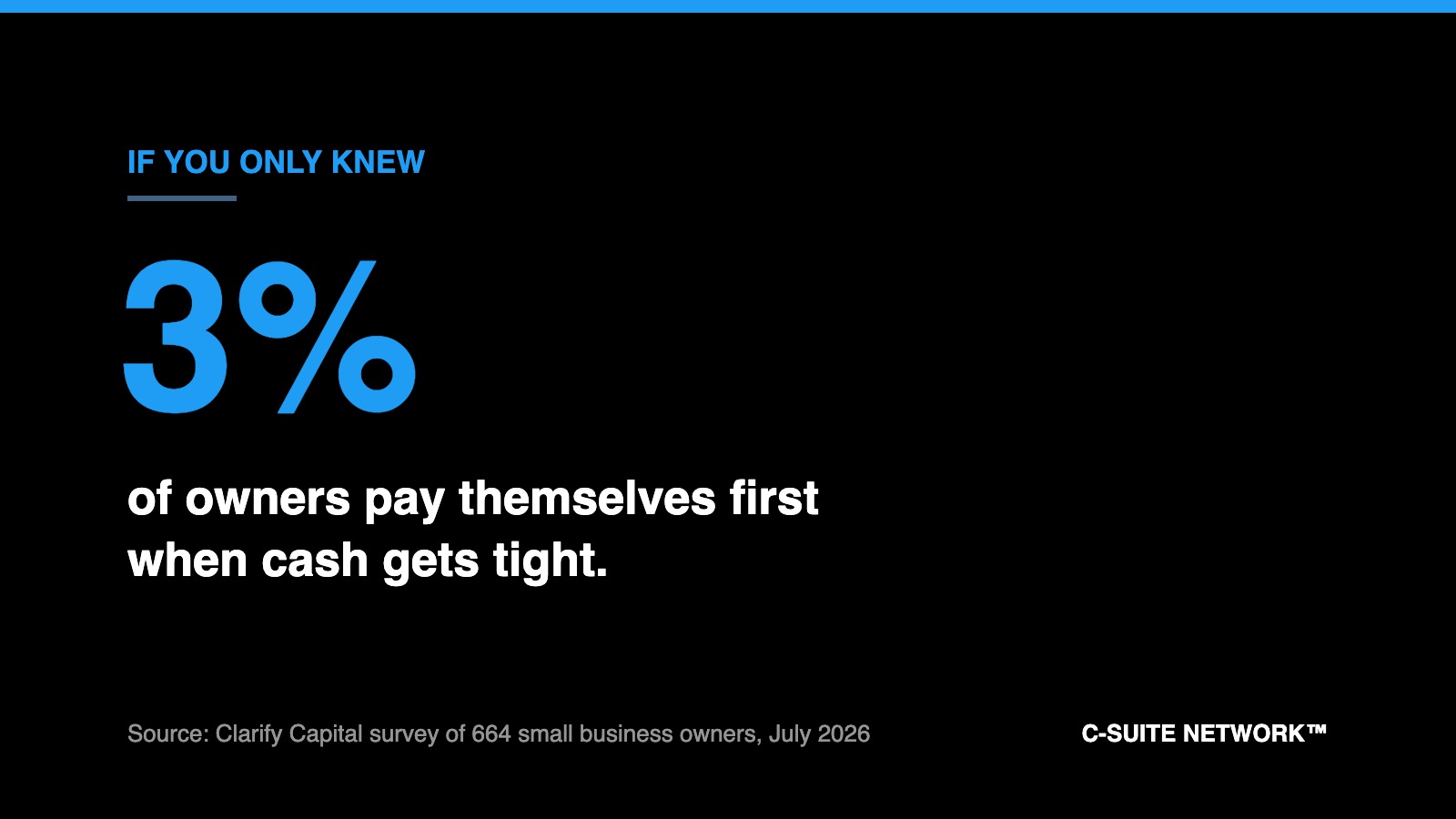
- Only 3% pay themselves first when cash gets tight. On average, owners gave up $12,745 of their own income in a year.
- Why it matters now: your team will never see this sacrifice, and they’re not supposed to. But if you’ve been quietly paying yourself last, you’re not bad at business. You’re in the overwhelming majority.
Friday comes. Payroll goes out. Everyone gets paid.
Almost everyone.
There’s one check that quietly gets smaller, or later, or doesn’t happen at all, and only one person in the building knows about it. You.
 Be our guestYour next big opportunity could be in a room you're not in.Meet CEOs, founders and owners at a reception in your city or online. Your first event is on us.Request my guest seat →
“Payroll for Me Is Not Optional”
Michelle Johnson owns a day spa in San Luis Obispo County, California, with nine employees. Her revenue fell to $525,000 from $642,000. As one payday got close, she realized the bank account didn’t have enough to cover it, for the first time in eight years. She took a $10,000 loan rather than miss payroll, Axios reported.
“Payroll for me is not optional,” she said. “There’s too many lives depending on it.”
Ask almost any owner and you’ll hear some version of the same thing. Rich Patterson, who runs a marketing company that makes custom products, has put his own pay on hold when cash ran behind. “Honestly, it’s just not possible to pay yourself first,” he told Reuters in 2019. “I wouldn’t be able to sleep at night if other people are losing out.”
Joanne Sonenshine, who runs the partnership advisory firm Connective Impact, regularly pauses her own salary depending on when clients pay. “You start to worry if you can make it,” she said. “There’s the fear of failure, the fear of letting your family down.”

You’re Not the Exception. You’re the Rule.
If you’ve done this, you’re in very large company. In a July 2026 Clarify Capital survey of 664 owners, 84% said they delayed, reduced or went without their own pay in the past year. 69% of owners with employees went without pay so their staff could be paid. Only 3% said they pay themselves first when cash is tight.
The average owner gave up $12,745 in personal income over the year. 13% of those who cut their pay stopped paying themselves entirely.
Read that again. Only three in 100 owners pay themselves first. Everyone else is the shock absorber.
Much of it traces back to customers paying late. 29% of owners have been forced to delay their own paychecks because customers didn’t pay on time, Bluevine found in a separate 2026 survey. And one-third of owners are absorbing rising costs out of their own paychecks instead of passing them on to customers, according to KeyBank’s 2026 small business survey.
The Sacrifice Nobody Sees
Here’s the hardest part: you can’t really tell anyone. Telling your team would scare them. Telling customers would hurt you. And only 48% of owners in the Clarify survey said their family knows most or almost everything about the sacrifices they make for the business.
So you carry it alone. The people who benefit most from your sacrifice will never know it happened. That isn’t weakness. That’s what it looks like to take responsibility for other people’s paychecks.
What Helps
- Make your pay a line item, not a leftover. Set a number, even a small one, and run it like any other payroll. Paying yourself something consistent is better than an all-or-nothing pattern.
- Build the cushion. KeyBank found 54% of owners can now cover at least a month of expenses from cash reserves, up from 33% in 2024. Every week of reserves is a week your own paycheck doesn’t have to be the buffer.
- Fix the late payments. If customers paying late is what pushes your check back, tighter terms and deposits protect your household, not just your business.
- Tell one person. A spouse, a CFO, a peer group. Carrying this in secret makes it heavier than it is.
Before Your Next Meeting
Here’s what this means for you:
- How many times did you skip or shrink your pay this year? Count it. If the answer is more than once, that’s a business problem to solve, not a personal one to keep absorbing.
- What would it take to pay yourself every month in 2027? A price increase, a deposit policy, one less hire. Pick the one that gets you there.
- Does anyone know? If the answer is no one, choose who you’ll tell this week.
 The Boardroom Needs the Ground: By Mark Madrid
 How Fractional Executives can Help Your Company Thrive: Key FactsBy Paul Whitley
 Do Not Cut 25% of Your Workforce YetBy Mahesh M. Thakur
 C-Suite TV · 22 minProject Calm: Johnny C. Taylor Jr. on Leadership, Culture, and the Future of Work
 C-Suite Radio · Manage Self, Lead Others: Emotional Intelligence and Leadership for Managers199 Look for the Second Right Answer--Nina Sunday with Dixie Carlton
 Chairman's Corner · Jeffrey HayzlettYour Best Performer Might Be Your Biggest Problem. And It’s Contagious.
Meet the founders, CEOs and operators behind stories like this one. Next reception: NYC Executive Reception, Tue, Nov 24.
Attend as a guestMembership: $100/mo →