The quick take:
- Americans spend about $2.3 billion a year on psychics, according to IBISWorld, and the industry has grown about 5.5% a year since 2020.
- But it’s spread across roughly 103,000 businesses. That works out to about $22,000 in revenue per business, which tells you most psychics are running a side gig, not an empire.
- Why it matters now: the money in this industry goes to whoever owns the customer, not whoever does the work. If you sell your services through someone else’s platform, you might be the psychic.
If you watched late-night TV around 2000, you remember Miss Cleo.
Jamaican accent. Colorful head wrap. And a phone number on the screen, promising a reading if you called right now.
A lot of people called. The company behind her lines racked up $1 billion in telephone charges over three years, according to Mental Floss. Callers paid $4.99 a minute.
 Be our guestYour next big opportunity could be in a room you're not in.Meet CEOs, founders and owners at a reception in your city or online. Your first event is on us.Request my guest seat →
Miss Cleo, whose real name was Youree Harris, said she got 24 cents of it.
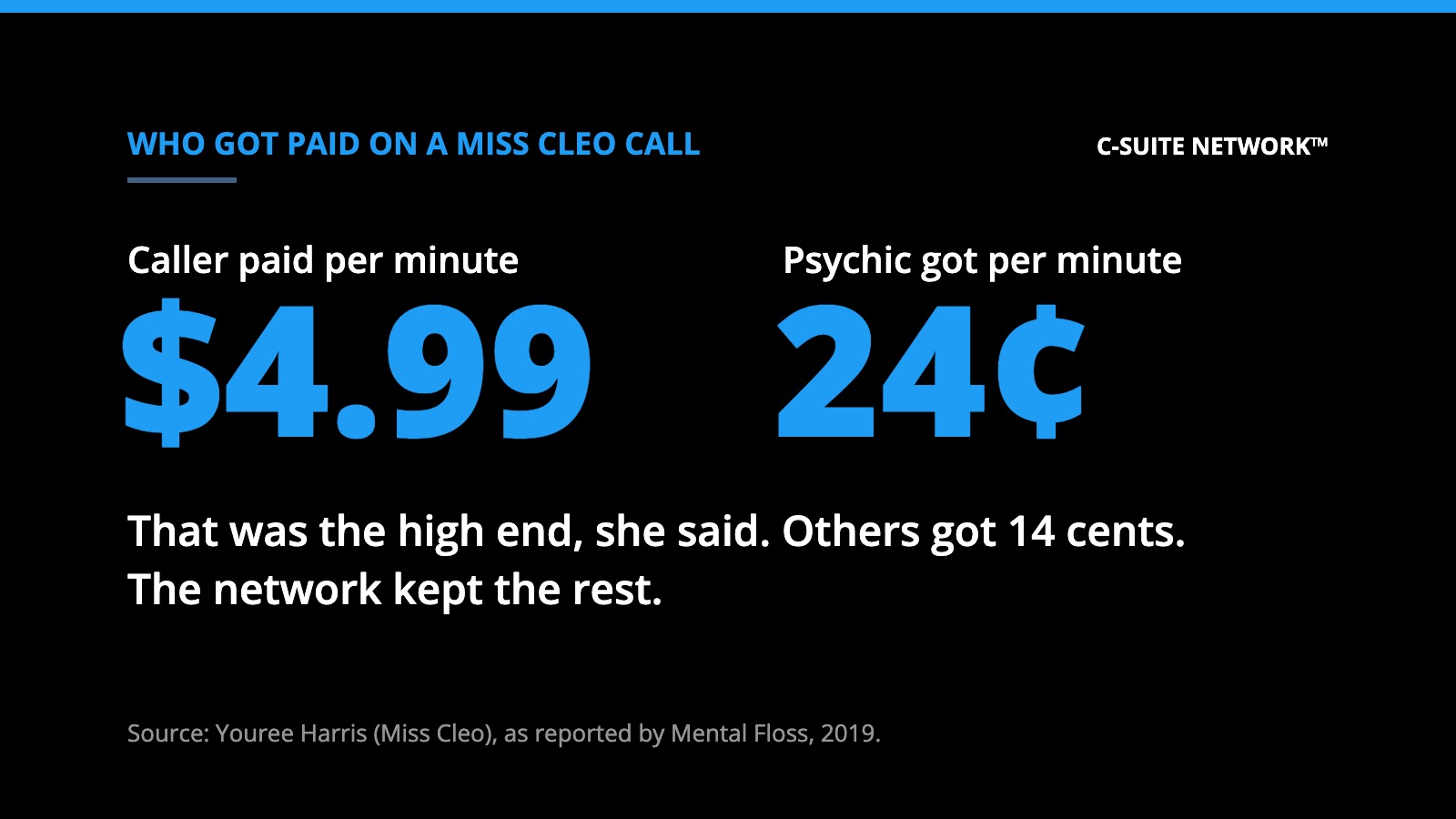
Read that again. The most famous psychic in America said she was making about $15 an hour. Other readers on the lines, she said, made as little as 14 cents a minute.
It didn’t end well. In 2002, the companies behind the hotline agreed to forgive an estimated $500 million in customer charges and pay $5 million to settle charges from the Federal Trade Commission that they had misled callers, including by advertising “free” readings that weren’t free.
“I’m no psychic, but I can foresee this,” said the FTC’s consumer protection chief at the time. “If you make deceptive claims, there is an FTC action in your future.”
But the psychic business didn’t die with Miss Cleo. It got bigger.
A $2.3 billion industry
US psychic services brought in about $2.3 billion in 2025, according to IBISWorld, up 2.2% this year and growing at about 5.5% a year since 2020.
IBISWorld credits a long, slow shift in how people see the industry: less skepticism, more mainstream acceptance, and more people looking for guidance when life, and money, feel uncertain.
So who’s getting rich?
Mostly, not the psychics.
$22,000 a business
That $2.3 billion is split across roughly 103,000 businesses. Do the math and the average psychic business takes in about $22,000 a year. Before rent, phone bills, marketing and taxes.
Some readers do better. ZipRecruiter pegs the average psychic medium at about $32 an hour. But that figure comes from job listings, and plenty of readers don’t have a full-time job’s worth of clients.
The money that is being made increasingly flows through the middlemen: the online networks that run the ads, own the customer list and take a cut of every reading.
How big a cut? one psychic network listed for sale says its margins run 73% to 78% after paying its readers and before its own operating costs. That suggests the psychic on the other end of the call is keeping roughly a quarter of what the customer pays.
Better than 24 cents on $4.99. Still not great.
Wait, why does this business work at all?
Skeptics will have their own answer. But from a pure business standpoint, psychic networks have a few things most companies would kill for:
- Repeat customers. People who find a reader they trust tend to come back, especially when something in life goes sideways.
- No inventory. The product is a conversation. There’s nothing to ship and nothing to stock.
- A product that sells better in bad times. IBISWorld notes that economic hardship pushed more people toward spiritual guidance. Most industries pray for that kind of countercyclical demand.
- A middleman that owns the relationship. The customer remembers the network’s app, not the reader’s name. That’s why the network gets three quarters of the money.
What a $5M owner can learn from a psychic hotline
You probably don’t sell tarot readings. But a few of these lessons travel well:
- Whoever owns the customer owns the margin. If most of your work comes through a platform, a referral partner or a prime contractor, you may be the reader making 24 cents. Building direct relationships is how you stop being the cheap labor in someone else’s business.
- People pay for certainty. Psychic customers are buying a feeling that someone knows what happens next. Your clients want the same thing from you. The clearer you are about what will happen, when, and what it costs, the more they’ll pay.
- Repeat business is built on trust, not transactions. The readers who do well are the ones customers ask for by name.
- Promises in your ads have to hold up. The hotline’s “free” readings cost it $500 million in forgiven charges. Fine print doesn’t save a promise you didn’t keep.
Or, as the FTC put it at the time: “companies that make a promise in an ad need to deliver on it.”
No crystal ball required.
Before Your Next Meeting
Here’s what this means for you:
- What share of your revenue comes through someone else’s front door? A platform, a prime contractor, a referral partner. If it’s more than half, what would it take to own more of those relationships?
- What are your customers really buying? If the honest answer is “certainty,” are you selling that clearly?
- Do clients ask for your people by name? If not, who do they think they’re doing business with?
 The Boardroom Needs the Ground: By Mark Madrid
 Coffee That Gives Back: How Devotion Coffee Could Reframe Christian FundraisingBy David James Dunworth
 The Executive Bottleneck: Why Over-Functioning Leaders Create Under-Functioning CulturesBy Hugh Ballou
 C-Suite TV · 20 minRiches in the Niches: How Smart Strategy Keeps Associations Ahead of Disruption with Ralph Vasami
 C-Suite Radio · Freedom Entrepreneurship041-The AI Mistake That Keeps Your Business Stuck
 Chairman's Corner · Jeffrey HayzlettYour Best Performer Might Be Your Biggest Problem. And It’s Contagious.
Meet the founders, CEOs and operators behind stories like this one. Next reception: NYC Executive Reception, Tue, Nov 24.
Attend as a guestMembership: $100/mo →