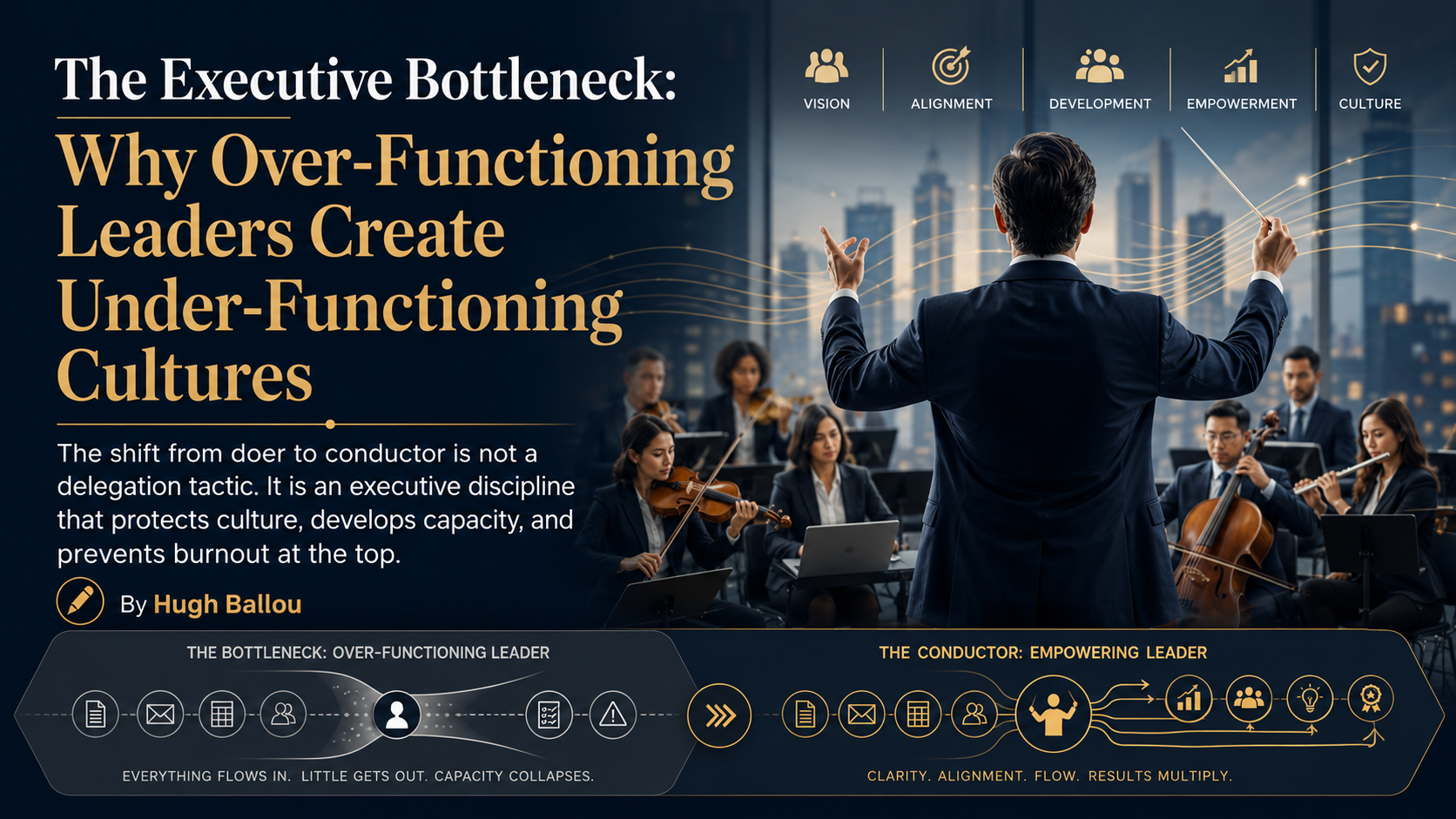
The Executive Bottleneck: Why Over-Functioning Leaders Create Under-Functioning Cultures
The shift from doer to conductor is not a delegation tactic. It is an executive discipline that protects culture, develops capacity, and prevents burnout at the top.
By Hugh Ballou
Many executives do not burn out because they lack commitment. They burn out because they have built a culture that depends on their constant intervention.
The executive who keeps solving every problem eventually teaches the organization to stop solving problems without them. That is the hidden danger of executive over-functioning. It looks responsible. It feels necessary. It may even be celebrated as dedication. But over time, the leader becomes the bottleneck, the team becomes cautious, and the organization becomes less capable than the mission requires.
In my work with leaders, boards, nonprofits, churches, and executive teams, I have seen this pattern repeatedly. A capable leader steps in because the stakes are high. A deadline is slipping. A team member is unsure. A board committee is passive. A client relationship needs attention. The leader rescues the moment. The immediate problem is solved. But the system quietly learns a dangerous lesson: when pressure rises, wait for the executive.
That is not high performance. It is dependency dressed as excellence.
The Hidden Cost of Executive Heroics
Executive heroics often begin with good motives. The CEO wants to protect quality. The founder wants to preserve the original vision. The board chair wants to keep momentum. The senior executive wants to spare the team from overload. These motives may be honorable, but the pattern can still be harmful.
The heroic executive attends every meeting, approves every decision, reviews every draft, rescues every deadline, and carries the emotional weight of the organization. At first, this may appear efficient. Decisions move quickly because the leader makes them. Problems are solved because the leader sees them. Work gets finished because the leader finishes it.
But every rescue reinforces the need for future rescue. Every time the executive takes back ownership, others learn that ownership is conditional. Every time the leader fixes what others could have learned to address, the organization sacrifices capacity for short-term control.
This is the executive bottleneck: the leader becomes the point through which too many decisions, relationships, approvals, corrections, and initiatives must pass. The organization may be busy, but it is not truly empowered. The executive is active, but the system is underdeveloped.
Over-Functioning and Under-Functioning as a Culture System
Bowen systems thinking gives us useful language for this pattern. In a relationship system, when one person carries too much responsibility, others often carry too little. This is the reciprocal pattern of over-functioning and under-functioning.
In executive leadership, over-functioning means the leader assumes responsibility for outcomes, decisions, emotions, and tasks that properly belong to others. Under-functioning appears when others wait, defer, avoid initiative, or lose confidence in their own judgment.
This pattern is not simply a personality flaw. It is a culture system. The more the leader does, the less the system has to learn. The more the executive rescues, the less the team develops resilience. The more the founder personally protects every detail, the less the organization becomes capable of carrying the vision beyond the founder.
Common symptoms include delayed decisions, weak ownership, passive meetings, conflict avoidance, low initiative, excessive upward delegation, and dependence on the leader for permission. What looks like a people problem may actually be a system trained by repeated executive intervention.
Low activity in a culture is not always laziness. Sometimes it is a learned response to being rescued, corrected, or overruled.
Doing as a Form of Control
Most executives do not think of themselves as controlling. They think of themselves as responsible. They step in because they care. They intervene because urgency is real. They correct the work because standards matter. They make the decision because the risk is high.
Yet doing can become a form of control when it prevents others from using their skills, passions, and judgment. A leader may say, “I am just helping,” while the system experiences, “You do not trust us.” A founder may say, “I am protecting the brand,” while the team experiences, “Our judgment does not count.” A board chair may say, “I am keeping things moving,” while other board members learn to sit back and wait.
This is where conflict begins. People resent responsibility without authority. They withdraw when work is assigned but then taken back. They become cautious when mistakes are treated as evidence that the executive should have handled it personally. The leader then sees their caution as lack of initiative and does even more.
The cycle tightens. The leader becomes more frustrated. The team becomes more passive. Trust erodes. Conflict hides beneath politeness, missed deadlines, and vague accountability.
The Culture Copies the Leader
A leader’s behavior becomes cultural permission. What the executive models, the organization repeats.
If the leader models frantic doing, the culture learns urgency without strategy. If the leader models control, the culture learns self-protection instead of initiative. If the leader models constant rescue, the culture learns that deadlines are negotiable until the executive intervenes. If the leader avoids defining ownership, the culture learns to operate through assumptions.
This is why the doer identity is so dangerous at the executive level. The higher the leader sits in the organization, the more their behavior becomes a template. The executive who over-functions does not merely carry too much work. The executive teaches the culture how to relate to work, authority, risk, and responsibility.
The Conductor Alternative
The conductor does not create music by playing every part. The conductor creates the conditions in which every part can be performed with clarity, timing, discipline, and expression.
This is the mature executive posture. The executive conductor clarifies the score, defines outcomes, assigns ownership, develops section leaders, and maintains the rhythm of execution. This is not abdication. It is integration.
A conductor-leader does not disappear. The conductor listens more deeply, intervenes more strategically, and develops the capacity of the whole system. The leader’s value shifts from personal production to organizational alignment. The executive stops being the source of every answer and becomes the architect of the conditions where better answers can emerge from the team.
In practical terms, the conductor asks different questions:
What outcome must be achieved? Who owns it? What authority do they need? What does success look like? What rhythm will keep the work visible? – Where is the system strained, silent, or overused? Who needs development rather than rescue?
These questions move the executive from activity to architecture.
Practical Executive Moves
The shift from doer to conductor begins with visible, disciplined changes. Here are six executive moves that reduce bottlenecks and build capacity.
1. Identify the three decisions, meetings, or deliverables that most depend on you. These are the places where the organization has learned to wait for the executive. Do not start by changing everything. Start with the recurring points of dependency.
2. Assign one owner per outcome. Shared responsibility often becomes no responsibility. Define one accountable owner for each major deliverable, decision process, or recurring meeting outcome.
3. Match responsibility with authority. Delegation without authority creates frustration. If someone owns an outcome, they must also have the authority to make defined decisions, gather information, call meetings, and move work forward within agreed boundaries.
4. Create a weekly review rhythm focused on deliverables, not activity. Activity reports keep people busy. Deliverable reviews keep people accountable. Ask what was completed, what is blocked, what decision is needed, and what will be delivered next.
5. Develop section leaders. The executive conductor does not manage every individual contributor directly. The executive develops leaders who can lead parts of the system. This builds scale, succession, and resilience.
6. Resist taking the work back too early. The first attempt may not meet your standard. That does not mean delegation failed. It may mean development has begun. Coach, clarify, and review, but do not automatically rescue.
Why This Matters for Enterprise Performance
The executive bottleneck is not merely a personal workload issue. It affects growth, succession, talent retention, board effectiveness, decision speed, and culture health. Organizations cannot scale beyond the capacity of a leader who insists on being indispensable.
Over-functioning may produce short-term results, but it limits long-term performance. The organization becomes dependent on the leader’s availability, energy, judgment, and emotional stamina. That is not a leadership advantage. It is a strategic risk.
The conductor model turns leadership into a system. It protects the executive from burnout, strengthens team ownership, reduces hidden conflict, and creates a culture where initiative is expected rather than exceptional.
Closing Thought
The mature executive is not the indispensable doer. The mature executive is the conductor who builds a system that can perform even when the leader is not in the room.
When leaders stop carrying what belongs to others, they do not weaken the organization. They strengthen it. They create clarity, rhythm, alignment, and accountability. They release the intelligence of the whole enterprise. And they move from being the bottleneck to becoming the architect of high performance.
“Transformation begins with the leader. It always has.”
— HUGH BALLOU, THE TRANSFORMATIONAL LEADERSHIP STRATEGIST™
Source References – http://HughResources.com
· The Nonprofit Success System: The Leadership System That Transforms Nonprofits into High-Performing Organizations, Hugh Ballou, 2026.
· Conducting Power-Packed Meetings, Hugh Ballou 2025.
· LeadForward Magazine, Vol. 2 No. 1, “Planning as a Leadership Discipline: How Intentional Planning Prevents Burnout and Drift,” Hugh Ballou.
· The Nonprofit Exchange: Leadership Tools and Systems for Success