The Executive Operating System
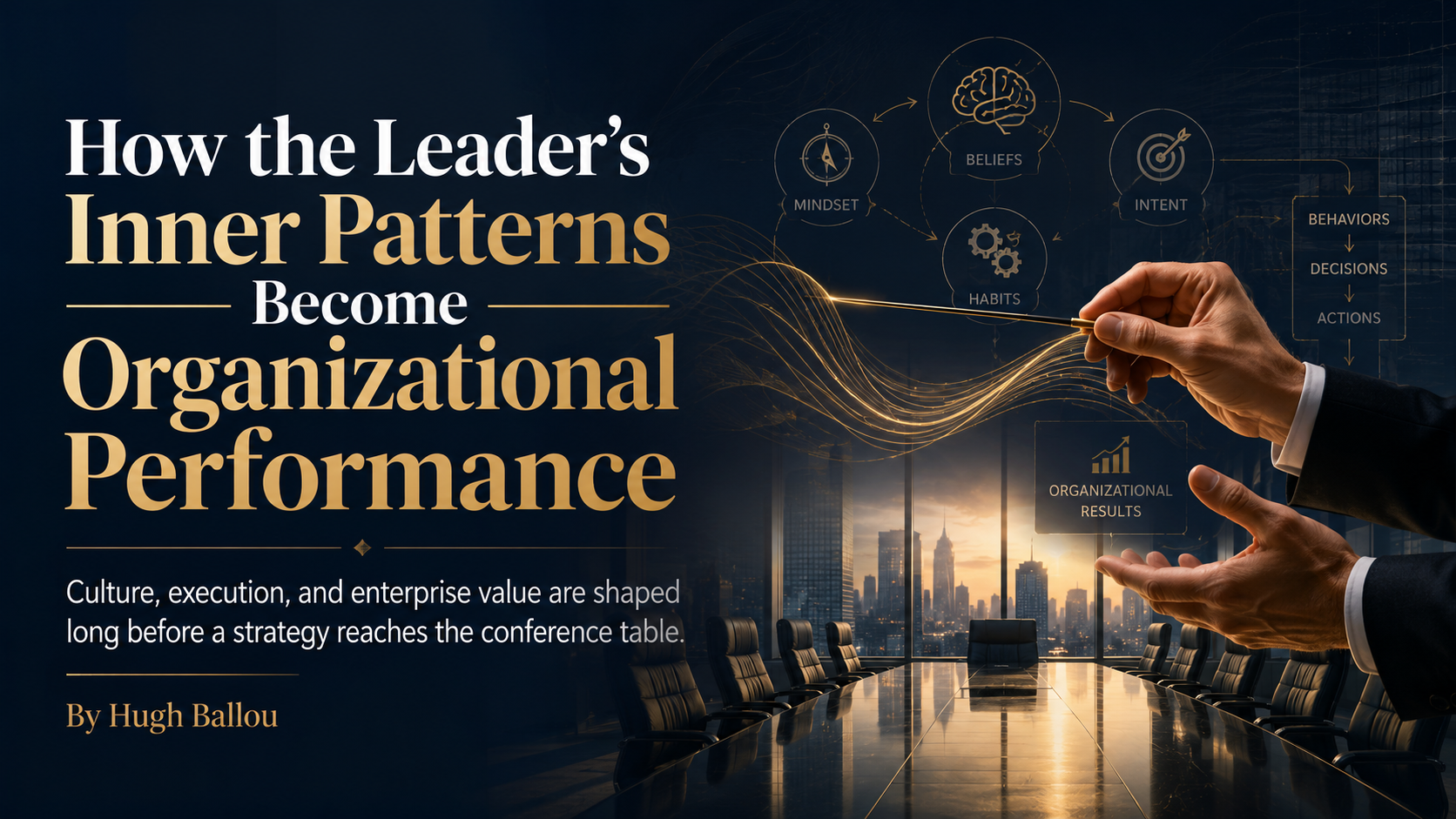
How the Leader’s Inner Patterns Become Organizational Performance
Culture, execution, and enterprise value are shaped long before a strategy reaches the conference table.
By Hugh Ballou
————————————————————————
Most executives look for performance problems in strategy, structure, talent, or capital. Those are reasonable places to look. But when the same problems return after new plans, new hires, and new systems, the organization may be faithfully reproducing something closer to the top: the leader’s own operating system.
Every organization has visible operating systems. They include the strategic plan, organizational chart, technology stack, governance process, meeting calendar, scorecard, and budget. Yet those systems do not operate themselves. They are designed, interpreted, reinforced, ignored, or overridden by human beings. At the center of that activity is the executive leader, whose beliefs, assumptions, habits, and internal narratives shape how the formal system functions in practice.
The Invisible System Behind the Visible System
The leader’s inner operating system is the set of largely invisible patterns that determine how the leader responds to pressure, uncertainty, conflict, opportunity, and responsibility. It includes what the leader believes about people, what the leader assumes without testing, the habits that have become automatic, and the self-talk that frames difficult moments.
This internal system matters because the formal organization tends to amplify what happens at the top. A well-designed delegation process will fail if the executive does not actually trust others. A thoughtful strategy will fragment if the leader repeatedly changes priorities. A strong leadership team will become passive if every important decision is pulled back to the CEO. The written system may say one thing while the leader’s behavior teaches another.
The culture is listening to what the leader repeatedly does, not merely to what the leader occasionally says.
Beliefs Become Executive Decisions
Beliefs are not abstract when they sit inside an executive role. They become decisions about hiring, delegation, investment, governance, succession, and risk. Consider the belief, “Quality requires my control.” It may produce repeated reviews, excessive approvals, and a reluctance to grant real authority. The executive experiences this as maintaining standards. The team experiences it as a lack of trust.
Or consider, “Speed requires me to decide.” That belief may feel efficient in the moment, especially during a crisis. Over time, however, it trains the organization to wait for the executive. Decision velocity appears high at the top while decision capacity remains weak everywhere else.
Beliefs about conflict are equally consequential. An executive who believes disagreement threatens unity may suppress candor, avoid difficult conversations, and reward surface harmony. The organization then pays for unresolved issues through delay, side conversations, turnover, and low accountability.
Assumptions Become Culture
Assumptions are beliefs that have stopped announcing themselves. They operate as hidden rules. If the CEO assumes people cannot be trusted, approvals multiply. If the CEO assumes the board will not understand the business, information is withheld and governance weakens. If scarcity is treated as permanent, short-term protection displaces investment in people, systems, and innovation.
The danger is not that every assumption is wrong. The danger is that untested assumptions become organizational architecture. They influence who is invited into decisions, how much authority is distributed, what risks are tolerated, and what conversations are avoided.
Strong executives make assumptions visible. They ask, “What am I treating as true? What evidence supports it? What would change if the opposite were partly true?” That discipline converts hidden programming into conscious leadership choice.
Habits Become Performance Architecture
Daily habits are where the inner operating system becomes measurable performance. Rescuing produces dependence. Delayed decisions produce organizational hesitation. Shifting priorities produce scattered execution. Inconsistent follow-through teaches the team that commitments are negotiable.
The opposite is also true. Clear outcomes, disciplined meeting rhythms, visible accountability, and consistent review create focus and reliability. Meetings are especially revealing because they function as the rehearsal space of the organization. They show whether the leader prepares, listens, clarifies, assigns ownership, and closes the loop—or merely gathers people and hopes alignment will emerge.
A leader can speak about empowerment while habitually taking work back. A leader can promote accountability while tolerating missed commitments. The habit becomes the real policy.
Self-Talk Sets the Emotional Tempo
Executives also lead through the narrative running in their own minds. Under pressure, self-talk can become catastrophic, defensive, or controlling: “If I do not fix this, everything will fail.” “No one else sees the whole picture.” “I cannot afford to let them make a mistake.” These statements may never be spoken aloud, yet they influence tone, pace, attention, and behavior.
From a systems perspective, anxiety travels. A reactive leader raises the emotional temperature of the organization. People become cautious, political, or overly dependent. A grounded leader does not eliminate pressure; a grounded leader contains it. Differentiation means staying connected to others without being governed by their anxiety—or by your own.
The conductor metaphor is useful here. The conductor sets tempo before a note is played. In the same way, the executive’s internal posture shapes the emotional rhythm of the enterprise. Calm is not passivity. It is the capacity to think, communicate, and act without surrendering judgment to the urgency of the moment.
The Leadership Ceiling in Practice
When the inner operating system is reactive, controlling, avoidant, or unclear, predictable symptoms appear. Decisions bottleneck. Teams wait for permission. Accountability weakens. Conflict recurs without resolution. Founders remain indispensable. Succession plans stay theoretical. Burnout rises. Strategy is discussed but never becomes consistent execution.
These are not always failures of intelligence or commitment. Often they are the visible expression of an internal pattern that has become a performance constraint. If the leader is the center of every result, the leader is also the ceiling of every result.
From Executive Hero to Organizational Conductor
Executive maturity is not measured by indispensability. It is measured by the capacity the leader creates in the system. The mature executive clarifies the score, defines outcomes, assigns ownership with authority, develops section leaders, listens across the whole, and protects tempo.
A conductor does not create the music by playing every instrument. The conductor creates the conditions in which the ensemble can perform together. Control creates compliance. Orchestration creates commitment.
This does not mean abandoning standards or withdrawing from accountability. It means replacing personal control with clear architecture: defined outcomes, decision rights, review rhythms, meaningful measures, and development. The measure of leadership is not what happens when you are in the room. It is what happens when you are not.
The Inner OS Executive Audit
Choose one recurring organizational problem and ask:
- What belief is driving my response?
- What assumption have I not tested?
- What habit is the organization copying?
- What am I telling myself under pressure?
- Where am I creating dependence?
- What would a grounded conductor do next?
These questions move the conversation from blame to responsibility. They do not place every organizational problem on the executive. They identify the place where the executive has the greatest leverage: self-management.
Reprogram Through Practice
Insight matters, but repetition rewires performance. Use a simple 30-day sequence. Notice the trigger. Name the belief. Test the assumption. Choose a replacement statement. Install one new behavior. Define one visible organizational measure. Review the pattern weekly.
For example, replace “Quality requires my control” with “Quality requires clear standards, capable ownership, and disciplined review.” Then change the behavior: delegate a defined outcome with real authority and schedule a review point instead of hovering. Measure whether decision time, rework, initiative, or team confidence improves.
The next performance breakthrough may not begin with another strategic initiative. It may begin when the executive recognizes that the organization has been running on an internal program that is no longer fit for the future. An executive’s inner operating system is either an invisible asset or an invisible constraint. The work of leadership is to make it visible—and then make it intentional.
30-Day Leadership Challenge
Choose one recurring organizational problem and trace it backward: from result, to team behavior, to leadership habit, to assumption, to belief. Then design one replacement practice and one performance indicator for the next 30 days.
______________________________________________________________________________________________________________
Based on “The Nonprofit Success System: The Leadership System That Transforms Nonprofits into High-Performing Organizations” by Hugh Ballou
Hugh Ballou is The Transformational Leadership Strategist, author, and founder of SynerVision International, Inc. and SynerVision Leadership Foundation. He empowers leaders across sectors to transform vision into high-performing results.
Article is based on my new series, “The Nonprofit Success System” – Get It on Amazon – https://www.amazon.com/dp/0977214877
For a list of resources go to – http://AboutHugh.com
#Leadership #HighPerformingTeams #Trust #Empowerment #Podcast #OrchestratingTeams #Teamwork #Transformation #Authenticity