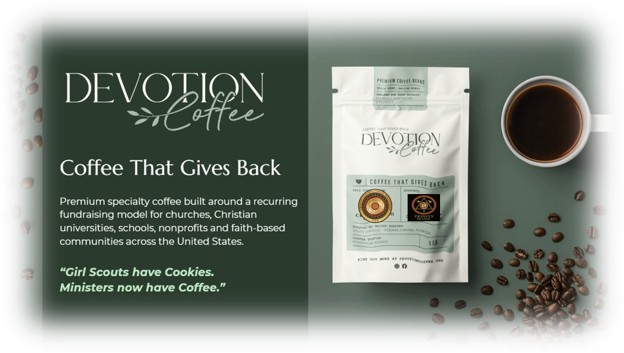
Coffee That Gives Back:
How Devotion Coffee Could Reframe Christian Fundraising
Soft Launch July 15th
For generations, churches, Christian schools, ministries, and faith-based nonprofits have relied on a familiar rhythm of giving: Sunday offerings, special appeals, banquets, seasonal campaigns, and the occasional emergency plea. These efforts often work, but they rarely remove the pressure. They demand attention, repetition, volunteer energy, and constant reminders. Devotion Coffee enters that pressure point with a simple but potentially powerful idea: what if a daily habit could become a recurring funding stream?
The pitch is easy to understand. People already drink coffee. Families buy it for the home. Offices brew it for staff. Friends send it as a gift. Congregations gather around it before worship, after Bible study, during meetings, and throughout the week. Devotion Coffee does not ask supporters to buy something strange, unnecessary, or seasonal. It asks them to redirect an existing purchase toward a mission they already care about.
That is the central brilliance of the model. Traditional fundraising often depends on interruption. Devotion Coffee depends on rhythm. Instead of asking a church member to attend another event or respond to another appeal, the ministry can invite them to choose a premium coffee brand that sends a portion of every purchase back to the church or organization.
According to the deck, each 12-ounce bag sells for $22, with 20 percent, or $4.40, returned to the participating church or organization. Devotion also builds margin in for itself and channel partners, which means the model is not merely charitable. It is commercial, repeatable, and designed for scale. That matters because fundraising systems that cannot sustain the operator eventually fail the cause.
The larger opportunity is the Christian community itself. Devotion Coffee identifies a potential ecosystem that includes ministers, churches, Christian universities, alumni networks, nonprofits, businesses, parent communities, and extended supporters. The stated phrase, “Girl Scouts have Cookies. Ministers now have Coffee,” captures the idea with memorable force. It positions coffee as the faith community’s recurring, everyday fundraising product.
The quality promise is also important. Devotion is not presenting coffee as a token item wrapped in religious sentiment. The deck emphasizes premium specialty coffee, ethically sourced beans, and award-winning roasting partners, including Oceana Coffee, Bonlife Coffee, and The Coffee Commune USA. That matters because mission may earn the first purchase, but quality earns the reorder.
The strategy is built around branded portals, promotional materials, social media assets, email support, communication scripts, and campaign guidance. In other words, Devotion is not only selling coffee. It is attempting to provide a fundraising system.
The bigger vision extends beyond coffee into travel, education, wholesale programs, alumni programs, merchandise, and membership-driven affiliate revenue. Coffee becomes the entry point, not the final destination.
The promise of Devotion Coffee is not that it replaces generosity. It is that it multiplies the usefulness of ordinary purchases. Every cup becomes a small act of alignment. Every bag becomes a modest but measurable contribution. Every reorder becomes a reminder that mission funding does not always have to begin with a plea.
Sometimes, it can begin with a cup.