
Most business owners I meet have tried the same thing at least once. They hired a marketing person.
Maybe it was a coordinator. Maybe a director. Maybe an agency on retainer. It started well, there were ideas, a plan, some new graphics. Six or nine months later it quietly stopped working, and the conclusion was usually the same: we hired the wrong person.
I don’t think you did. I think the job you were hiring for doesn’t exist anymore.
Marketing specialized. Nobody told the org chart.
Think about how medicine changed. Fifty years ago, you saw a doctor. Today you see a cardiologist for your heart, a dermatologist for your skin, an endocrinologist for your thyroid. Nobody finds that strange. Nobody asks their family physician to perform heart surgery, and nobody concludes medicine is broken because one person can’t do all of it.
Marketing went through the same fracture, in about half the time. What was one job in 1995 is now a dozen.
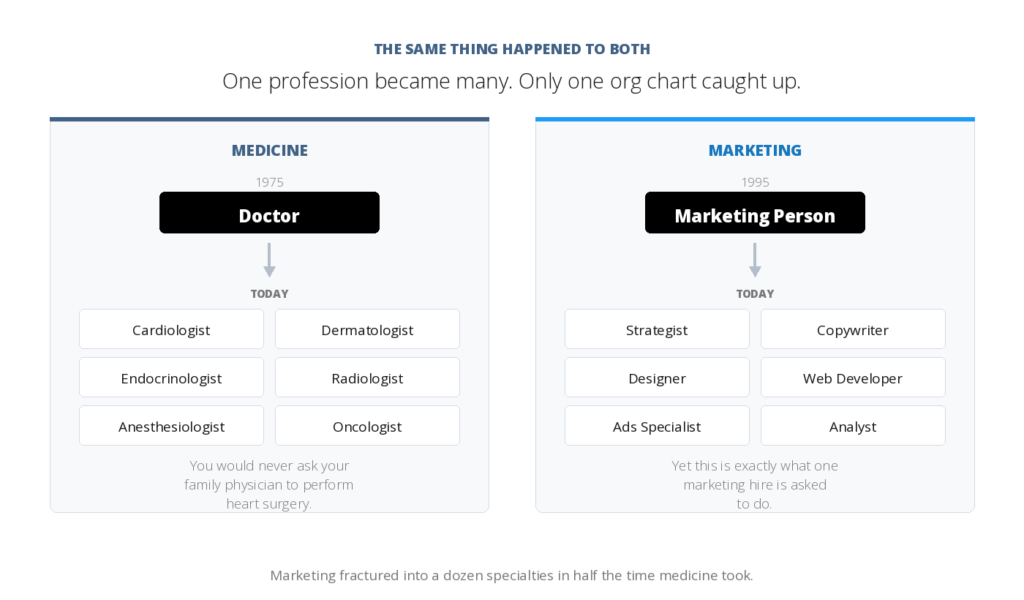
One profession became many. Only one org chart caught up.
Consider what a single campaign actually takes today. Someone to set the strategy – who you’re selling to, what the offer is, why anyone should care. Someone to write it. Someone to design it. Someone to build the page it lives on. Someone to set up the emails and texts that follow up automatically. Someone to run the advertising, which is really two or three people, because whoever is excellent at Google is rarely the same person who is excellent at LinkedIn. Someone posting consistently on social. And someone watching the numbers who can tell you what actually worked.
That is ten roles. Ten genuinely different skill sets – some creative, some technical, some analytical. Very few people are strong in more than two of them.
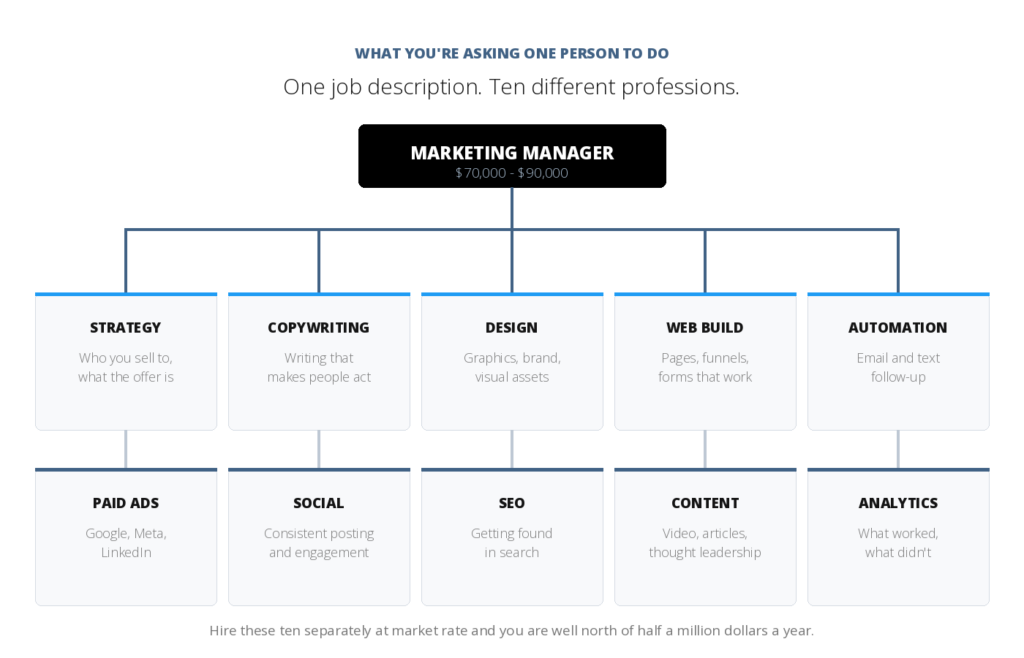
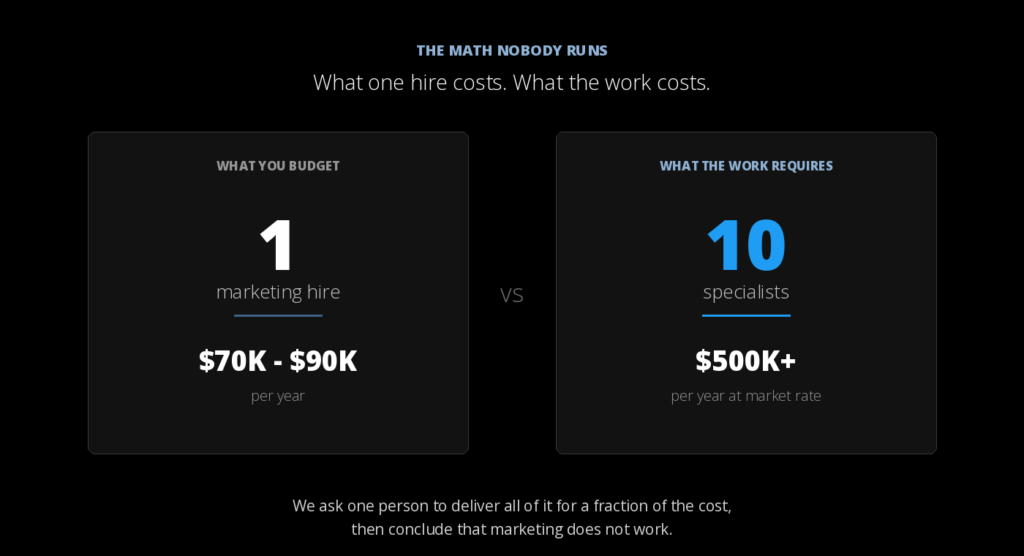
Now the part that stings. Most companies write all ten of those into one job description, title it Marketing Manager, and offer somewhere between seventy and ninety thousand dollars.
Hire those ten people individually at market rate and you are well north of half a million dollars a year. We ask one person to deliver all of it for a fraction of that, and then we’re surprised when it doesn’t work.
The evidence is not subtle
This isn’t a hunch. The data on what happens when nobody genuinely owns marketing is unusually clear, and it shows up in two places: the software you buy, and the customers you lose.
Start with the software. Gartner’s martech survey found that marketing teams use just 33% of the capabilities they are paying for – down from 42% two years earlier and 58% in 2020. Utilization has fallen every year while spending has climbed. Deloitte’s research is blunter still: roughly 44% of marketing technology stacks go completely underutilized. Companies are not buying the wrong tools. They are buying tools nobody has the time or the training to operate.
The scale is worth pausing on. There are now more than 14,000 distinct marketing technology products on the market, a figure that grew nearly 28% in a single year. No one person can evaluate that landscape, let alone master a meaningful slice of it. We are asking a single hire to be an expert in a category that adds three thousand new products a year.
Then there is what happens to the customers you already earned. In a Harvard Business Review audit of 2,241 U.S. companies, the average response time to an inbound lead was 42 hours. Twenty-three percent never responded at all. Firms that made contact within an hour were roughly seven times more likely to qualify that lead than firms that waited just sixty minutes longer. Separate research out of MIT found that reaching a lead in five minutes rather than thirty made it 21 times more likely to qualify.
Read those two findings side by side. Most companies are paying for software capable of responding in seconds, and taking the better part of two days to respond by hand. That gap is not a technology failure. It is an ownership failure – and it is almost certainly the most expensive one in your business.
It wasn’t their fault
The person you hired was probably genuinely good at one or two of those things. Maybe a strong writer. Maybe they knew social. Then they spent their week doing eight other jobs they were never trained for, badly, while the thing they were actually good at went untouched.
Consider how unstable this seat is even at the top of the profession. Spencer Stuart’s tracking puts average chief marketing officer tenure at about 4.2 years across the Fortune 500, and roughly 3.1 years among the largest consumer advertisers – the shortest of any C-suite role. More than one in five spent a year or less in the job. If the most experienced marketing executives in the country struggle to hold a role scoped to one function, it is worth asking what we reasonably expect from a single hire covering ten.
That isn’t a hiring mistake. It’s a structural one. You can repeat it five times with five different people and get five versions of the same result.
What you actually need
You don’t need a better hire. You need access to a team.
You already do this everywhere else in your business. You don’t employ a full-time attorney – you retain a firm and use the specialist you need when you need them. You probably don’t employ a chief financial officer either; you have an accounting firm. Nobody treats that as a compromise. It’s simply how you get expert coverage without carrying ten salaries.
Marketing is now that kind of function. It is too broad and too specialized to sit in one seat on your payroll, and that isn’t going to reverse. The firms that have figured this out are not the ones with the biggest marketing headcount. They are the ones who stopped trying to build a department and started renting one.
Where that leaves you
There are two pieces to this – the software and the people.
You already have the software. Every C-SUITE NETWORK™ membership includes a full marketing platform: your customer list, your pages, email and text automation, a booking calendar, a sales pipeline. Roughly three hundred dollars a month in value, sitting in an account with your name on it since the day you joined. Given the utilization numbers above, I’d guess most of you are using a fraction of it, if you have opened it at all.
The people were the missing half. That’s why we brought in MOGDX. Sheila Rondeau’s team is the department – strategy, copy, design, build, automation, advertising – working inside member accounts.
You can see what’s included, and how the team works, here: pages.c-suitenetwork.com/marketingcloud/services
On August 13 at noon Central, Sheila is walking through what’s in your account and what her team can do with it.
If you’ve hired a marketing person before and it didn’t take, come to that one. I suspect it will explain a few things.