
The quick take:
- A deepfake applied for a senior engineering job at a company that detects fakes for a living, and got caught in the middle of the video interview.
- More than 300 U.S. companies unknowingly hired North Korea-linked impostors using stolen American identities, and Gartner predicts one in four candidate profiles worldwide will be fake by 2028.
- Why it matters now: AI has made faking a candidate cheap, and the best defenses are surprisingly old-fashioned.
The candidate applied for a senior engineering job at Pindrop Security, a company that builds voice authentication software. He said he was a Russian coder living in western Ukraine.
Then the recruiter noticed something off. His facial expressions were slightly out of sync with his words.
Pindrop later traced his IP address to a spot thousands of miles east, possibly a Russian military facility near the North Korean border, CNBC reported. The company nicknamed him “Ivan X.”
In other words, a deepfake applied for a job at a company that catches fakes for a living.
“Gen AI has blurred the line between what it is to be human and what it means to be machine,” Pindrop CEO Vijay Balasubramaniyan told CNBC. “We are no longer able to trust our eyes and ears.”
Ivan X has company
According to the Justice Department, more than 300 U.S. companies unknowingly hired impostors with North Korean ties for remote IT work. The list included a major national television network, a defense manufacturer, an automaker and other Fortune 500 companies.
The workers used stolen American identities, masked their locations and sent millions of dollars in wages back to North Korea to help fund its weapons program.
Read that again. Fortune 500 companies, with HR departments and background checks, put them on payroll.
One in four
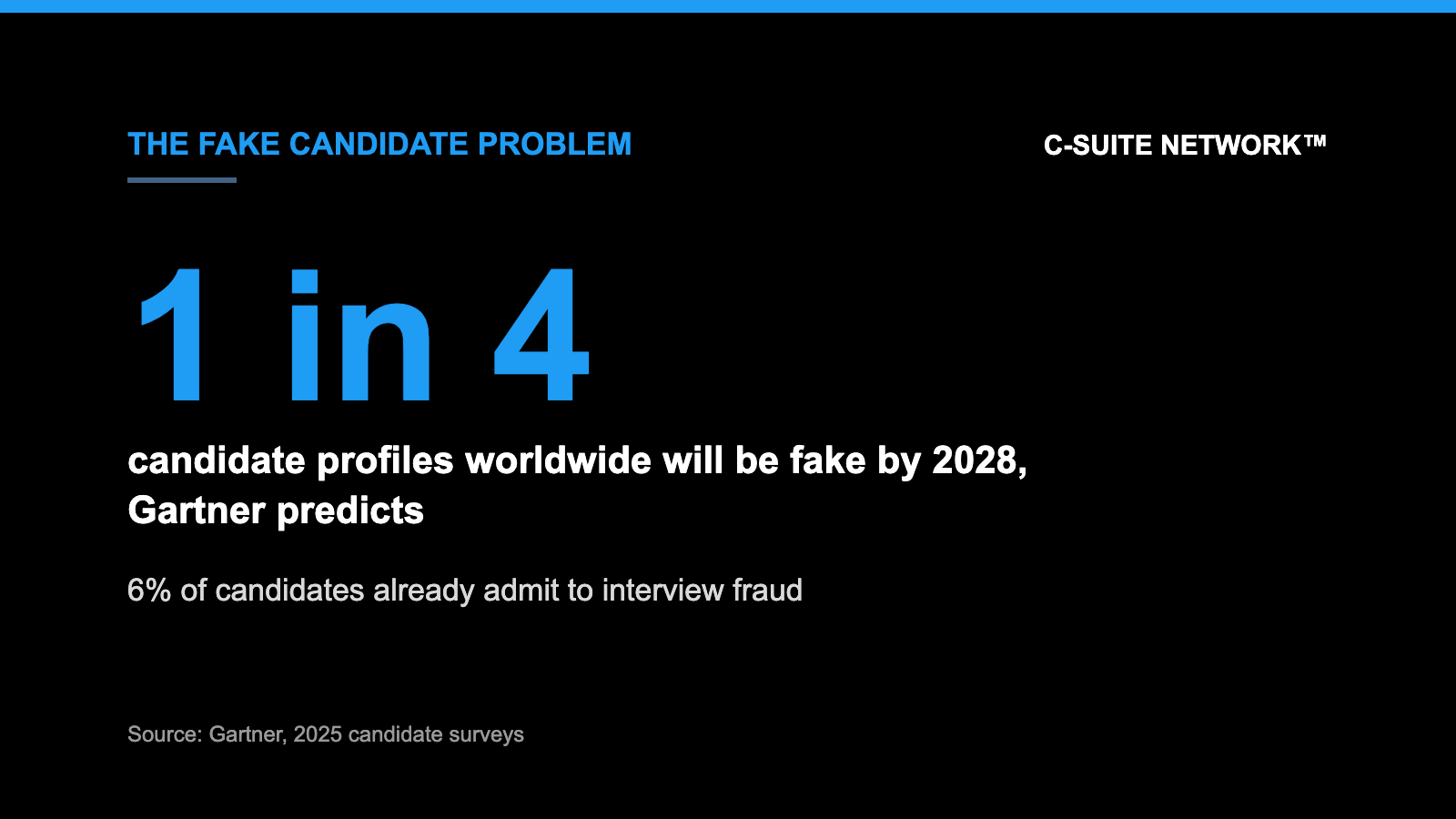
This is not a handful of spy stories. Gartner predicts that by 2028, one in four candidate profiles worldwide will be fake.
Some of it is already admitted. In Gartner’s surveys, 6% of job candidates said they had taken part in interview fraud, either posing as someone else or having someone else pose as them. And 39% said they used AI during the application process.
Then someone turned cheating into a startup
In 2025, Columbia student Roy Lee built a tool called Interview Coder. It fed answers to engineering candidates through a hidden window the interviewer could not see. He says he used it to land an Amazon internship. Columbia suspended him, TechCrunch reported.
He turned it into a company, Cluely, which markets an AI tool to “cheat on everything,” including job interviews. It raised $5.3 million, then a $15 million round led by Andreessen Horowitz.
Amazon said candidates must agree not to use unauthorized tools during interviews. Which is a little like asking a pickpocket to sign a pledge.
“But I’m not hiring remote engineers”
Fair. The North Korean scheme targeted remote IT jobs, and a 15-person firm is not a Fortune 500 company.
But the tools that made Ivan X are cheap and getting cheaper, and the 6% who admit to interview fraud are ordinary job seekers, not foreign agents. If you hire anyone you have only met on a screen, you are in the game.
The good news: honest candidates are on your side. In Gartner’s survey, 62% said they were more likely to apply for a role that required in-person interviews.
So what do you actually do?
Meet at least once for real. In person if you can, live video with the camera on if you cannot. Pindrop’s first clue was a face out of sync with its words.
Check that where they say they are is where they are. Ivan X claimed western Ukraine. His connection said otherwise. Confirm identity before the offer and send equipment only to a verified address.
Call references yourself. Use numbers you look up, not the ones on the résumé. The North Korean scheme ran on stolen identities.
Ask the second question. Anyone can rehearse “tell me about a challenge you faced.” Fewer can answer “what would you do differently?” and “who disagreed with you?” on the spot.
Test the work, not the talk. A short, paid task that looks like the real job is hard to fake in real time.
Pindrop sells technology that spots fakes. Its first clue still was not a detection tool. It was a recruiter who noticed a face that was a beat behind its words.
Pay attention. It still works.
Before Your Next Meeting
- When did we last meet a new hire in person, or at least on live camera, before making an offer?
- Do we verify identity, location and references ourselves, or trust what the candidate hands us?
- What is one short, paid work test we could add for our next open role?