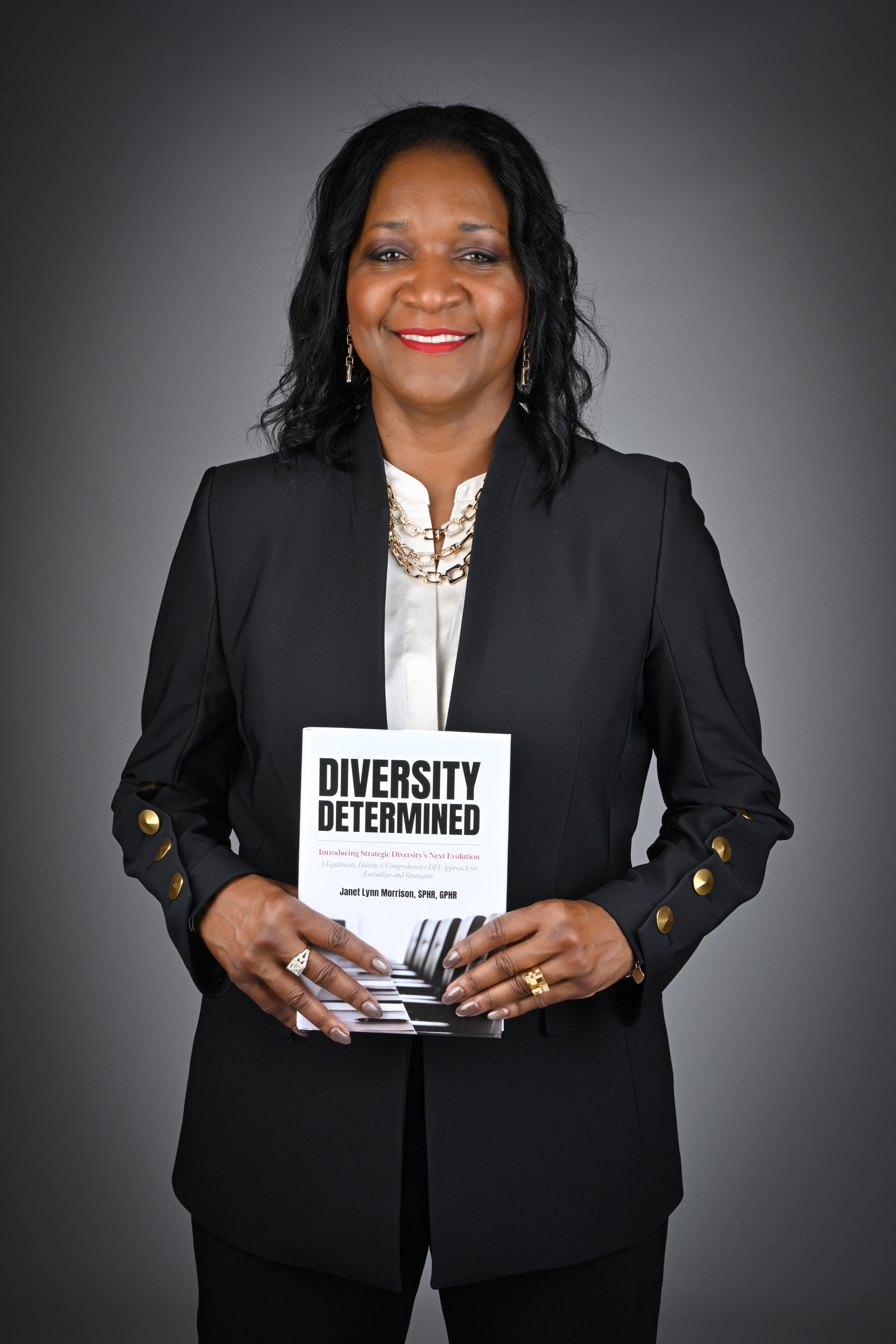
A CHRO with global experience at Ford, Nike, Dell Technologies, and Schneider Electric makes the case that diversity’s credibility problem is a structural one — and that the fix is legal, not ideological.
Janet Lynn Morrison, SPHR, GPHR, has spent more than two decades leading human resources and business transformation for global organizations — including Ford Motor Company, Nike, Dell Technologies, and Schneider Electric. Across that career she has watched the diversity conversation swing between two poles. In one era it is the most celebrated initiative in the enterprise. In the next it is the most politically radioactive.
What has rarely changed, in her assessment, is the underlying problem: too many diversity programs are built on sentiment rather than structure — and sentiment does not survive a change in the political weather.
That is the argument at the center of her book, Diversity Determined: Introducing Strategic Diversity’s Next Evolution, and it is a conversation worth continuing with C-suite leaders.
Politics Is a Poor Foundation for a Business Program
When a diversity strategy is anchored in politics or polarizing narratives, Morrison argues, three things reliably follow. Workplaces divide into camps. Trust between employees and leadership erodes. And the organization gets distracted from the mission it actually exists to accomplish.
None of that is a diversity outcome. It is an organizational effectiveness failure — and it is expensive. Executives who have lived through a public discrimination claim know that the settlement is rarely the worst part. In fiscal year 2022 alone, the EEOC recovered roughly $40 million across 91 employment discrimination filings. In an era where a headline has an indefinite shelf life, the reputational cost outlasts the check. Talent notices. Customers notice. Boards notice.
The question Morrison puts to C-suite leaders, then, is not whether diversity is politically fashionable this quarter. It is whether their employment system can withstand scrutiny.
Diversity Was Born in the Law — and That Is Its Strength
Diversity Determined opens with the history most diversity discourse skips. Organizational diversity did not begin as a values statement; it began as a legal response. Long before the word “diversity” was popularized in 1994, organizations were hiring EEO and affirmative action consultants to navigate EEOC mandates. It was Justice Powell’s commentary in Bakke v. Regents of the University of California that first framed diversity as a compelling interest. As Morrison puts it, diversity initiatives “were born out of the law.”
Somewhere along the way, the profession decided the law was the unglamorous part of the work — the compliance box to be checked before the real conversation began. Morrison considers that a strategic error. Her central proposition is that diversity leadership should “not run from legal requirements but run toward them,” in partnership with legal counsel.
The reasoning is practical. Title VII, the Equal Pay Act, the Americans with Disabilities Act, and the Equal Protection Clause are not one leader’s ethical opinion. They are a shared, enforceable standard that does not require every employee to agree with a philosophy in order to be bound by it. Ethics vary by individual; the law does not. That neutrality is what makes it durable — and after the Supreme Court’s 2023 decision in Students for Fair Admissions v. Harvard, durability is not a theoretical concern. Programs grounded in law adapt to legal change. Programs grounded in ideology simply become indefensible.
What C-Suite Accountability Actually Looks Like
Grounding a program in legal compliance and business strategy is not the softer approach. In Morrison’s framing it is the more demanding one, because it makes executives accountable rather than merely supportive. In practice, that means a few concrete commitments:
- Executive education that is legally specific. C-suite diversity training should be delivered proactively and include a review of legal trends with EEOC case studies, comparator litigation and settlement analysis, crisis communication preparedness, and guidance on handling difficult employee questions in large-audience settings.
- Reporting on a business cadence. Diversity leaders should report program status to their C-suite colleagues quarterly at minimum, with an annual “state of the organization’s diversity efforts” — covering training completion, representation and participation rates across hiring, retention and promotion, engagement, and any current workplace issues carrying legal or brand exposure.
- Metrics that measure reality, not optics. One of the most corrosive practices the book identifies is what Morrison calls metrics manipulation — interviewing a diverse candidate for a role where the decision has already been made, then reporting the interview as progress. Sound analytics exist to tell leadership the truth, not to protect a narrative.
- An equity standard that leaves no one out. A program that quietly overlooks White males, employees with disabilities who need accommodation, or employees who require religious accommodation is not comprehensive, and it will not hold up — legally or culturally.
Consider the scale of what is at stake operationally: a diversity program costs an average of $1.5 million annually. Measured against the cost of a single public discrimination claim, a legitimate, legally grounded program is not a “nice-to-have.” It is one of the better risk-adjusted investments on the executive agenda.
“Optimistically, organizations continue to be increasingly interested in establishing diversity programs. However, realistically, equitable change for diverse employees will not be overnight — no matter the immediacy of the need.”
— Janet Lynn Morrison, Diversity Determined
Bringing Credibility Back to the Conversation
Reader response has borne out the appetite for this reframing. Many have described Diversity Determined as strategic, practical, legally grounded, and refreshingly different from other books on the subject. Several have said it brings credibility back to the diversity conversation by focusing on organizational effectiveness rather than ideology.
That is precisely the shift Morrison hopes executives will make. The future of diversity leadership will not be won through argument. It will be earned through employment systems that are legally sound, strategically integrated, and led by executives who understand their own accountability — workplaces where every employee, without exception, feels valued, respected, and empowered to contribute to the organization’s success.
As the book’s closing chapter frames it, that is less a policy question than a “call for courage”: harnessing diversity with the neutral authority of employment law as its baseline framework. It takes more than good intentions. It takes determination.
About Janet Lynn Morrison, SPHR, GPHR
Janet Lynn Morrison is a Chief Human Resources Officer with global executive leadership experience spanning human resources and business transformation for organizations including Ford Motor Company, Nike, Dell Technologies, and Schneider Electric. She holds the Senior Professional in Human Resources (SPHR) and Global Professional in Human Resources (GPHR) certifications, and has spoken on diversity strategy and organizational effectiveness at venues including Harvard University. She is the author of Diversity Determined: Introducing Strategic Diversity’s Next Evolution — A Legitimate, Holistic & Comprehensive DEI Approach for Executives and Strategists(Palmetto Publishing). Learn more at diversitydetermined.info.