By Dr. Patricia Scipio, Author of CEO of Self: Lead Your Life Like a Business
What if the biggest obstacle between you and the life you want isn’t your circumstances, your employer, your past, or your resources—but the fact that you haven’t taken full ownership of your future?
You wake up every morning with responsibilities. You meet deadlines, solve problems, support your family, and fulfill expectations. You work hard, make sacrifices, and do what needs to be done.
Yet somewhere between managing your obligations and meeting everyone else’s expectations, you may have lost sight of something important: Who is running your life?
 Be our guestYour next big opportunity could be in a room you're not in.Meet CEOs, founders and owners at a reception in your city or online. Your first event is on us.Request my guest seat →
You may be successful by someone else’s standards but dissatisfied by your own. You may have achieved the career, acquired the credentials, or earned the title, only to discover that something is missing.
Perhaps you feel stuck in a career that no longer fulfills you. Perhaps financial uncertainty keeps you awake at night. Perhaps you’ve experienced a setback that has shaken your confidence. Or perhaps you simply know that you are capable of more but cannot figure out how to move forward.
You don’t lack ambition. You lack a clear strategy for turning that ambition into the life you actually want.
Here’s what I want you to understand:
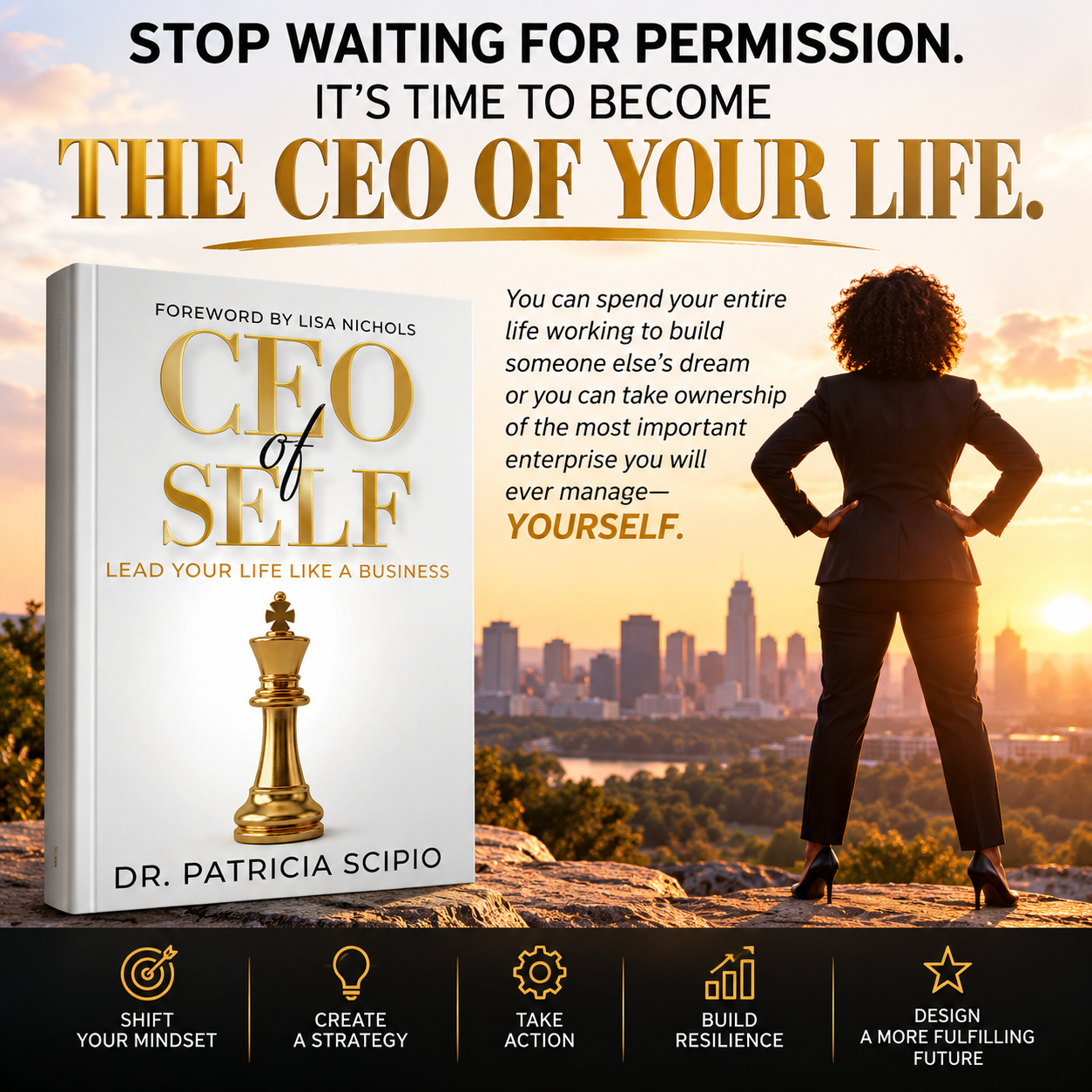
You can spend your entire life working to build someone else’s dream while neglecting the most important enterprise you will ever manage—yourself.
It’s time to change that.
If corporations need leadership, vision, strategy, accountability, and risk management to succeed, why shouldn’t individuals apply those same principles to their lives?
That question is the foundation of my book, CEO of Self: Lead Your Life Like a Business.
The Hidden Cost of Living Without a Strategy
Think about how a successful organization operates.
Its leaders establish a mission. They define a vision. They identify opportunities, evaluate risks, allocate resources, measure performance, and make adjustments when circumstances change.
They don’t simply wake up each morning and hope everything works out.
Yet that is exactly how many people approach their personal lives.
They hope their careers will advance. They hope their finances will improve. They hope opportunities will appear. They hope someday they’ll have enough time, money, or confidence to pursue their dreams.
Hope is important. But hope without intentional action is not a strategy.
The external challenges are real: economic uncertainty, workplace restructuring, discrimination, financial pressures, family obligations, and unexpected losses.
But another challenge operates beneath the surface.
It’s the internal voice that says:
“I’m not ready.”
“I don’t have enough experience.”
“What if I fail?”
“It’s too late to start over.”
“People like me don’t get those opportunities.”
And beneath these challenges lies an even deeper problem: the belief that someone else must give you permission to change your life.
Your employer must recognize your value. Your circumstances must improve. Someone must open the door.
But what happens when they don’t?
You wait.
And while you’re waiting, opportunities pass, confidence erodes, and your dreams become increasingly distant.
The greatest risk isn’t always making the wrong decision. Sometimes it’s allowing indecision to become your life strategy.
A Different Approach: Lead Your Life Like a Business
After more than four decades working inside major organizations, auditing systems, evaluating risks, advising leaders, and helping businesses improve performance, I recognized something remarkable.
The same principles that strengthen organizations can help individuals build more purposeful, fulfilling lives.
I call this becoming the CEO of Self.
Being the CEO of your life doesn’t mean controlling everything. It doesn’t mean doing everything alone, having all the answers, or never experiencing failure.
It means accepting responsibility for the direction of your life and making decisions that align with the future you want to create.
It means shifting from reacting to circumstances to responding with intention.
And it begins with a practical leadership plan.
Step One: Change Your Mindset Before You Change Your Circumstances
Every meaningful transformation begins with how you think.
Your mindset influences how you interpret challenges, evaluate opportunities, and respond to disappointment.
A fixed mindset sees failure as evidence of inadequacy. A growth mindset sees failure as information that can guide improvement.
Failure is data, not defeat.
When something doesn’t work, examine what happened. Identify what you can learn. Adjust your approach.
Your circumstances may change your plans, but they don’t have to cancel your future.
Step Two: Create a Personal Strategic Plan
Imagine walking into a boardroom and asking the executive team about the organization’s future.
What if the CEO responded, “We’re just going to see what happens”?
You would immediately question the organization’s leadership.
Yet how often do we approach our own futures without a defined destination?
A personal strategic plan begins with the corporate trifecta: Mission, Vision, Values.
What is my mission? What gives my life meaning? What contribution do I want to make?
What is my vision? What do I want my life to look like three, five, or ten years from now?
What are my core values? Which principles will guide my decisions, especially when circumstances become difficult?
Once you’ve answered those questions, conduct a personal SWOT analysis.
Identify your strengths, weaknesses, opportunities, and threats.
Perhaps your greatest strength is your ability to connect with people. Perhaps your weakness is procrastination. Perhaps an emerging industry presents an opportunity, while outdated skills threaten your career security.
This isn’t an exercise in criticizing yourself. It’s an opportunity to understand your current position and make informed decisions.
Then establish specific, measurable goals.
Don’t simply say, “I want financial freedom.”
Define what that means. Determine how much you need to save, what debt you want to eliminate, what skills could increase your income, and when you intend to achieve those objectives.
A dream becomes a goal when you give it direction. A goal becomes a strategy when you give it a plan.
Step Three: Build Your Personal Board of Directors
One of the greatest misconceptions about personal success is that you must accomplish everything independently.
No successful corporation operates without advisors, experts, and trusted partners.
Neither should you.
In my book, I encourage readers to build a personal cabinet—a network of mentors, coaches, financial professionals, trusted friends, and other advisors who can provide perspective and accountability.
I learned the value of this approach while completing my doctorate.
After finishing my coursework, I struggled for years to complete my dissertation. I had the knowledge and ability, but I lacked structure and accountability.
Eventually, I hired an executive coach.
That investment changed everything.
My coach helped me clarify priorities, establish accountability, and maintain momentum.
Six months later, I became Dr. Scipio.
The lesson?
Seeking support isn’t a sign of weakness. It’s an executive decision to invest in your future.
You may be the CEO of your life, but you don’t have to be the entire executive team.
Step Four: Manage Risk, Resources, and Resilience
Every organization faces uncertainty.
Markets shift. Technology evolves. Competitors emerge. Unexpected events disrupt carefully constructed plans.
Your life is no different.
A job loss, illness, financial emergency, or family crisis can change your circumstances overnight.
I witnessed this reality on September 11, 2001, when I helped lead my team down 29 flights of stairs at the World Trade Center. Later, I faced another professional disruption when my function was outsourced.
Those experiences reinforced a lesson I had learned repeatedly: preparation matters, but so does resilience.
You cannot eliminate every risk. You can, however, strengthen your ability to respond.
Build financial reserves. Develop transferable skills. Maintain professional relationships. Protect your physical and emotional well-being. Create alternatives before you desperately need them.
Most importantly, remember that a setback is an event, not your identity.
The CEO of Self doesn’t measure success by the absence of challenges.
Success is demonstrated by the ability to learn, adapt, recover, and continue moving forward.
The Future You Create Begins With One Decision
Now imagine two possible futures.
In the first, nothing changes.
You continue working hard but without a clear direction. You postpone difficult decisions. You allow fear to influence your choices. You tell yourself that someday you’ll pursue the opportunities you’ve been considering.
Five years pass.
You’re still waiting for the right moment.
Now imagine another future.
You define your mission. You establish meaningful goals. You strengthen your finances, invest in your development, build supportive relationships, and begin making decisions aligned with your values.
Challenges still occur.
But instead of feeling powerless, you have a framework for responding.
Instead of waiting for someone else to recognize your potential, you begin investing in it yourself.
Instead of measuring your life solely by titles, income, or other people’s expectations, you define success on your own terms.
That’s the transformation at the heart of CEO of Self.
Not perfection.
Not unlimited control.
Ownership. Direction. Purpose.
Your First Executive Decision Starts Today
You don’t need to transform your entire life overnight.
Start by scheduling your first personal board meeting—with yourself.
Choose one priority.
Make one commitment.
Then take one action.
That’s how effective leaders operate. And that’s how you can begin leading yourself.
I wrote CEO of Self: Lead Your Life Like a Business to share lessons and give others a practical framework along with tools for taking charge of their futures.
Because your life is too important to leave entirely to chance.
You are not simply a participant in your life. You are its chief decision-maker.
Your future is waiting.
Your next chapter is unwritten.
And your most important leadership assignment begins now.
It’s time to hire yourself as the CEO of your life.
Opinions expressed by C-Suite Network contributors are their own.
 The Boardroom Needs the Ground: By Mark Madrid
 How Fractional Executives can Help Your Company Thrive: Key FactsBy Paul Whitley
 Do Not Cut 25% of Your Workforce YetBy Mahesh M. Thakur
 C-Suite TV · 22 minProject Calm: Johnny C. Taylor Jr. on Leadership, Culture, and the Future of Work
 C-Suite Radio · Leadership Without Losing Your Soul: Master Communication & Management Skills To Boost Productivity, Teamwork & Ease Overwhelm380 Stop Doing All the Thinking: 4 Leadership Communication Skills That Get Your Team Solving Problems
 Chairman's Corner · Jeffrey HayzlettYour Best Performer Might Be Your Biggest Problem. And It’s Contagious.
Meet the founders, CEOs and operators behind stories like this one. Next reception: NYC Executive Reception, Tue, Nov 24.
Attend as a guestMembership: $100/mo →