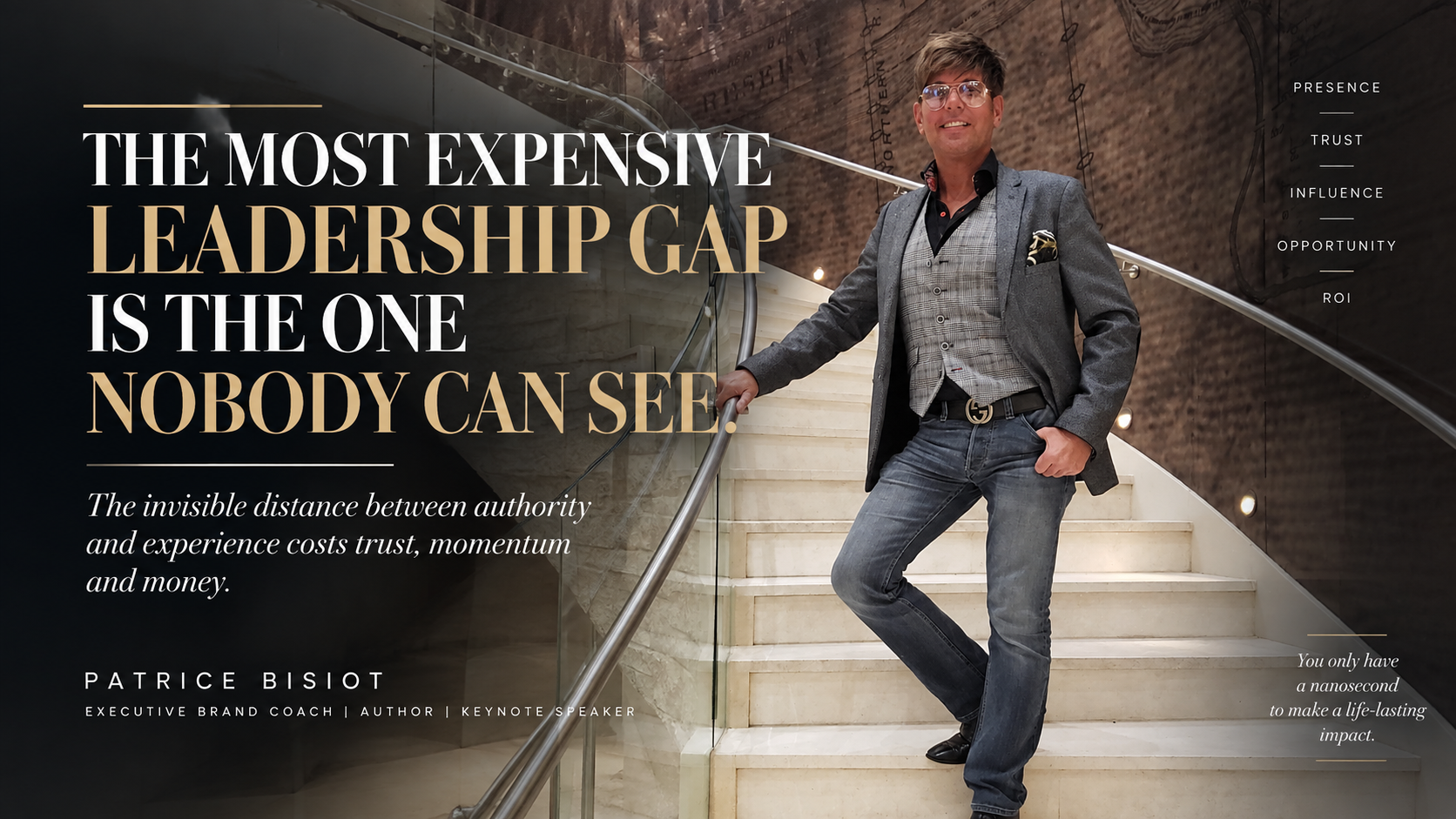
Why the invisible gap between authority and experience quietly costs leaders trust, momentum, and money.
Most leadership problems are discovered after they become visible.
The client hesitates. The negotiation slows. The team stops challenging the leader. The promotion goes elsewhere. A strong recommendation receives a lukewarm response. A decision that should have moved quickly suddenly requires another meeting.
By then, leaders naturally focus on the visible outcome.
But the outcome may have begun much earlier, in something nobody measured.
A moment of uncertainty.
A contradiction between message and behavior.
A subtle loss of trust.
A signal that created hesitation before anyone could explain why.
The most expensive leadership gap is often the one nobody can see.
Hesitation has a price
In high-stakes environments, people rarely announce that their confidence has shifted.
They do not say, “Something about this interaction made me slightly less certain about your judgment.”
They hesitate.
And hesitation is expensive.
It appears as a longer decision cycle. A smaller commitment. More questions after the meeting. A cautious mandate. Reduced enthusiasm. Another layer of approval. A client who was nearly ready but never quite moves forward.
None of these outcomes necessarily looks like a leadership problem.
But when trust must move faster than doubt, even small amounts of friction compound.
Executive Presence is not aesthetic
Executive Presence is often treated as presentation: posture, clothing, communication technique, confidence, polish.
Those things can contribute to presence, but they are not its source.
Presence is not aesthetic.
It is psychological alignment made visible.
When internal conviction and external expression reinforce one another, people experience coherence. The leader’s words, behavior, emotional regulation, judgment, listening, and physical presence tell the same story.
When they do not, the audience begins resolving contradiction.
That cognitive friction changes the interaction.
The leader may still be brilliant. The strategy may still be correct. The credentials may still be impeccable.
But now the argument has to work harder because the person delivering it has introduced uncertainty into the experience.
Where high performers quietly lose influence
This is particularly dangerous for accomplished leaders because success can disguise the gap.
A senior executive may become more polished, more controlled, more deliberate, and more strategically aware while becoming less relationally accessible.
From the inside, this feels like refinement.
From the outside, it may feel like distance.
Conversations remain technically excellent, yet people volunteer less. Feedback becomes filtered. Influence requires more explanation. Decisions take longer. Stakeholders remain respectful but become slightly more cautious.
Nothing dramatic happens.
That is precisely why the cost is difficult to see.
The leader has not lost authority in one visible event. Authority has begun leaking through a series of invisible moments.
The economic architecture of authority
Authority operates on more than one level.
It is psychological: How quickly does another person’s nervous system experience reliability?
It is relational: Does trust deepen or weaken across repeated interactions?
And it is economic: Do decisions accelerate, stall, expand, contract, or disappear?
This is why Executive Presence belongs in a business conversation.
Trust affects the speed of commitment.
Clarity affects the speed of decision-making.
Congruence affects perceived risk.
Listening affects the quality of interpretation.
Judgment affects whether the right problem is being solved.
These are human variables, but their consequences appear in numbers.
The invisible cost of performance
Modern leadership culture encourages people to study what authority should look like.
They learn the language. Refine the posture. Optimize the presentation. Rehearse the message.
Refinement is useful.
Performance is different.
When leaders begin performing authority instead of embodying it, people often detect the difference before they can articulate it.
The solution is not less sophistication.
It is greater congruence.
Authenticity at the executive level is not emotional exposure. It is the absence of contradiction between internal conviction and external behavior.
Alignment reduces the amount of uncertainty other people have to resolve.
What organizations should measure differently
Organizations measure leadership outcomes constantly.
Revenue. Retention. Engagement. Conversion. Productivity. Decision speed. Client satisfaction.
But the human conditions producing those outcomes are harder to see, so they are often treated as secondary.
They are not secondary.
A technically exceptional leader who repeatedly creates hesitation carries a cost.
A brilliant professional whose value is difficult to experience carries a cost.
A culture where people filter what they say to senior leadership carries a cost.
A client relationship that requires unnecessary reassurance carries a cost.
The numbers eventually reveal the consequence.
The opportunity is recognizing the cause earlier.
The gap nobody can afford to ignore
Leadership does not begin when the leader speaks.
It begins when other people start interpreting the leader.
That interpretation shapes trust. Trust shapes willingness. Willingness shapes decisions. Decisions shape outcomes.
The visible business result sits at the end of an invisible chain.
This is why the next level of leadership development cannot focus only on what leaders know or what they say.
It must develop the quality of the human signal from which their decisions, communication, relationships, and authority emerge.
Because the greatest leadership costs are not always the failures everyone can see.
They are the small, repeated moments of doubt nobody notices until they have already become expensive.
Patrice Bisiot
Executive Brand Coach | Author | Keynote Speaker
Author of Mind Your Brand