Quick take
- DoorDash agreed on October 29 to buy Instacart for about $17 billion, or $65 a share. If regulators approve, one company would handle roughly three of every four dollars Americans spend on the major delivery apps.
- DoorDash says the deal helps smaller grocers fight Walmart and Amazon. Critics say it hands one company too much power over restaurants, grocers and drivers.
- Why it matters now: The deal won’t close until late 2027 at the earliest. If delivery is part of how you sell, the next year is your window to cut your dependence on any one app before it gets bigger.
Five years ago, DoorDash was the biggest food delivery app in America. Now it’s about to swallow the grocery one too.
On October 29, DoorDash announced it would buy Instacart for about $17 billion. It’s paying $65 a share, a 26% premium, and at least three-quarters of it in cash. Instacart will keep its name and its app. The two companies say they’ll run separately until regulators decide, which they expect to take until late 2027 or the first half of 2028.
How big is “big”?
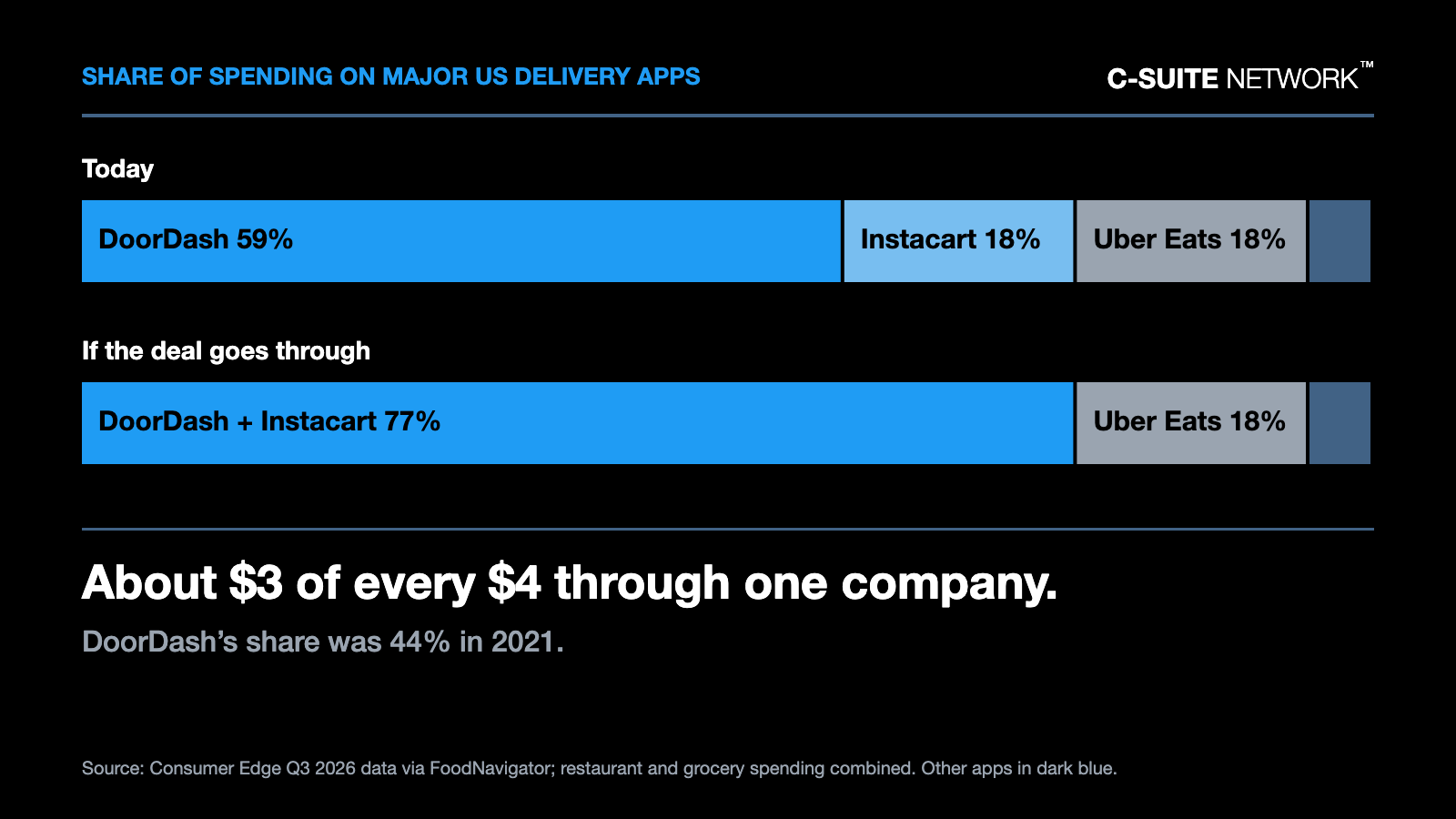
Here’s the number that makes this deal different. According to Consumer Edge data cited by FoodNavigator, DoorDash already takes in 59% of what Americans spend across the major delivery apps, restaurants and groceries combined. That’s up from 44% in 2021. Instacart has about 18%. Uber Eats has about 18%.
Put DoorDash and Instacart together and you get roughly 77%. In plain terms: of every $4 spent on a major delivery app, about $3 would go through one company.
Instacart isn’t small on its own, either. Last quarter it handled $10.5 billion in orders for more than 2,200 retailers and nearly 100,000 store locations, and earned $147 million.
DoorDash’s case: this is about Walmart and Amazon
DoorDash CEO Tony Xu put it simply: “Grocery is one of the hardest things to get right online.” The pitch is that independent and regional grocers can’t build what Walmart and Amazon have on their own. With the combined company, they’d get Instacart’s technology to run their own online stores and ad businesses, and DoorDash’s delivery network to get orders out the door cheaper. DoorDash also says grocers could keep working with any delivery platform they want, and that subscribers who pay for both DashPass and Instacart+ would pay one fee instead of two, saving about $100 million a year.
There’s a quieter reason, too. Instacart sells ads to the brands on its shelves, and one analyst told FoodNavigator that advertising may matter more to the deal than delivery fees, because selling digital shelf space earns better margins than driving groceries around.
The critics’ case: one company sets the terms
Consumer and labor groups have already asked the FTC to block it. The American Economic Liberties Project says the merger would hurt grocers, drivers, consumers and restaurants. Groundwork Collaborative’s president called the two companies “two of the biggest ripoff machines in America.” The FTC is separately looking at how DoorDash, Instacart and others use personal data to set prices.
DoorDash is clearly bracing for a fight. If regulators block the deal, DoorDash owes Instacart a $1.25 billion breakup fee.
What it means if you sell through the apps
For restaurants, the math was already tight. DoorDash charges restaurants a 15%, 25% or 30% commission on delivery orders, depending on the plan. The median full-service restaurant keeps about $2.80 of every $100 in sales before taxes, according to the National Restaurant Association. On a $100 delivery order on DoorDash’s middle plan, DoorDash keeps $25. The restaurant’s typical profit on all of its sales is less than $3 per $100.
That’s the real issue with a bigger platform. Fees aren’t set by a law of nature. They’re set by how many other places a restaurant or grocer can go to reach the same customers. When one company handles three out of four delivery dollars, the restaurant has fewer places to go, and less leverage when the contract comes up.
None of that changes tomorrow. The deal may not close for a year or more, and regulators could block it or force changes. But that’s exactly why this is the time to act, not after.
Before Your Next Meeting
- Know your number. What share of your sales comes through delivery apps, and what are you really paying on it after commissions, promotions and refunds?
- Push customers to pickup and your own channels. DoorDash’s pickup commission is 6%, far below its delivery rates. Your own website, ordering and loyalty program cost even less and let you keep the customer’s contact information.
- Don’t get stuck on one app. If one platform is most of your delivery business, start building a second channel now, while you still have a choice.
- Watch the FTC review. The terms you’ll negotiate in 2028 may depend on what regulators require of the combined company.
Sources: TechCrunch; FoodNavigator (Consumer Edge spending share data); Martin Cid Magazine on deal terms and antitrust review; TradingKey on deal premium and Instacart results; DoorDash merchant pricing; National Restaurant Association margin data, via Bloom Intelligence.