The quick take:
- About 2.3 million small businesses are owned by baby boomers, and nearly half of all owners are 55 or older. A big share will try to sell in the next few years.
- Good businesses are selling for more than ever: the median sale price jumped 17% last quarter. But fewer deals are closing, and buyers are getting pickier.
- Why it matters now: buyers are paying for one thing above all, a business that doesn’t need its owner. Most owners haven’t built that.
Here is the hardest thing I tell owners: if your business can’t run without you, nobody wants to buy it.
Not your competitor. Not private equity. Not your best employee. And probably not your kids.
I’ve bought and sold more than 250 businesses over my career, some great, some not so great. I’ve sat on both sides of that table. And the owners who get the big check almost never have the best product. They have the business that keeps running when they walk out the door.
A lot of owners are about to find out what theirs is worth
About 2.3 million small businesses are owned by aging baby boomers, and those businesses account for about 1 in 6 U.S. jobs, according to Project Equity, as Entrepreneur reported. Nearly half of all small business owners are 55 or older, and only about 54% have any kind of succession plan, according to U.S. Bank’s 2025 survey.
And here is the number nobody likes to hear. An often-cited estimate from the Exit Planning Institute’s research says 70% to 80% of small businesses that go to market never sell.
Read that again. Most owners who want out can’t get out.
The market is splitting in two
The latest data from BizBuySell, the largest online marketplace for buying and selling small businesses, shows exactly what’s happening.
In the third quarter, 2,132 businesses changed hands on its platform, down 7% from a year earlier. But the median sale price jumped 17% to $350,000, according to the report.
Fewer deals. Higher prices. That’s a market where the good businesses are getting paid and the rest are getting passed over.
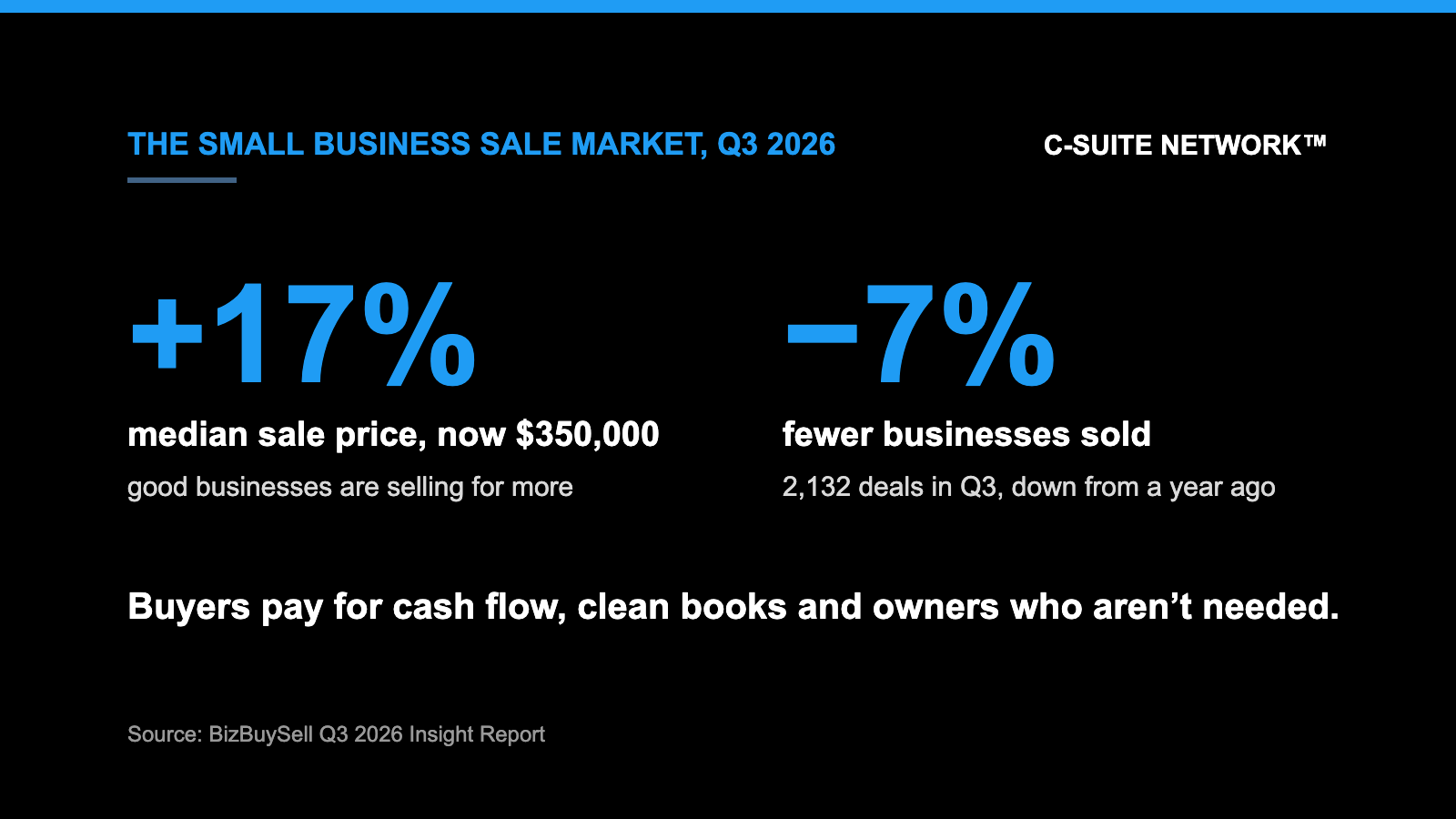
BizBuySell’s president, Bob House, said buyers “haven’t left the market. They’re simply becoming more selective.” What are they selecting for? “Reliable cash flow, clean financials, limited owner dependence.”
That last one is the killer.
Every decision runs through you. That’s the problem.
I’ve said it before: if every decision runs through you, you’re the bottleneck, and your business will never grow bigger than your bandwidth.
Now flip it around and look at it like a buyer. If the customers call you, the employees wait on you and the vendors only know you, what exactly am I buying? Your job. And I don’t want your job.
At Tallgrass, my PR and social media firm, I gave a new employee a rule: you get to ask me 21 questions. That was it. A good employee should be able to figure out the rest without walking into my office. Build a whole company of people like that and you have something worth buying.
Here’s a simple test. Could you leave for two weeks, phone off, and come back to a business that is still standing? If the answer is no, you don’t have a business. You have a job with extra stress.
What buyers pay for, and what to do about it
1. Reliable cash flow. Buyers pay for what the business earns without heroics. Know your real numbers, month by month, and stop running personal expenses through the company. Every “add-back” you have to explain costs you trust at the table.
2. Clean books. If your financials need a story to make sense, the price just dropped. Get a real accountant, not your brother-in-law, and get a valuation now, years before you need it.
3. A business that doesn’t need you. Name a No. 2 and give them real authority. Put your biggest customer relationships in somebody else’s hands. Write down how things work so they don’t live only in your head.
4. Start earlier than you think. Among owners planning to sell, 27% say today’s conditions have them thinking about selling sooner, according to BizBuySell. Building a sellable business takes years, not months. If you want out in five years, you are already late.
Same problem. Fewer zeros.
The only difference between a business on Main Street and a business on Wall Street is the number of zeros. A $350,000 shop and a $350 million company get bought for exactly the same reasons.
And here is the best part. Do all of this and you may decide you don’t want to sell at all. A business that runs without you is worth more to a buyer, and it’s worth a whole lot more to you.
Build the business somebody would want to buy. Then decide if you want to sell it.
Before Your Next Meeting
- If I disappeared for two weeks, what would break first?
- Who is my real No. 2, and what decisions can they make without me?
- When did I last get an honest valuation of this business, and what would a buyer question first?