The quick take:
- On paper, an executive writing articles looks like a terrible use of time. In practice, thought leadership is one of the few things buyers say they trust more than your marketing, and one of the few assets that keeps working after you stop.
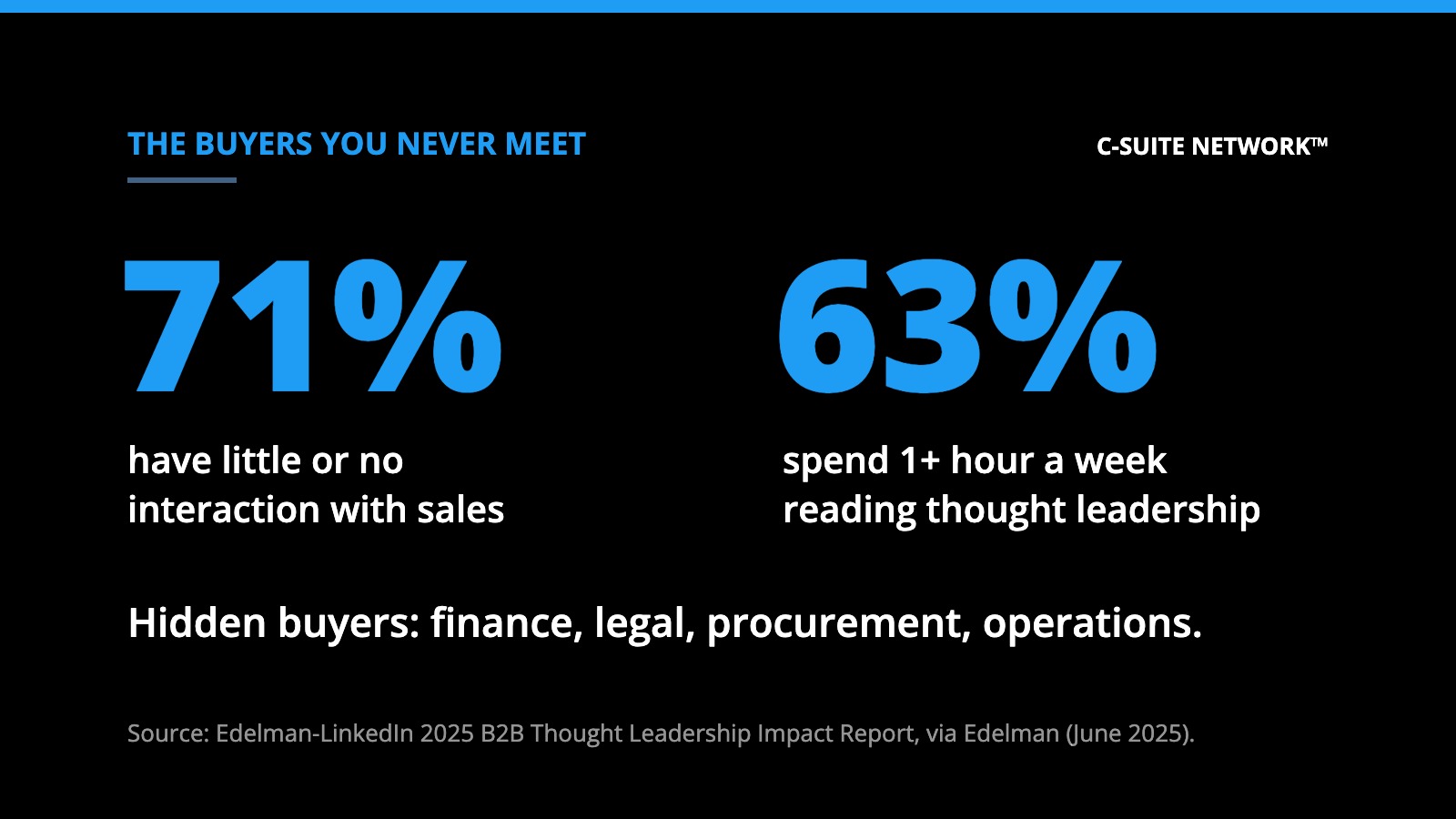
- It also reaches the people you’ll never get a meeting with. In a 2025 study, 71% of the “hidden” buyers who sway B2B deals said they have little or no contact with sales teams, but 63% spend more than an hour a week reading thought leadership.
- Why it matters now: more than 40% of B2B deals stall because the buying group can’t agree internally. When you’re not in the room, your articles are.
On first impression, an executive writing articles makes no sense.
You run a company. Your calendar is a crime scene. Your time is worth hundreds of dollars an hour, and nobody is asking you to spend three of them writing 1,000 words about how you price a project.
You could spend that time on sales calls. Or hiring. Or, let’s be honest, sleeping.
And yet a lot of the executives you’ve actually heard of share a habit: they put their thinking in writing, under their own name, over and over.
Here’s why the math works.
1. Buyers trust it more than your marketing
Your website says you’re great. So does everyone else’s. Buyers know that.
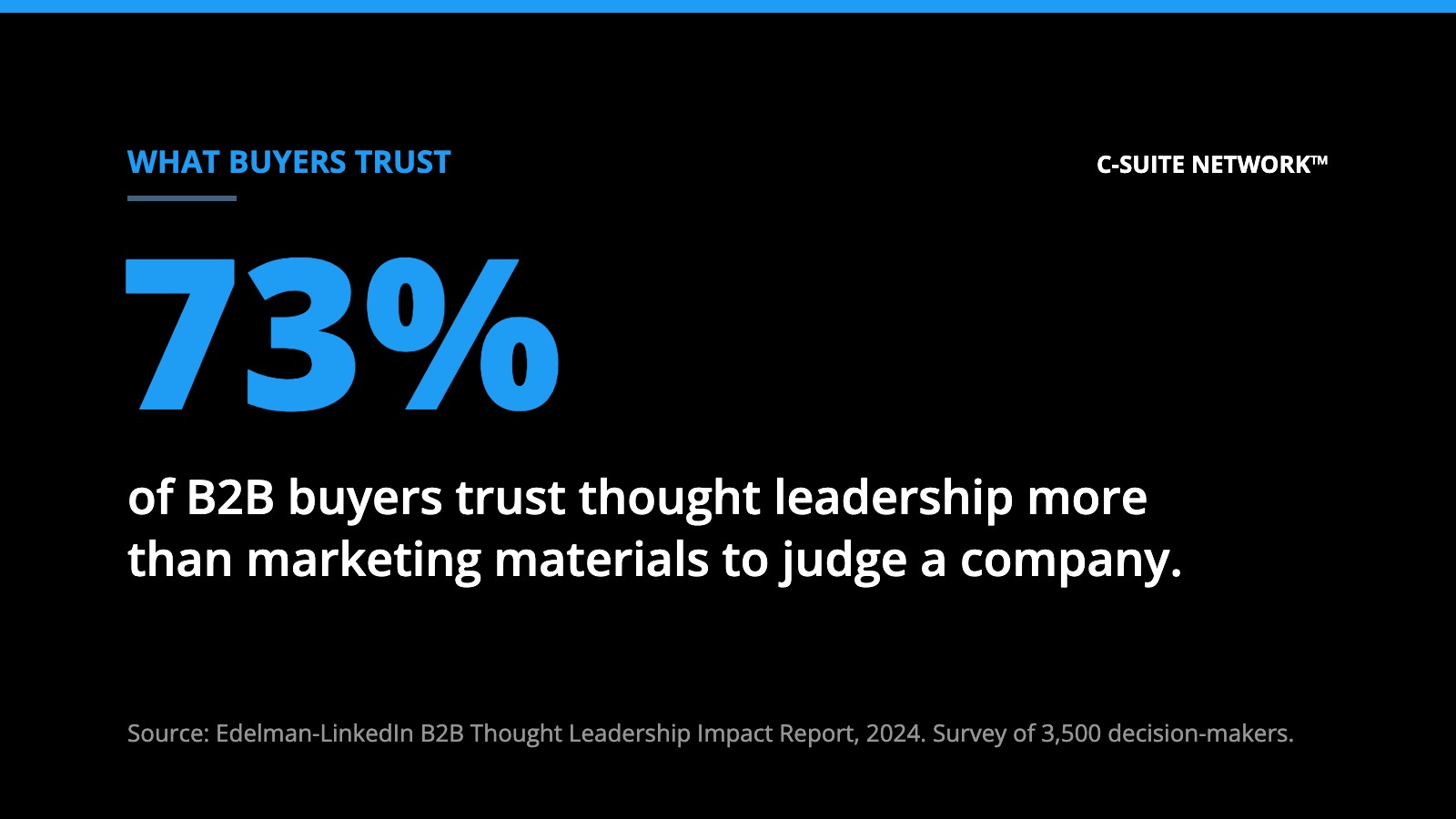
When Edelman and LinkedIn surveyed 3,500 business decision-makers in 2024, 73% said thought leadership is “a more trustworthy basis for judging a company’s competencies” than marketing materials. 60% said they’d pay more to work with organizations that put out valuable thought leadership. And 86% said they were likely to invite those organizations into an RFP.
Translation: your sales deck is the claim. Your articles are the evidence.
2. It reaches the buyers you’ll never meet
Here’s the part most executives miss.
You pitch the person who took the meeting. But the deal gets decided by a group, and a lot of that group never shows up on a call: the CFO, someone in legal, procurement, the operations lead who has to live with whatever gets bought.
Edelman and LinkedIn call them “hidden buyers,” and in Edelman and LinkedIn’s 2025 study, they’re not exactly sitting around waiting for your sales rep. 71% said they have little or no interaction with sales teams.
But they’re reading. 63% said they spend more than an hour a week consuming thought leadership.
And it moves them. 79% of hidden buyers said consistently good thought leadership makes them more likely to advocate for a proposal during an RFP. 51% said it helps them convince their own C-suite. 95% said it makes them more receptive to sales and marketing outreach.
That matters because, according to research the report cites, more than 40% of B2B deals stall when the buying group can’t get on the same page.
Read that again. The person who kills your deal may never have heard your pitch. But they might have read your article.
3. It’s what shows up when they Google you
After the first call and before the second meeting, your prospect types your name into Google. So does their boss. So does the CFO.
If all they find is a LinkedIn profile and a bio from three jobs ago, they fill in the blanks themselves. If they find five articles where you explain how you think about their exact problem, the second meeting starts halfway to a yes.
4. It’s the follow-up that doesn’t feel like a follow-up
“Just checking in” is where deals go to die.
“Saw this and thought of our conversation” gets opened, and it gets forwarded to the people you’ve never met. Every article you publish is a no-pressure reason to reach every open deal, past client and referral partner. You’re not asking for anything. You’re being useful.
5. It gets you invited
Podcast hosts, conference organizers and reporters have one job: find someone worth listening to, fast. They book people who are already on the record. Nobody books the expert they’ve never heard of.
6. It keeps working after you stop
A sales call ends when you hang up. An ad stops when the budget does.
An article keeps answering the same question for every prospect who searches it, next month and next year, without another minute of your time. Few things an executive does have that kind of shelf life.
“But nobody wants to read what I’d write”
It’s a common objection, and it’s usually wrong.
In a Stanford experiment, people tapped out famous songs on a table and predicted listeners would name half of them. Listeners named 3 out of 120. The tappers could hear the melody in their heads; everyone else just heard knocking.
Your expertise works the same way. It feels obvious to you because you’ve lived it. To the CFO trying to decide whether to trust you, it’s exactly what they’re looking for. And per the 2025 study, 85% of hidden buyers rank understanding their business challenges as a top factor in the final decision.
“But I don’t have time”
You don’t need a content calendar. You need one article a month that answers one question you’re already answering anyway. Record yourself explaining it on a call, clean up the transcript and you’ve got a draft. That’s an hour, not a weekend.
Where to put it (and where not to)
Full disclosure: we run a media network, and one of the things we offer is a place for executives to publish. So weigh this section accordingly. We tried to write it so it’s useful even if you never publish a word with us. And it isn’t for everyone: if you don’t have something to say from actually running something, skip it.
The honest version: a brand-new website or a company blog that posts twice a year often can’t rank even for its owner’s own name, because Google leans on a site’s history and on the credible sites that link to it. An established publication usually gets your article found faster. The tradeoff is that you don’t own that page, so keep the same bio on your own site and link to your articles from it.
And be picky. In 2024, Google began penalizing “third-party content produced primarily for ranking purposes and without close oversight of a website owner,” Search Engine Land reported. If a site will publish anything for anyone, your name doesn’t belong there.
The catch
One article won’t change your business. Few people will read a piece and call you out of nowhere. The payoff comes from doing it consistently, and it’s quieter than an ad: the CFO who already trusts you, the follow-up that gets forwarded, the invitation you didn’t ask for.
On second look, those three hours might be the best ones you spend all month.
Before Your Next Meeting
Here’s what this means for you:
- Who’s deciding your biggest open deal that you’ve never met? What would they find if they Googled you tonight?
- What question do you answer on every sales call? That’s your first article.
- Who’s in your pipeline right now? The day it goes live, send it to every one of them, and ask them to pass it along.