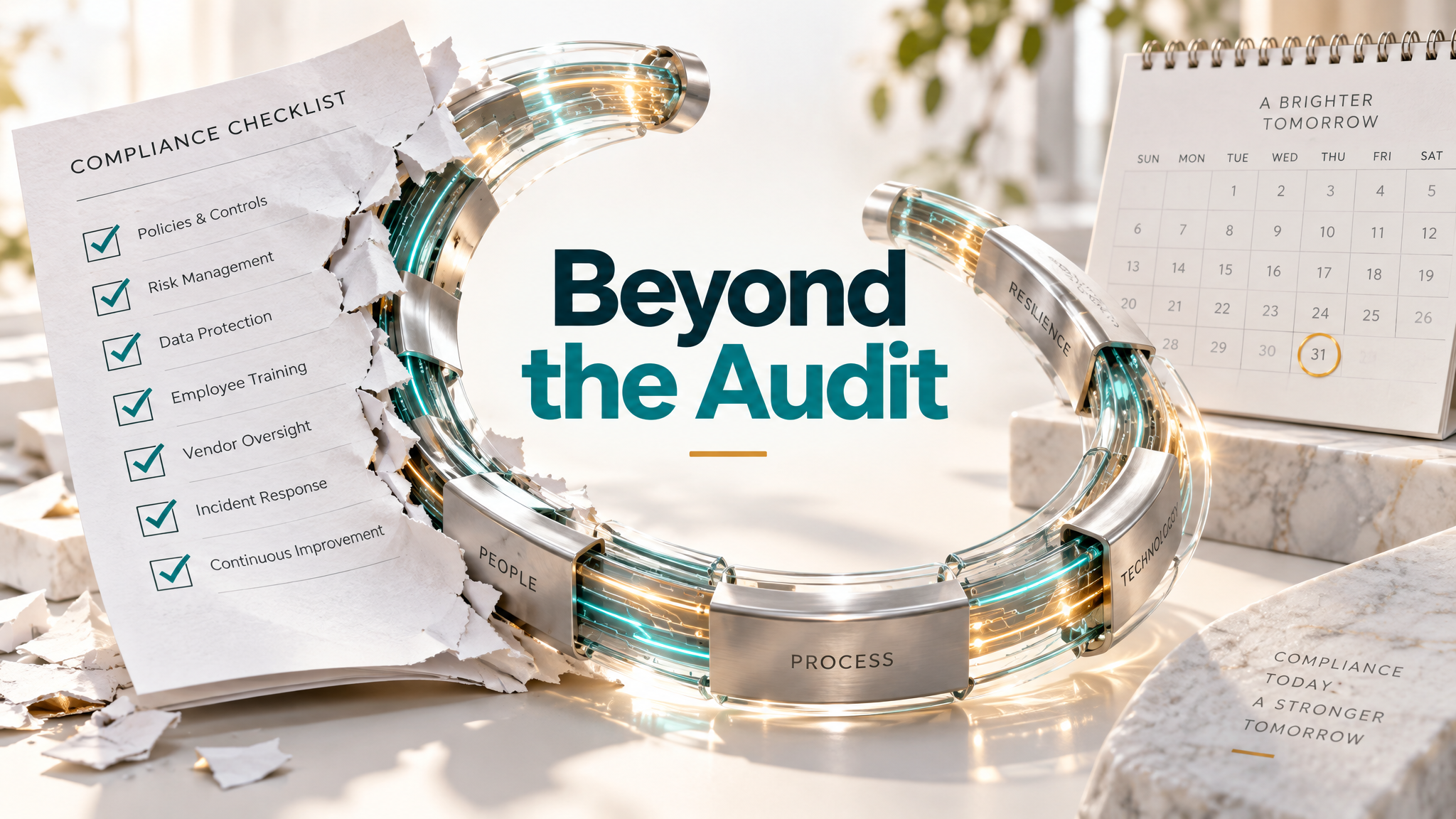
Many companies still manage cybersecurity as if risk operates on an annual schedule. Policies are reviewed before the audit. Evidence is gathered when someone asks for it. Vulnerabilities are addressed when a contract, customer, regulator, or auditor creates enough pressure to move the issue to the top of the list.
That is not continuous cybersecurity. It is seasonal compliance, complete with predictable rituals, rushed remediation, and the organizational equivalent of hoping nobody looks too closely behind the curtain.
The costly assumption underneath this behavior is that passing an audit means the business is secure. It does not. An audit provides evidence about specific controls at a specific point in time. The business keeps changing the moment the auditors leave, which means the security posture can change with it.
The executive issue is not whether your company has controls. The real question is whether those controls remain effective while systems, people, vendors, products, and customer requirements continue to change.
Security Cannot Be Separated from Business Operations
This article was developed from my conversation with Lori Crooks, founder and CEO of Cadra, whose work includes helping Department of Defense contractors and software companies navigate security and compliance requirements such as CMMC and FedRAMP. Her central observation applies well beyond companies pursuing government contracts: too many organizations treat security as a box to check rather than a discipline embedded in how the business operates.
Crooks described a familiar pattern. A contractual requirement appears, the organization discovers that it must demonstrate compliance, and security suddenly becomes urgent. Leaders then have to work backward to determine which controls exist, which are missing, whether policies reflect actual practices, and who is responsible for closing the gaps.
This is expensive, disruptive, and usually avoidable. Building security after the product, process, or operating environment has already been established means retrofitting controls into decisions that were made without them. The company pays not only for the technical work, but also for delays, rework, diverted leadership attention, and the friction of changing established behavior.
Security introduced late becomes an obstacle because the business designed it that way. Security considered early becomes part of the operating architecture.
That distinction matters whether the relevant framework is NIST, CMMC, FedRAMP, HIPAA, SOC, COSO, or another set of requirements. Frameworks differ in scope and purpose, but the broader executive principle remains consistent: controls should help the organization protect information, manage access, clarify responsibility, and verify that critical processes work as intended.
An Audit Is a Test, Not an Operating Model
Annual audits have value, but they can create a false sense of rhythm. Teams prepare, auditors test, findings are documented, and remediation plans are produced. Then the plans sit quietly until the next audit begins to cast its shadow.
Anyone who has spent time around compliance has seen some version of this. Policies receive new dates without meaningful reconsideration. Evidence collection becomes a scavenger hunt. Last year’s findings reappear because ownership was unclear or the remediation effort lost priority once the immediate pressure disappeared.
The problem is not necessarily laziness or incompetence. It is often a design failure. When security work exists outside the normal cadence of the business, employees experience it as an interruption rather than part of their responsibilities.
Crooks emphasized that policies alone are not enough. People need to know that the policies exist, understand the responsibilities assigned to them, and recognize how their daily decisions affect the protection of data. A policy stored somewhere in the corporate wilderness may satisfy a documentation requirement, but it does not change behavior.
Executives should be careful not to confuse documented intent with operational reality. A control can exist on paper and still fail in practice. A policy can be approved and still be ignored. A vulnerability scan can be completed and uploaded while the identified vulnerabilities remain unresolved.
Compliance evidence proves that an activity occurred. Operational discipline asks whether the activity produced the intended result.
Controls Decay as the Business Changes
A well-designed automated control can create efficiency and consistency. For example, a transaction may move through requisition, purchase order, receiving documentation, and payment authorization with defined checkpoints. If the required conditions match, the system can process the transaction without unnecessary manual intervention.
But automation does not eliminate the need for oversight. Systems change. Configurations are updated. Access permissions accumulate. Integrations are modified, sometimes without the control owner fully understanding the consequences.
Crooks noted that automated and manual controls both need periodic testing to confirm that they continue to operate from beginning to end as intended. That includes reviewing whether the people with access to a control still require that access. It also means checking whether changes to an ERP system or another platform have altered the process behind the scenes.
This is where executives need to challenge another comfortable assumption: once automated, always controlled. Automation can execute a flawed process with impressive consistency. It can also conceal failure because people stop looking at what the system is doing.
Continuous cybersecurity does not mean manually inspecting every transaction or drowning the organization in control activity. It means designing a monitoring cadence that reflects the speed and significance of operational change. High-risk controls may require frequent review; more stable areas may justify a different schedule.
The objective is not more security theater. It is earlier detection of control failure, before that failure becomes a breach, an audit finding, a customer problem, or a lost contract.
The Real System Is People, Process, and Technology
Cybersecurity is frequently delegated as a technical matter, which is convenient for everyone except the technical team. Technology is essential, but it is only one part of the control environment. People make access decisions, interpret policies, approve exceptions, change systems, handle information, and decide whether remediation receives attention.
Process connects those decisions across the organization. It determines how access is granted and removed, how vulnerabilities are prioritized, how incidents are escalated, how vendors are evaluated, and how evidence is retained. If these processes depend on informal knowledge or individual heroics, the organization has not built resilience; it has built dependency.
Technology can support and automate parts of that environment, but it cannot repair unclear ownership. A dashboard does not remediate a vulnerability. A policy-management platform does not make employees understand their responsibilities. A completed scan does not reduce exposure unless someone evaluates the findings and acts within an appropriate timeframe.
The most effective security posture therefore sits at the intersection of people, process, and technology. The controls must be technically sound, operationally realistic, and clearly owned. Remove any one of those conditions and the framework begins to separate from the way the company actually works.
For executives, this means security governance cannot be confined to the security function. Product, operations, finance, human resources, legal, procurement, and business leadership all influence the control environment. If accountability stops at the chief information security officer’s door, it does not go far enough.
Continuous Monitoring Changes the Economics
The financial argument for continuous cybersecurity is not that it eliminates all risk. Nothing does. The argument is that it reduces the cost and disruption of discovering problems late.
When controls are divided across the year, tested on a defined cadence, and assigned to accountable owners, the organization can make progress without creating an annual emergency. Policies can be reviewed as the related processes change. Access can be evaluated before unnecessary permissions become entrenched. Vulnerabilities can be tracked through remediation rather than merely recorded.
This approach also improves decision quality. Leaders can see where controls are operating, where exceptions are accumulating, and where remediation is repeatedly delayed. That information helps distinguish an isolated failure from a structural problem requiring investment or redesign.
Decision speed improves when evidence is accessible and responsibility is clear. Audit preparation becomes less disruptive because the organization is not reconstructing a year of activity at the last minute. Contract conversations become more credible because leaders understand what they can demonstrate rather than relying on optimistic assumptions.
There is also a growth implication. Crooks explained that customer contracts frequently trigger security requirements, particularly for organizations seeking government-related work. A company that waits for the requirement may find itself choosing between delaying the opportunity, spending heavily to catch up, or making commitments it is not prepared to support.
Readiness creates strategic flexibility. It allows the business to evaluate opportunities based on fit and value rather than whether the control environment can survive due diligence.
From Annual Panic to an Operating Cadence
The shift does not require every control to be tested constantly. It requires leaders to stop treating the control environment as a once-a-year project. The practical work begins by identifying which controls protect the company’s most important data, transactions, systems, and contractual commitments.
Each critical control needs an owner who understands both the requirement and the business process behind it. That owner should know what evidence demonstrates effectiveness, how often the control should be reviewed, which changes could affect it, and what happens when it fails. Shared responsibility is valuable; anonymous responsibility is not.
The organization can then distribute monitoring throughout the year. Crooks described an approach in which subsets of controls and policies are reviewed each quarter, creating visible progress and avoiding the last-minute rush. The exact cadence will vary, but the principle is straightforward: review activity should follow risk and change, not simply the anniversary of the audit.
Executives should also examine the quality of remediation. Closing a ticket is not the same as resolving the underlying issue. If the same finding returns, if deadlines are repeatedly extended, or if vulnerability scans are performed without timely follow-through, the governance process is measuring motion rather than risk reduction.
A useful executive conversation is not, “Did we complete the control?” It is, “What does this control protect, how do we know it worked, and what changed since we last tested it?” Those questions move the discussion from compliance administration to business performance.
Continuous Cybersecurity Still Requires Judgment
Continuous monitoring can become its own form of bureaucracy if the organization values activity over insight. Testing everything at the same frequency wastes resources and encourages teams to treat meaningful controls and low-risk formalities as equivalent. They are not.
The approach also fails when leaders demand evidence but refuse to fund remediation, tolerate unclear ownership, or repeatedly override controls for convenience. Employees quickly learn which priorities are real. If speed is rewarded while control failures carry no consequence, the operating culture will make the decision for them.
Nor should audit readiness become a promise that the organization is permanently ready for every possible review. Systems and requirements change, and no control environment is flawless. The credible goal is a business that can explain its controls, produce relevant evidence, identify known gaps, and demonstrate disciplined remediation.
That level of transparency is stronger than performative perfection. It gives leaders a realistic view of risk and creates a basis for better investment decisions.
Make Security Part of How the Business Runs
Continuous cybersecurity is not a technical upgrade or a compliance campaign. It is an operating discipline that connects strategy, accountability, execution, and evidence. The organization should not have to rediscover its own control environment every time an auditor or customer asks a difficult question.
The executive challenge is specific: choose one business-critical control and trace it from policy through operation, evidence, testing, and remediation. Identify who owns it, when it was last proven effective, what has changed since then, and whether any unresolved issue remains.
If those answers are difficult to obtain, do not wait for the next audit to confirm what you already know. Security is not seasonal, and your risks are not checking the calendar.
Listen to the podcast episode on C-Suite Radio: Disrupt & Innovate | C-Suite Network
Watch the episode: Building a Resilient Security Posture
Check our websites: LcubedConsulting.com and AI ValuePath™
This article was drafted with the assistance of an AI writing assistant (Abacus.AI’s ChatLLM Teams,) the image was generated with AI (Abacus AI Studio) and edited by Lisa L. Levy for accuracy, tone, and final content.