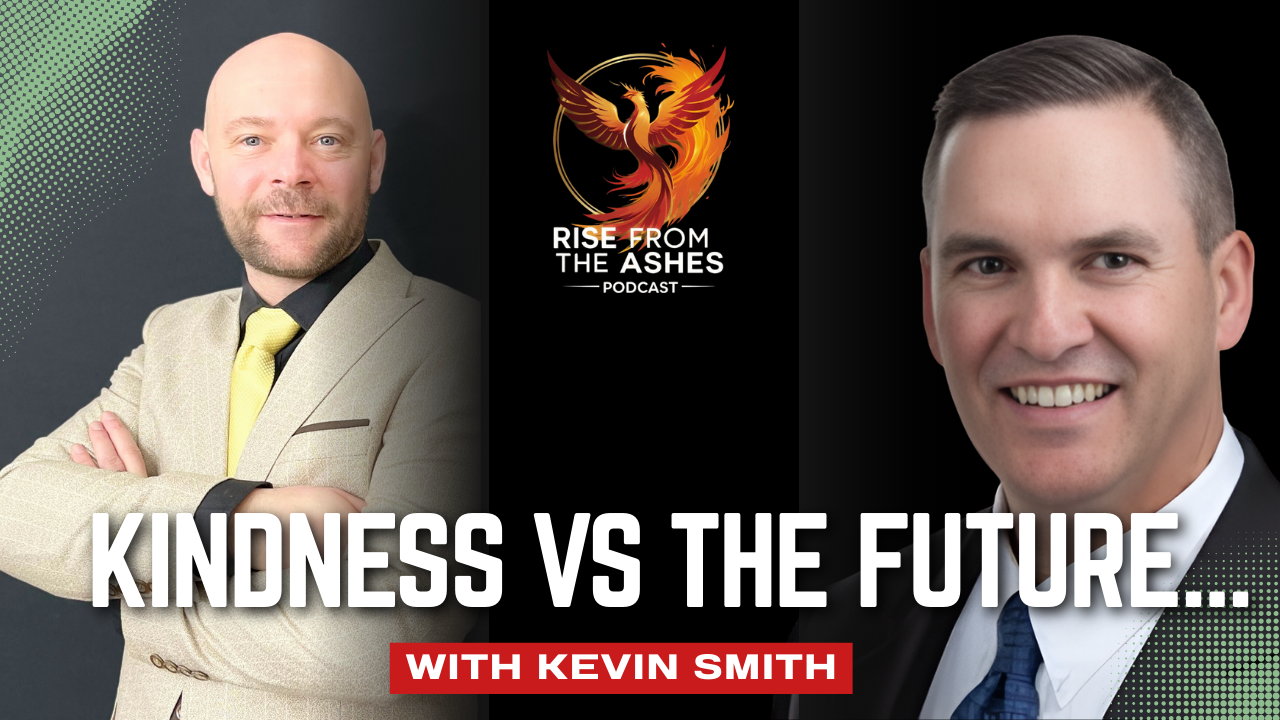
Kevin Smith has a definition of community most people haven’t heard. He says a community is any place where two or more people need each other to thrive. Your family is one. Your kid’s classroom is one. Your workplace, your town, your country, the whole world — all of them are communities by that test. And every one of them, he argues, is running low on the same thing.
He calls it an epidemic of empathy erosion. When he was growing up, mass school shootings were not something you read about or heard about. Now they happen often enough that people are getting numb to them. Kevin’s warning is sharp: getting numb to something can never make it normal. And a society that keeps drifting in that direction does not end well.
In the second part of his conversation on Rise From The Ashes, Kevin lays out why he still believes the drift can be reversed — and what he thinks it will take.
His first point is about how the brain works. He says it can be rewired toward kindness through repetition and reminder, and that one of his Kindness Worldwide ambassadors, Dr. Jen Razer, studies the science behind exactly that. The exceptions, he’s blunt about: people in the dark triad — narcissistic, Machiavellian, psychopathic — are not who this is for. Everyone else can be reached.
His second point is about children. Kevin believes people are born inherently good and that hate is conditioned into them later by circumstance and the people shaping their values. He uses a hard example — a newborn Israeli baby and a newborn Palestinian baby know nothing but joy and need; the animus is taught. His conclusion follows directly: if hate can be taught, kindness can be taught, and the place to start is the future generations, in the classroom, alongside the academics.
His third point is the one that makes the rest usable. Kevin decided “kindness” was too broad a word to hold anyone accountable with. So he broke it into what he calls the eight characteristics: gratitude, patience, forgiveness, empathy and compassion, respect, joy, generosity, and service. With those, “that’s not kind” stops being vague. It becomes specific and measurable — and, he argues, it becomes a lens for public policy and for judging the people we elect. Are they uniting or dividing? Are they part of the problem or the solution?
By day, Kevin runs Smith Wealth Advisory Group, a practice he built from scratch over 25 years with a team of six he describes as family. He doesn’t treat his business and his nonprofit as a contradiction. He calls himself the holding company: both entities run on one value system — that the meaning of life is to live it in a way that makes a meaningful difference. As a wealth advisor, that means helping people turn money into meaningful life experiences. As a nonprofit founder, it means building something from scratch again, this time without the ceiling on how many people it can reach.
He’s candid about the strain. Kindness Worldwide, he says, is all heart and no staff. He has been funding most of it himself, and he knows that cannot continue. For the mission to outlive him — he says if Kindness Worldwide doesn’t exist in 200 years, he failed — other people have to stop waiting to be inspired and start carrying it with him.
His warning about AI is the part that stays with people. Kevin’s view is that AI is an amplifier, not a fixer — feed a bad system into it and it amplifies the bad; feed in the good and it amplifies that. He believes that as it grows more capable, it may one day ask whether humanity is worth saving, and that the honest answer, on our current trajectory, would not be reassuring. His response is not despair. It’s agency: once you become aware you’re being conditioned by what you watch and read, the control shifts back to you.
He closes on the end of life. He asks what we want said at our funeral, and answers it himself: not the money, the cars, or the homes — the lives you touched and how you made people feel. And then the line this show keeps returning to, which he earned in his own words: every one of us is a miracle, because the odds of any of us being born at all are almost zero, and yet here we are.
Questions listeners ask
What does Kevin Smith mean by an epidemic of empathy erosion? Kevin argues that society is trending toward less empathy over time, pointing to how people have become desensitized to events like mass school shootings that were once unthinkable. He says getting numb to something can never make it normal, and that the trend can be reversed by deliberately teaching and modeling kindness.
What are Kevin Smith’s eight characteristics of kindness? Kevin breaks kindness into eight parts: gratitude, patience, forgiveness, empathy and compassion, respect, joy, generosity, and service. He created them because he felt “kindness” was too broad a word to hold people accountable with, and these specific elements make it possible to name exactly when someone is not being kind.
How does Kevin Smith balance his wealth advisory business and Kindness Worldwide? Kevin describes himself as the holding company, with Smith Wealth Advisory Group and Kindness Worldwide as separate entities that run on the same value system: living life in a way that makes a meaningful difference. The skills he used to build a 25-year wealth practice are the same ones he is now using to scale the nonprofit.
Hear the full conversation in their own words.
Rise From The Ashes on YouTube — subscribe here: https://www.youtube.com/@risefromtheashespodcast