Quick take
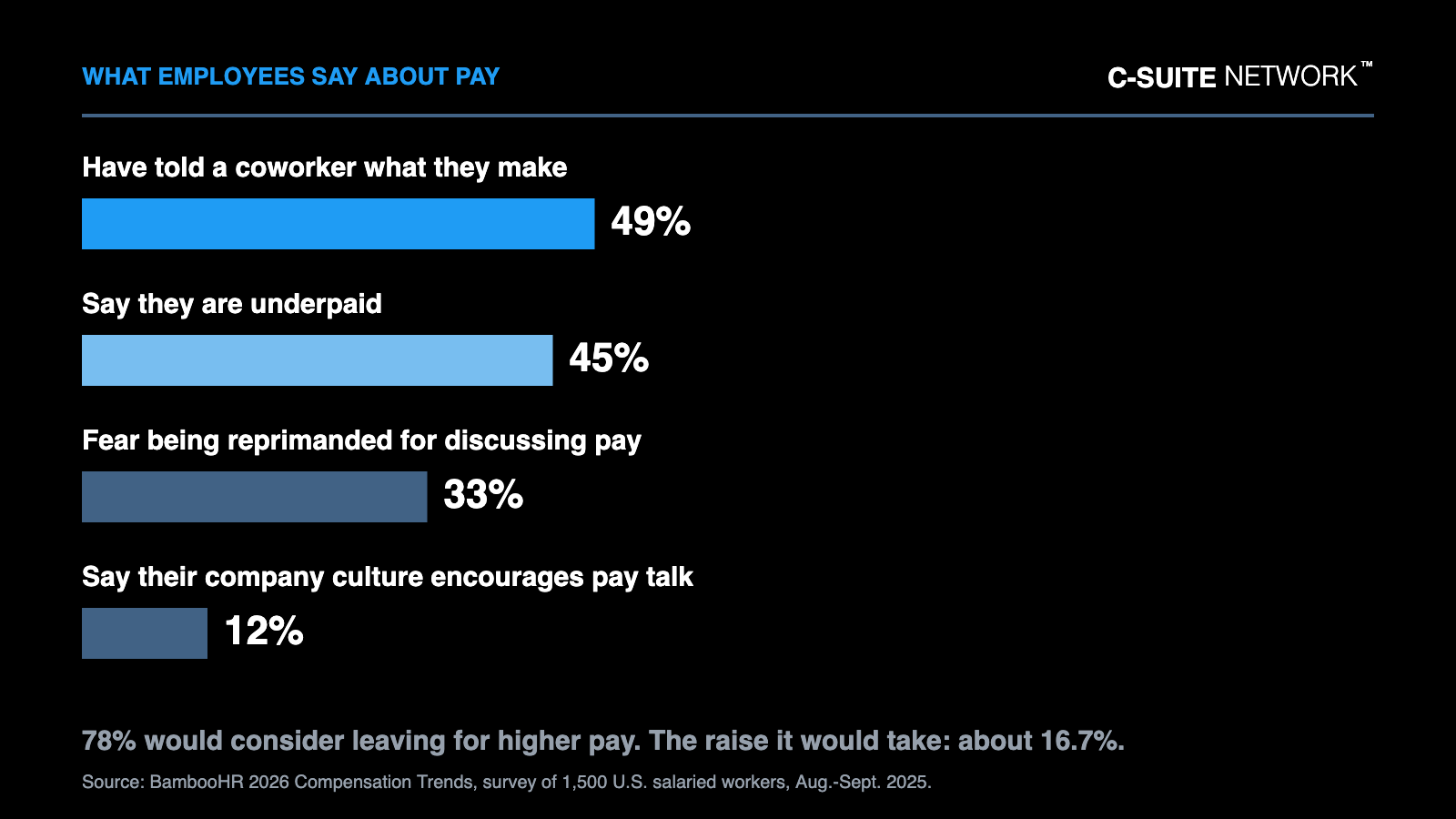
- About half of salaried workers, 49%, have already told a coworker what they make, according to a BambooHR survey of 1,500 U.S. employees.
- Here’s what many owners don’t know: for most private-sector employees, federal labor law protects that conversation. A policy that bans it is unlawful, according to the National Labor Relations Board.
- Why it matters now: More states require pay ranges in job ads every year. The question isn’t whether your people will compare paychecks. It’s whether your pay makes sense when they do.
A manager posted a question in Glassdoor’s community recently that’s probably been asked in a lot of break rooms. A new hire had asked them twice whether they knew what their coworkers made. Is that really an appropriate question?
Whether it’s polite is up for debate. Whether it’s allowed isn’t. And if you own the business, that new hire’s question is about to become your question.
You can’t tell them to stop
The National Labor Relations Act has protected workers who band together over pay and working conditions since 1935. Talking about wages with coworkers counts. According to the NLRB, if you’re an employer covered by the law, you can’t:
 Be our guestYour next big opportunity could be in a room you're not in.Meet CEOs, founders and owners at a reception in your city or online. Your first event is on us.Request my guest seat →
- Have a policy that bans employees from discussing pay
- Require them to get permission first
- Punish, threaten or question them about those conversations
- Bury a pay-secrecy clause in a handbook, offer letter or severance agreement
The NLRB says even a rule that “could” discourage pay talk may break the law, and that a rule you never enforce can still count. The law applies whether or not your business has a union.
Your employees may not know this either. In the same BambooHR survey, 33% said they fear being reprimanded for discussing pay. Only 12% said their company culture encourages it.
The numbers are already out
Do the math on your own team. If 49% of employees have told a coworker their pay, then on a 20-person team, roughly 10 people have already shared their number with someone. That information doesn’t stay in one conversation.
And the job ads are doing the rest. Colorado started requiring pay ranges in job postings in 2021. California, Washington and New York followed in 2023, then Hawaii and Maryland, then Illinois in 2025, according to Rippling’s state tracker. New Jersey, Vermont and Massachusetts added their own rules in 2025, and Delaware’s takes effect in 2027, according to the law firm Hunton Andrews Kurth.
So when you post a job at $60,000 to $75,000, the people already doing that job can read it too.
The twist owners don’t expect
You might assume more pay talk means higher pay across the board. The research says it’s more complicated.
Economists Zoë Cullen and Bobak Pakzad-Hurson studied state laws protecting workers’ right to ask about coworkers’ pay. They found the laws led wages to decline by about 2% overall. Their explanation: when every deal can be compared, an employer can credibly say no to one person’s big raise, because saying yes means reopening everyone else’s pay too. The gap between coworkers tends to shrink, but so does room for one-off deals.
That’s the real lesson. Transparency doesn’t have to cost you more. But it does make every exception visible. Say you quietly gave one person $8,000 more because they negotiated hard. That’s the gap everyone else will ask about.
What happens if they don’t like what they hear
In the BambooHR survey, 45% of workers said they’re underpaid. And 78% said they’d consider leaving for higher pay, with the average raise it would take to move about 16.7%. On a $60,000 salary, that’s about $10,000.
That’s the number to keep in mind when someone finds out a coworker makes more. If you can’t explain the difference, a competitor may be happy to close it for them.
Before Your Next Meeting
- Check your paperwork. Search your handbook, offer letters and severance agreements for anything that tells people to keep pay confidential. Have your employment lawyer review what you find.
- Tell your managers. Make sure no one on your team is telling employees to stop discussing pay. Many managers think they’re supposed to.
- Write down the why. For each role, write one sentence explaining what drives pay: experience, results, market rate. If you can’t explain a gap, fix it before someone asks.
- Know your posting rules. If you hire in any state with a pay-range law, or post remote jobs people there can apply for, check what your ads need to include.
This article is general information, not legal advice. Talk to an employment lawyer about your specific situation.
Sources: NLRB: Your Right to Discuss Wages; NLRB: Interference with Employee Rights; BambooHR 2026 Compensation Trends (survey of 1,500 U.S. salaried workers, fielded August and September 2025); Cullen and Pakzad-Hurson, “Equilibrium Effects of Pay Transparency,” NBER; Rippling; Hunton Andrews Kurth. Featured photo: Vitaly Gariev on Unsplash.
 The Boardroom Needs the Ground: By Mark Madrid
 How Fractional Executives can Help Your Company Thrive: Key FactsBy Paul Whitley
 Do Not Cut 25% of Your Workforce YetBy Mahesh M. Thakur
 C-Suite TV · 22 minProject Calm: Johnny C. Taylor Jr. on Leadership, Culture, and the Future of Work
 C-Suite Radio · Manage Self, Lead Others: Emotional Intelligence and Leadership for Managers199 Look for the Second Right Answer--Nina Sunday with Dixie Carlton
Meet the founders, CEOs and operators behind stories like this one. Next reception: Fort Worth Executive Reception, Tue, Nov 17.
Attend as a guestMembership: $100/mo →