Quick take
- Laika, the Oregon studio behind Coraline, just released Wildwood, a stop-motion film it spent 16 years developing and reportedly about $100 million to make.
- The studio is owned by Nike co-founder Phil Knight and run by his son, Travis. That ownership is the reason a movie like this exists at all.
- Why it matters now: Most businesses never get to choose their timeline. Laika’s backer gave it one most companies could only dream of, and it shows exactly what patient money can buy, and what it costs.
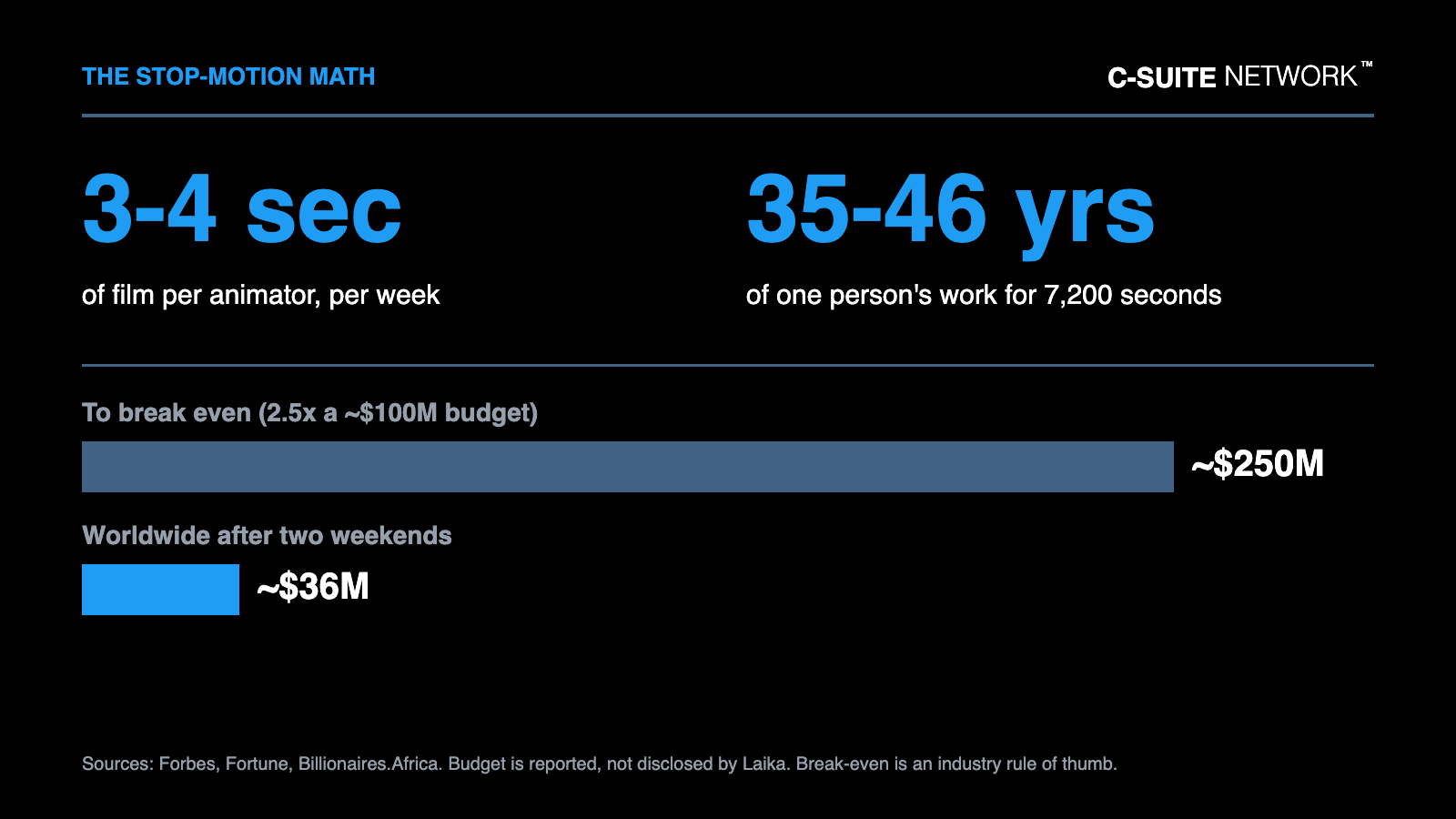
Here’s how stop-motion works. An animator moves a puppet a tiny bit, takes a picture, moves it again, takes another picture. Thousands of times. At Laika, each animator produces about 3 to 4 seconds of finished film a week.
Now do the math on Wildwood, which runs over two hours. Two hours is 7,200 seconds. At 3 to 4 seconds per animator per week, that’s 1,800 to 2,400 weeks of animating. Divide by 52, and it comes to roughly 35 to 46 years of one person’s work, for the animation alone.
The details are just as wild. The General, an eagle voiced by Angela Bassett, has more than 9,000 feathers placed by hand across two puppets, according to Forbes. The film used 231 puppets and 136 sets, all built at Laika’s campus outside Portland.
The box office math
Wildwood opened October 23 to about $12.3 million in the U.S. and Canada, according to Fortune. That beat analysts’ forecasts. After two weekends, it had about $25.9 million at home and nearly $36 million worldwide.
Here’s the catch. Theaters keep about half of each ticket. A common rule of thumb says a film needs to gross about 2.5 times its budget to break even in theaters. On a $100 million film, that’s about $250 million.
Laika has been here before. Its first feature, Coraline, earned about $75 million in the U.S. in 2009. Each film since has earned less at home: ParaNorman, The Boxtrolls, Kubo and the Two Strings, then Missing Link, which took in $16.6 million in 2019. All five were nominated for the Oscar for Best Animated Feature. Laika is private and doesn’t report its finances.
Why this is possible
Phil Knight invested in Laika’s predecessor, Will Vinton Studios, in 1998 and became majority owner in 2002. Travis Knight started there as an animator. Today he’s Laika’s president and CEO, directed Wildwood, and has sat on Nike’s board since 2015.
That ownership is the whole story. A public studio answering to shareholders every quarter can’t spend 16 years on one film. A studio backed by one of the richest founders in America can. Travis Knight called the movie “a celebration of artistry over algorithms.”
And sometimes patient money pays off in ways a quarterly report would miss. In 2024, Coraline came back to theaters for its 15th anniversary and grossed more than $50 million worldwide, 15 years after it first came out. Laika had built something people wanted to see again.
What owners can take from it
You don’t need a billionaire backer to learn from Laika. Every business makes the same trade on a smaller scale: how much do you put into the work that takes years to pay off, and how much do you need back this quarter?
The answer depends on who’s paying. Your bank, your investors and your own bank account all set a clock on your business, whether you notice it or not. Laika’s clock runs on a 16-year timeline because its owner chose that. Most owners don’t get that luxury, which is exactly why it’s worth knowing what clock you’re on before you start the long project.
Before Your Next Meeting
- Know your clock. Who funds your business, and how long will they wait for a return? Write the answer down.
- Do the break-even math first. Hollywood’s rule of thumb is 2.5 times budget. What’s your multiple on your biggest project, and how far are you from it?
- Look for your Coraline. Is there work you did years ago that customers still love? It might be worth bringing back.
- Protect one long bet. If everything you do has to pay off this quarter, you’ll never build the thing people come back to 15 years later.
Sources: Fortune; Forbes; Billionaires.Africa; Wikipedia. Featured photo: James Coleman on Unsplash.
 The Boardroom Needs the Ground: By Mark Madrid
 Is It Worth Hiring a Career Coach? An Honest AnswerBy Kate Rosenberg
 The CMO’s New Mandate: Community, Credibility, and Cutting Through the AI Noise By Jeffrey Hayzlett · Chairman
 C-Suite TV · 20 minRiches in the Niches: How Smart Strategy Keeps Associations Ahead of Disruption with Ralph Vasami
 C-Suite Radio · Freedom Entrepreneurship040-How to Make Better Business Decisions in Uncertain Times
 Chairman's Corner · Jeffrey HayzlettThe Typical Small Business Still Sells for Less Than a House. Wall Street Just Figured Out Why That’s a Bargain.
Meet the founders, CEOs and operators behind stories like this one. Next reception: Fort Worth Executive Reception, Tue, Nov 17.
Attend as a guestMembership: $100/mo →