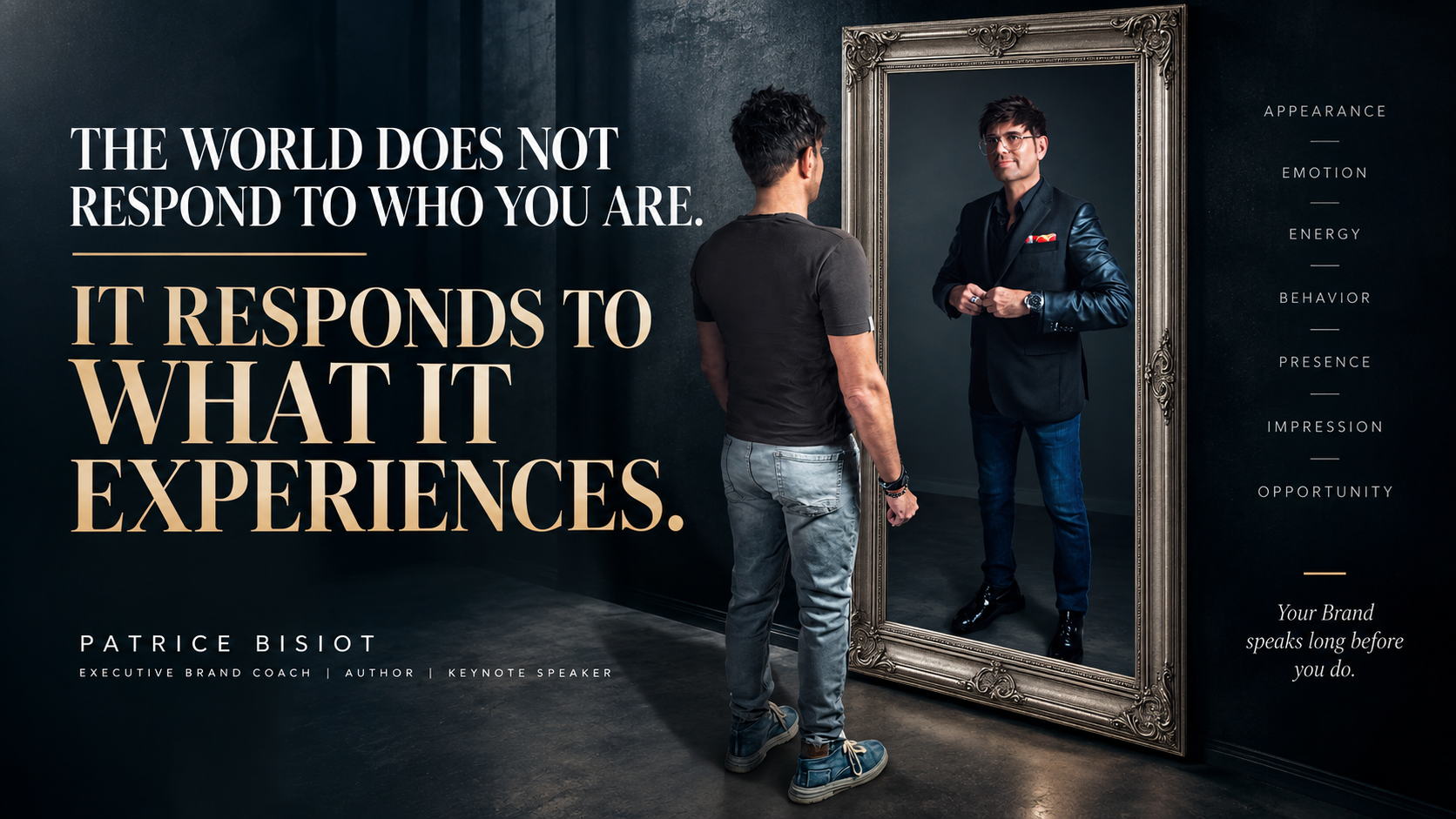
Why Branding is not what you say about yourself—it is what another human being experiences.
One of the greatest misconceptions about Branding is that it begins with a logo.
A website. A business card. A social profile. A marketing campaign.
Those things are not a Brand.
They are expressions of a Brand.
A Brand exists before any of them because human beings were reading one another long before marketing existed. We interpret signals. We form impressions. We decide what feels credible, safe, valuable, trustworthy, authoritative, or uncertain—often before we can explain why.
That means Branding is not fundamentally a marketing discipline.
It is a human behavior discipline.
People respond to experience
Imagine two leaders entering the same room with comparable expertise, comparable authority, and equally strong ideas.
One creates trust quickly.
The other must work much harder to establish the same credibility.
The difference is not automatically competence.
It may be experience.
People do not encounter our résumé, intentions, values, intelligence, and capability as separate facts. They encounter a human being. They interpret the totality of what that person communicates: language, tone, behavior, emotional regulation, appearance, attention, consistency, judgment, and presence.
Together, those signals create an experience.
And the world responds to that experience.
The story begins before your story
When we meet someone, we do not wait patiently for all the evidence before forming an impression.
Our nervous system begins interpreting immediately.
Is this person certain or hesitant?
Are they listening or performing?
Does what they say match what I am experiencing?
Do I trust them?
Should I move closer, remain cautious, follow, challenge, buy, hire, promote, recommend, or walk away?
An impression forms first. Then the interaction begins supplying evidence.
This is why someone can possess extraordinary value and remain underestimated. The value exists internally, but the external experience does not make that value easy to recognize.
Value hidden from experience creates the same practical outcome as value that does not exist: it cannot influence the decision.
Branding is the relationship between truth and perception
This is where the conversation about Branding becomes far more consequential than logos or visibility.
Branding is the relationship between what exists and what people experience.
If those two things are aligned, people receive a clearer signal.
If they are misaligned, friction appears.
A leader may care deeply about people while communicating impatience.
An entrepreneur may be extraordinarily capable while appearing uncertain when discussing their value.
An organization may describe itself as innovative while forcing customers through an experience that feels rigid and outdated.
In every case, intention exists.
But intention is not what the other person experiences.
The world cannot respond to the truth it cannot recognize.
Signal has economic consequences
This is not cosmetic.
Perception influences whether people trust a recommendation, accept a price, follow a leader, remain with an organization, refer a client, extend an opportunity, or advocate for someone when they are not in the room.
Two advisors can offer comparable expertise and command different fees.
Two candidates can hold comparable qualifications and create different levels of confidence.
Two leaders can communicate the same strategy and produce dramatically different levels of commitment.
The visible outcome may be revenue, retention, influence, promotion, loyalty, or opportunity.
The invisible variable is the experience that helped produce it.
That is why Brand alignment has economic value.
The objective is not performance
Once people understand Branding this way, the objective changes.
It is no longer: How do I make myself look impressive?
It becomes: How accurately does the experience I create communicate the value that is already there?
That is a much harder question.
It requires self-awareness, observation, emotional intelligence, judgment, and congruence. It requires understanding not only what we intend to communicate, but what other people are actually receiving.
The goal is not to manufacture an identity.
It is to remove the distortion between identity and experience.
That is alignment.
Your Brand is already in the room
Every person has a Brand because every person creates an experience.
The question is not whether you have one.
The question is whether the experience people have of you reflects the truth of your value.
Branding begins long before the logo.
It begins in the moment another human being encounters you and starts interpreting what your signals mean.
The world does not respond to who you know yourself to be.
It responds to what it experiences.
And when those two realities align, value becomes easier to recognize, trust becomes easier to establish, and influence no longer has to fight through contradiction.
Patrice Bisiot
Executive Brand Coach | Author | Keynote Speaker
Author of Mind Your Brand