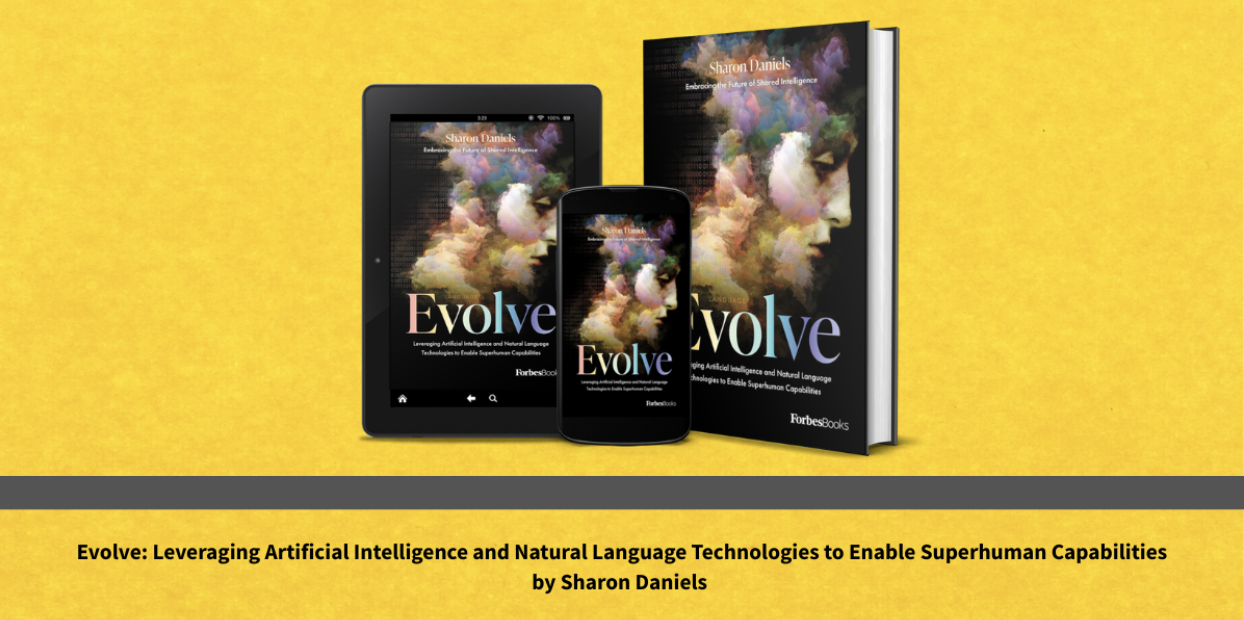
There is a particular kind of clarity that comes from someone who has spent three decades not just thinking about a technology but actually building it, selling it, and watching it change the way organizations understand and communicate about their own data. Sharon Daniels is a technology CEO who has been working at the intersection of artificial intelligence and natural language generation long before most people knew those words belonged in the same sentence, and Evolve is the book that emerges from that accumulated immersion. It is not a breathless account of AI’s promise or a cautionary tale about its dangers. It is something considerably more interesting and considerably more useful: a serious and warm-hearted argument for why the relationship between language and technology is the most consequential thing happening in human civilization right now, and why understanding it changes everything about how you relate to both.
Reading this book produces a specific quality of reorientation that the best technology writing always generates at its most effective. Daniels is not asking you to be afraid of AI or uncritically excited about it. She is asking you to understand it, specifically through the lens of language, which turns out to be precisely the lens that makes the whole landscape suddenly legible. Her argument that humanity is defined by language, and that for the first time in human history the power of language has been captured in software and moved outside the human mind into the digital mind, is not a marketing claim for her company’s technology. It is a genuine historical observation with profound implications for how we think about what AI is and what it means for who we are.
The themes the book explores are ones that resonate far beyond the domain of technology leadership. At its core Evolve is about the symbiotic relationship between human intelligence and artificial intelligence, about the specific ways in which combining human knowledge and skills with AI’s speed and scale produces capabilities that neither could achieve alone. That framing, which Daniels captures in the elegant shorthand of Hu plus AI equals superhuman, is one of the book’s most lasting contributions to a conversation that too often gets stuck in the binary of replacement versus augmentation without ever quite articulating what genuine partnership between human and artificial intelligence could actually produce.
Daniels writes with the fluency of someone who has spent her career translating between the technical and the human, between what the technology can do and what it means for the people who will live and work alongside it. Her use of language’s history as the organizing backdrop for the book is one of its most inspired structural choices, giving readers a way to understand Natural Language Generation not as an isolated technological development but as the latest and most significant chapter in a story that began with the first human beings who discovered that sounds could carry meaning. That historical grounding makes the contemporary developments she describes feel genuinely momentous rather than simply novel.
Evolve is the book for anyone who has been watching the AI conversation accelerate and has felt something was missing from most of the accounts they were reading. What was missing, it turns out, was exactly this: a clear-eyed, historically grounded, humanistically oriented account of why language is the key to everything, written by someone who has been building the proof of that claim for thirty years.
If you have been watching the AI conversation accelerate and felt that something essential was missing from most of the accounts you were reading, Evolve by Sharon Daniels is the book that supplies exactly what was missing. Grab your copy on Amazon today and discover why language is the key to everything happening in artificial intelligence right now and what that means for you.