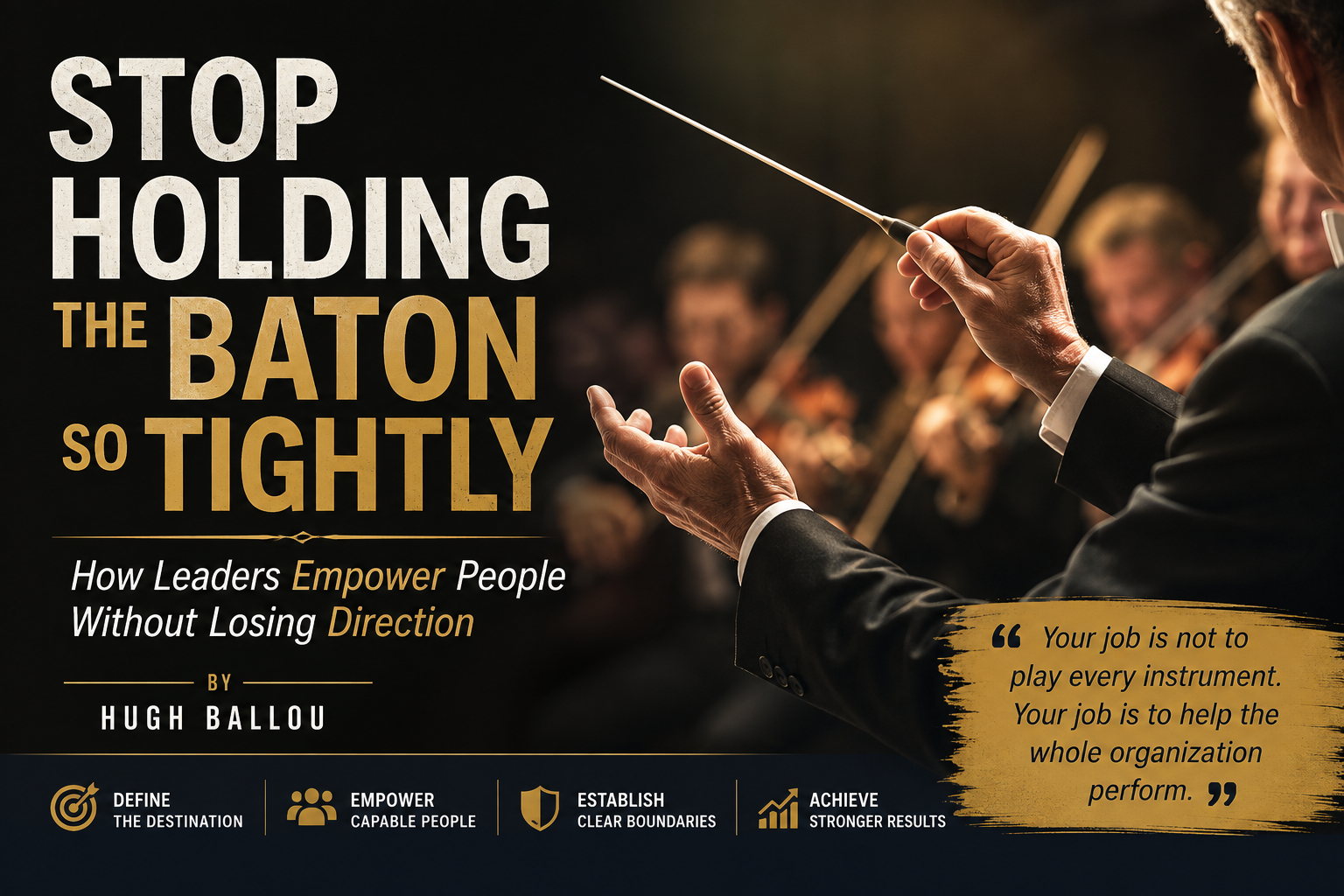
Stop Holding the Baton So Tightly
How Leaders Empower People Without Losing Direction
By Hugh Ballou
One of the most common contradictions I see in leadership is this: leaders say they want people to take initiative, yet they continue to make nearly every important decision themselves. They want staff and volunteers to step up, but then they rewrite the work, change the approach, or require approval at every stage. From the leader’s perspective, this can feel like protecting quality. From the team’s perspective, it often feels like, “You don’t really trust me.” Over time, people stop taking initiative because they learn that the safest course is to wait for the leader.
That is how capable leaders become bottlenecks. The problem is not that they care too much. It is that too much of the organization’s control is located in one person instead of in the leadership system. The answer is not to abandon standards or simply “let go.” The answer is to build enough clarity into the organization that people can act with confidence without the senior leader having to remain involved in every move.
The Executive Cost of Being Indispensable
Being indispensable can feel flattering. It can also be dangerous. In many organizations, especially entrepreneurial companies, nonprofits, churches, and founder-led organizations, the senior leader knows the history, the relationships, the unwritten rules, and the reasons behind past decisions. In the early days, that leader may have done almost everything. The problem comes when the organization grows but the leadership habits do not.
When every significant decision comes back to the same person, the organization slows down. Staff members wait for answers. Volunteers become hesitant. Emerging leaders do not develop judgment because someone above them is always making the final call. Eventually, the leader is working harder and harder while wondering why everyone else seems reluctant to take ownership.
I do not see that as good stewardship. Stewardship does not mean personally touching every decision. It means creating the conditions in which good decisions can be made throughout the organization. There is an important difference between being accountable for the result and controlling every action that produces the result. Strong leaders learn to put appropriate control into the system rather than keeping it in themselves.
Why Capable Leaders Still Hold On
There are understandable reasons leaders hold on too tightly. One is speed. “It is faster if I just do it myself” may be absolutely true today. But if we keep choosing today’s speed over tomorrow’s capacity, we never develop the people who could carry the responsibility later. We save ten minutes now and create another year of dependence.
Another reason is concern about quality. Leaders know that work done by the team can reflect on the whole organization and on them personally. So they improve the wording, rearrange the presentation, revise the proposal, or change the plan until the result looks exactly the way they would have done it. The danger is that the team hears a message the leader may never intend to send: “Your work is not really finished until I make it mine.”
There can also be an identity issue. Some leaders have become accustomed to being the person everyone needs. They solve the problem, rescue the project, answer the difficult question, and step in when something goes wrong. That feels useful, and sometimes it is useful. But leadership is not measured by how many people need us. It is measured, in part, by how many people become capable because we led them well.
Replace Personal Control with Leadership Architecture
Delegation works best when it begins with the outcome, not the activity. I have often seen leaders tell people what to do in great detail without first explaining what success is supposed to look like. That produces compliance, not ownership. When people understand the destination, the reason it matters, and the standard to be achieved, they can bring their own judgment and creativity to the work.
The next step is to make the boundaries clear. Some things are non-negotiable. There may be budget limits, legal requirements, ethical standards, brand commitments, board policies, or strategic priorities that must be honored. Say so. But once those boundaries are clear, give people room to operate inside them. If several methods will achieve the desired result, there is little leadership value in insisting that everyone use the method you would have chosen.
Decision rights need the same clarity. Who actually decides? Who should be consulted? Who simply needs to be informed? A surprising amount of organizational drag comes from the fact that people do not know the answers to those three questions. So they schedule another meeting, copy another person, or send another email asking for permission. Clear decision rights speed the work and reduce unnecessary executive involvement.
Finally, define what good looks like before the work begins. Leaders sometimes become frustrated because a deliverable does not meet a standard that was never clearly communicated. Standards hidden in the leader’s head are not standards the team can reliably follow. Clarity up front is far more effective than correction at the end.
The Conductor Principle
My years as a musical conductor have given me a very practical picture of leadership. A conductor does not create a great performance by playing every instrument. In fact, the conductor may not be the best player of any instrument in the orchestra. The work is to prepare the ensemble, establish the tempo, communicate the interpretation, cue the entrances, listen for balance, and keep the whole group aligned around the same result.
Every musician still has to prepare and play the part. The conductor cannot do that work for them. What the conductor can do is create the environment in which individual excellence becomes collective performance. That is a useful way for senior leaders to think about their role. Our value is not in proving that we can do everybody’s job. Our value is in helping capable people do their work together with clarity and purpose.
This is what I often describe as the shift from doer to conductor. It does not mean becoming detached from the work. It means becoming more intentional about the work that belongs uniquely to the leader: defining direction, building alignment, developing people, protecting values, and ensuring that the parts of the organization work together.
Empowerment Needs Guardrails
Empowerment without clarity can create confusion, so I am not suggesting that leaders simply step away. People do their best work when they know both the freedom they have and the boundaries around that freedom. Staff members should be able to own outcomes rather than wait for a new set of instructions.
Volunteer leaders should understand which decisions they can make without coming back for repeated permission. Senior leaders should know when they will review progress rather than feeling compelled to monitor it continuously.
This is where agreed checkpoints are helpful. A checkpoint is not micromanagement. It is simply a planned point at which the leader and the person responsible for the work review progress, surface issues, and make any needed adjustments. Depending on the project, that might be at the first draft, halfway through the work, or a week before completion. The important point is that both people know in advance when the review will happen.
That creates accountability without dependency. The person doing the work owns the result. The leader retains appropriate visibility. Neither person has to guess when communication is expected. In my experience, that kind of clarity actually increases trust because people are not constantly looking over their shoulder wondering when the leader will step in.
The Leadership Question to Ask This Week
A useful leadership exercise is to look at your own calendar, inbox, and decision load and ask: What am I still holding that someone else should own? It might be a meeting, a client relationship, a recurring approval, a program, a communication process, a partnership, or a project that keeps coming back to you for small decisions.
When you identify one, do more than hand off the task. Transfer the outcome. Give the person the authority that appropriately belongs with that outcome. Clarify the standards and the boundaries. Agree on the checkpoint. Then allow that person to lead. Their approach may not look exactly like yours, and that is not necessarily a problem. Different is not the same as wrong.
One of the clearest signs that leaders are developing other leaders is that excellent work begins happening without everything carrying the senior leader’s fingerprints. That is organizational capacity. That is how leadership multiplies. And that is how an organization becomes stronger than the individual at the top.
So here is the question I would put in front of every executive this week: Where am I still the bottleneck because I have confused control with leadership?
Choose one responsibility you normally hold closely and redesign it as an owned outcome with clear authority, clear standards, and one scheduled checkpoint.
Then loosen your grip on the baton. Your job is not to play every instrument. Your job is to help the whole organization perform.
__________________________________________________________________________________________________________________
Hugh Ballou is The Transformational Leadership Strategist, author, and founder of SynerVision International, Inc. and SynerVision Leadership Foundation. He empowers leaders across sectors to transform vision into high-performing results.
Article is based on my new series, “The Nonprofit Success System” – Get It on Amazon – https://www.amazon.com/dp/0977214877
For a list of resources go to – http://AboutHugh.com
#Leadership #HighPerformingTeams #Trust #Empowerment #Podcast #OrchestratingTeams #Teamwork #Transformation #Authenticity