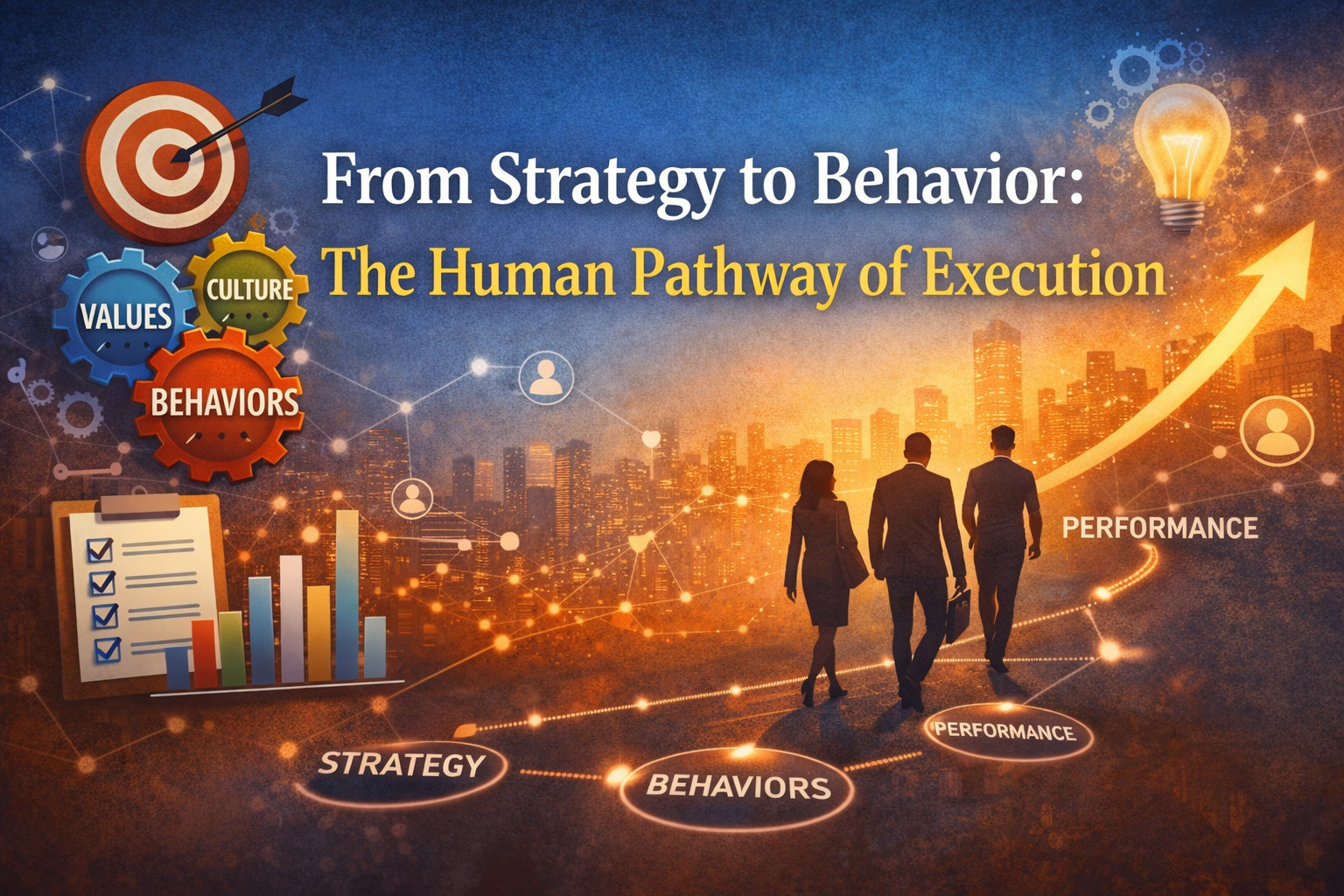
From Strategy to Behavior: The Human Pathway of Execution
By Hugh Ballou
“Your strategic plan is not complete until you’ve defined the behaviors, metrics, and people responsible for bringing it to life. It’s the integration of strategy to performance.” – Hugh Ballou
A strategic plan often looks impressive on paper—vision statements, strategic priorities, timelines, and aspirational outcomes. Yet many plans fail not because the strategy was flawed, but because leaders stopped at intention rather than translating strategy into daily behavior. Strategy does not execute itself. People do.
The first pathway to effective implementation is behavioral clarity. Leaders must move beyond asking, “What do we want to achieve?” and ask, “What must people consistently do differently for this strategy to succeed?” This requires defining observable; repeatable behaviors aligned with strategic goals. If collaboration is a priority, what behaviors demonstrate collaboration? If innovation matters, what actions signal permission to experiment and learn?
Leadership processes must intentionally shape behavior. This includes modeling desired actions, reinforcing expectations through meetings and communication, and aligning recognition with the behaviors that advance the plan. Culture is not a vague concept—it is the cumulative result of repeated behaviors that leaders tolerate, reward, or correct.
A practical process begins with behavioral mapping. For each strategic objective, leaders identify three to five critical behaviors required at every level of the organization. These behaviors are then integrated into job descriptions, onboarding, performance conversations, and team norms. When behaviors are named and normalized, strategy becomes actionable.
The final step is accountability with dignity. Leaders must create feedback loops that support learning rather than fear. When behaviors drift, the response is coaching, not blame. This reinforces ownership while preserving trust.
Strategy succeeds when leaders understand that execution is less about control and more about alignment. Defining behavioral pathways turns vision into lived practice and transforms plans into performance.
Summary Notes:
- Strategy fails without defined behaviors
- Leaders shape execution through modeling and reinforcement
- Behavioral clarity bridges vision and action
- Accountability should support learning, not fear
Based on “Leaders Transform: Mastering the Art of Influence, Book 3: Leadership Systems: Orchestrating Success” by Hugh Ballou
Hugh Ballou is The Transformational Leadership Strategist, author, and founder of SynerVision International, Inc. and SynerVision Leadership Foundation. He empowers leaders across sectors to transform vision into high-performing results.
Article is based on my new series, “Leaders Transform: Mastering the Art of Influence” – http://LeadersTransform.info
For a list of resources go to – http://AboutHugh.com
#Leadership #HighPerformingTeams #Trust #Empowerment #OrchestratingTeams #Teamwork #Transformation #Authenticity #Strategicexecution #leadershipbehavior #organizationalculture #accountability #changeleadership