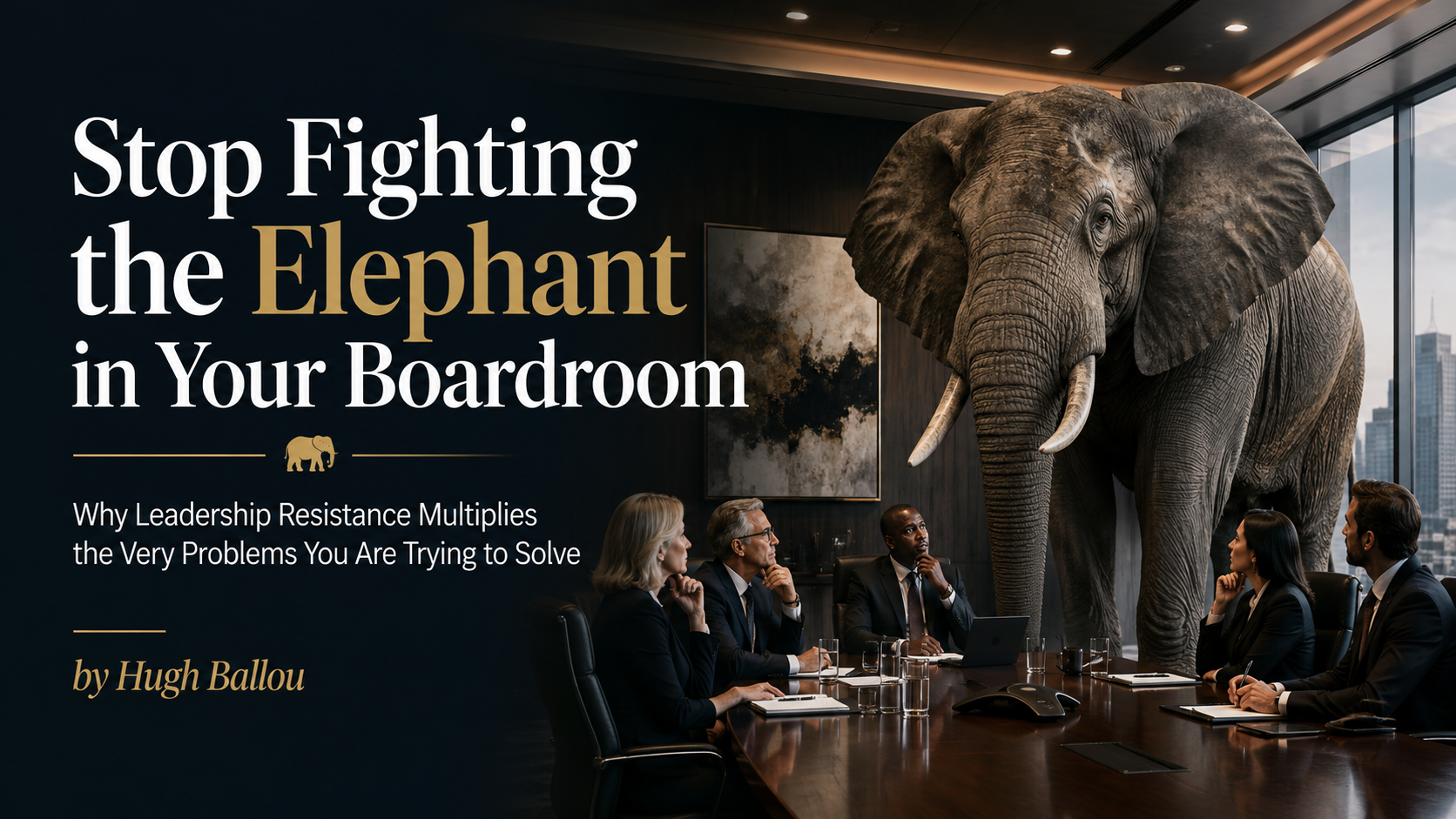
Stop Fighting the Elephant in Your Boardroom
Why Leadership Resistance Multiplies the Very Problems You Are Trying to Solve
By Hugh Ballou | Chair, C-Suite Nonprofit Prosperity Council
There is an old saying every leader has heard: do not think of an elephant. The moment you hear it, the elephant is the only thing in the room. The harder you try not to think of it, the more space it occupies.
This is the quiet trap of modern leadership. We are trained to suppress, resist, and push past whatever is uncomfortable in our organizations. A difficult board member. A program that is no longer producing impact. A donor relationship that has quietly eroded. A staff dynamic that everyone senses but no one names. We are taught that strong leadership means powering through these realities, redirecting attention, and keeping the room positive.
It does not work. And in the C-Suite Nonprofit Prosperity Council, where I have the privilege of convening executives from across the sector, this pattern is one of the most consistent obstacles we see to organizational prosperity.
The Old Shibboleth
The inherited model of leadership is built on resistance. Do not show weakness. Do not let conflict surface. Do not slow down. Do not name the problem until you have the solution. Do not admit that the strategic plan from three years ago is no longer working.
This is willpower leadership, and it is exhausting. It treats every uncomfortable reality as a threat to be defeated rather than information to be received. And as anyone who has tried not to think of an elephant knows, the harder we resist, the more energy we feed the very thing we are trying to suppress.
I have watched gifted executives spend years fighting elephants. The board chair whose tenure should have ended two cycles ago. The legacy program that consumes thirty percent of the budget and produces three percent of the outcomes. The development director who has not raised a major gift in eighteen months. Everyone in the organization knows. The CEO knows. But the official position is that everything is fine, the strategy is sound, and we just need to work harder.
Meanwhile, the elephant grows.
Acceptance is not surrender to dysfunction. It is the doorway to changing it.
The New Paradigm
There is a different way to lead, and it begins with a single shift in posture. Instead of starting with what we are against, we start with what is. We say yes to reality before we try to change it.
This is not positive thinking. It is not denial dressed up in better language. It is the strategic discipline of acknowledging what is actually happening in the organization before deciding what to do about it. The board member is disengaged. The program is underperforming. The donor pipeline is thin. The culture is anxious. These are facts. They are not failures of leadership to be hidden. They are data to be received.
When leaders make this shift, something remarkable happens. The energy that was being spent on resistance becomes available for response. The team that was performing alignment begins to perform honestly. The board conversation that was orbiting the real issue lands on it. The strategic plan stops being a defensive document and starts being a living one.
In the Council, we call this leading from yes rather than leading from no. It is the difference between a leader who is exhausted by the weight of what cannot be said and a leader who is energized by the clarity of what has been named.
Why This Matters for the C-Suite
Nonprofit C-Suite leaders carry a particular burden. The sector celebrates sacrifice, normalizes overwork, and often treats the appearance of optimism as a leadership virtue. Boards reward executives who project confidence and punish those who name complexity. Funders prefer success stories to honest assessments.
This creates a leadership culture in which the most senior people in the room are the least able to say what is true. The CEO performs certainty. The CFO softens the numbers. The development officer rounds up the pipeline. The program lead overstates impact. Everyone is fighting an elephant, and the organization slowly loses its capacity to see itself clearly.
The cost is enormous. Strategy becomes wishful. Risk becomes invisible. Innovation becomes impossible because innovation requires honest assessment of what is not working. And the leader, carrying the unnamed weight of all of it, moves steadily toward burnout.
The Practice of Naming What Is
The shift is simple to describe and demanding to practice. It requires four moves.
- First, name the elephant. In your next executive team meeting, identify the one reality everyone is working around. Say it out loud. Not with blame, not with urgency, just with clarity. The act of naming releases the energy that suppression has been consuming.
- Second, refuse the impulse to immediately solve it. Most leaders, having named a problem, rush to fix it. This is resistance in a new costume. Sit with the reality long enough to understand what it is telling you. What does the underperforming program reveal about how decisions get made? What does the disengaged board member reveal about how the board was recruited?
- Third, separate the thought from the identity. A struggling program is not a verdict on your leadership. A difficult board dynamic is not proof of your inadequacy. Let the information yield its wisdom without letting it define your worth.
- Fourth, move forward from yes. Once reality has been named and received, action becomes possible. Not reactive action driven by anxiety, but intentional action grounded in clarity. This is where strategic leadership actually begins.
Prosperity Requires Honesty
The C-Suite Nonprofit Prosperity Council exists to foster new thinking that produces new methods. Nowhere is this more urgent than in how leaders relate to the difficult realities inside their own organizations. The old shibboleth told us to fight, suppress, and push through. The new paradigm invites us to name, receive, and respond.
Prosperity in the nonprofit sector will not come from leaders who are better at hiding their elephants. It will come from leaders who are courageous enough to name them, wise enough to learn from them, and disciplined enough to move forward from yes.
The elephant in your boardroom is not your enemy. It is your most honest advisor. Stop fighting it. Start listening to it. And then lead.
________________________________________________________________________
Hugh Ballou is The Transformational Leadership Strategist, author, and founder of SynerVision International, Inc. and SynerVision Leadership Foundation. He empowers leaders across sectors to transform vision into high-performing results.
The article is based on “The Transformational Leadership Accelerator: The Fast Track to Leadership Excellence” a personal study course for leaders in all segments and in all levels of personal development. For more information about my courses, go to https://synervisionleadership.org/self-study-courses/
For a list of resources go to – http://AboutHugh.com
#Facilitation #Leadership #Development #ConsensusBuilding #Collaboration #TeamLeadership