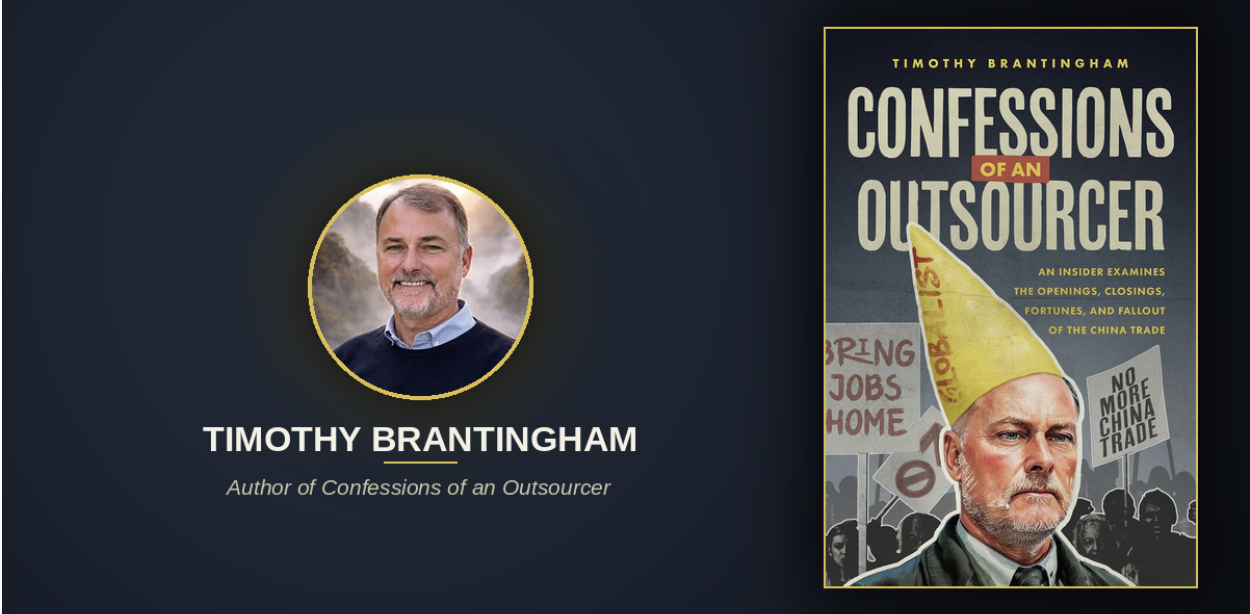
There is a particular kind of expertise that cannot be acquired in a think tank or a congressional hearing room. It lives in factory floors in Shenzhen, in hot pot dinners with suppliers in Suzhou, in the baijiu-soaked reality of how trade actually works between human beings who are trying to make money on both sides of the world’s most consequential economic relationship.
Timothy Brantingham has that expertise. And after watching the American conversation about China trade flatten into what he describes as body-slamming ghosts and political projections, he decided someone needed to say what he knew.
Confessions of an Outsourcer: An Insider Examines the Openings, Closings, Fortunes, and Fallout of the China Trade is the result. It is the work of a fourth-generation China Hand whose family has been woven into the US-Asia story for 125 years, born in Taiwan to Quaker missionaries, raised speaking Mandarin, educated at William and Mary, the University of Hong Kong, and Oxford, and spent thirty years actually doing the things most commentators only theorize about.
The Moment It Crystallized
Timothy traces the moment the gap between political narrative and ground-level reality became impossible to ignore to a site evaluation in Suzhou in 2016. In the morning, he sat in a conference room with city officials who parroted government talking points, insisting there was no IP problem in China and that it was an American story. That evening, over hot pot and baijiu with a factory supplier named Mr. Liu, the same topic produced a completely different conversation. Mr. Liu scoffed at the officials, asked Timothy to connect him with an American immigration lawyer, talked about sending his son to a US university, joked about Trump’s tweets, and looked across the table and said: those guys have to say that stuff. But you and me? We’re just trying to make money.
That contrast between what Timothy calls the rigid ideological moral center and the pragmatic deal-making economic periphery proved to him that Washington’s view of China as a unified villainous monolith was a complete illusion. It is the kind of insight that no amount of policy reading or satellite imagery can produce. It requires being in the room.
What Four Generations Taught Him
His family’s connection to Asia goes back to 1900, when his great-grandparents went to Nanjing as Quaker medical missionaries. His parents served in Taiwan. What those earlier generations understood, and what the current political conversation has completely lost, is that China is not a blank slate for America to write its own script on.
America has always approached China as a missionary demanding conversion, Timothy argues. Whether the gospel was 19th-century Christianity or 20th-century free-market democracy, America expected China to throw an altar call and turn into the United States. When China declined, America reacted with what he calls the bitter, spurned-benefactor rage of the Great Disappointment. His family learned something different. Chinese legitimacy is rooted in performance, order, and dignity. They are not waiting to be saved or remade. They are navigating their own path.
That understanding, accumulated across four generations and thirty years of personal experience, is what Timothy brings to a conversation that has been dominated for too long by people who have, as he puts it, pontificated from twenty thousand feet in the air while doing at most one of the four major supply chain moves.
He has done all four. And the conclusions he reaches are very different from anything Washington is currently saying.
If you are tired of the China trade conversation being driven by people who have never set foot in a Chinese factory, Timothy Brantingham’s Confessions of an Outsourcer is available now on Amazon. Four generations of history. Thirty years of ground-level experience. One book that finally tells the truth.