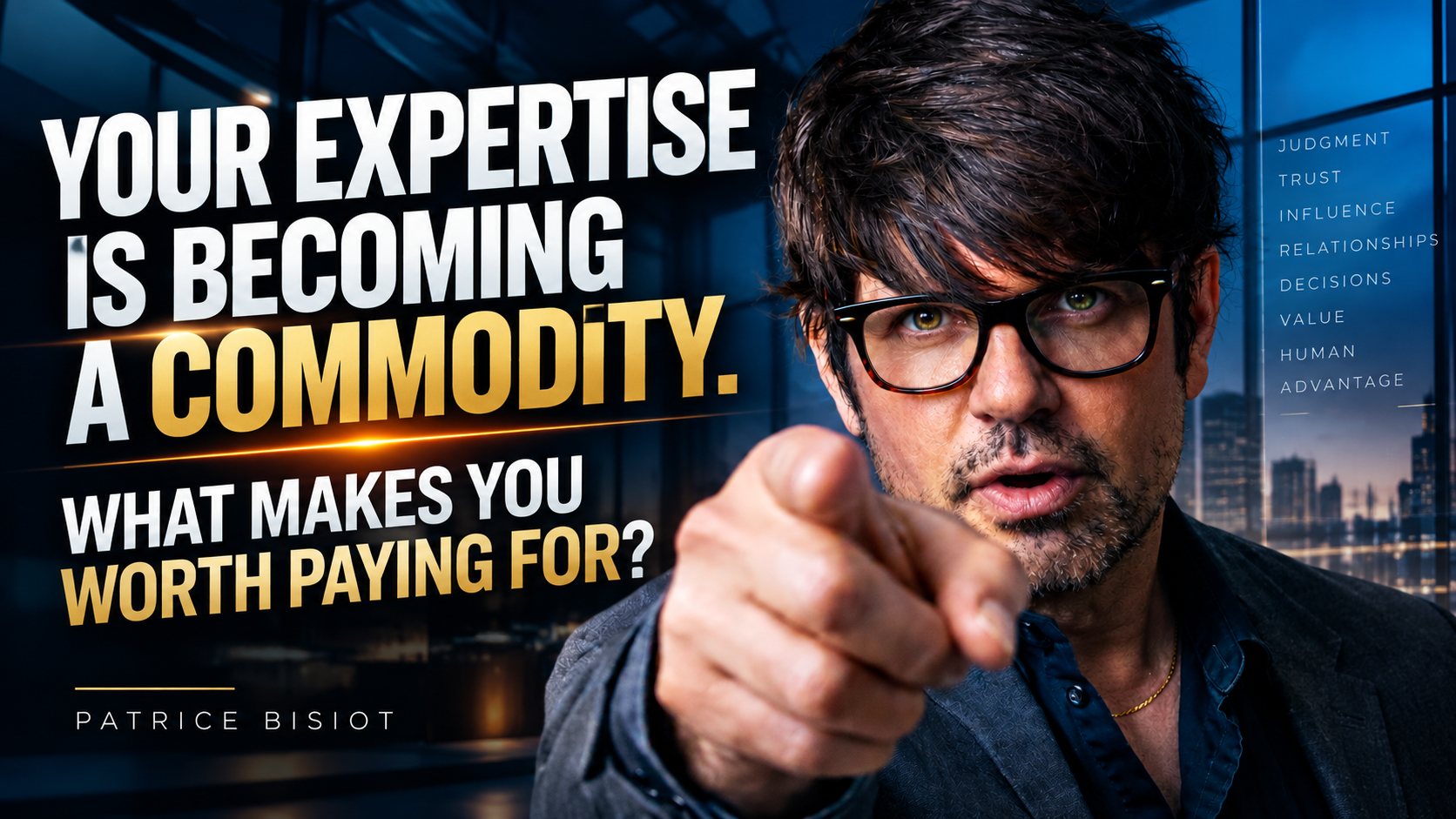
AI produces the work. Your judgment determines its value—and whether the money goes to your business, your competitor, or you.
For decades, access to information created an advantage. The professional who knew more, researched faster, or could assemble the strongest analysis held a valuable position.
AI is changing that equation.
It can summarize a market, compare competitors, draft a strategy, and generate recommendations at a speed that would have been unimaginable a few years ago.
But speed is not judgment.
A recommendation can be technically correct and commercially disastrous. A presentation can be persuasive and still fail to earn trust. A decision can look excellent on paper while ignoring the human reality that determines whether it succeeds.
As information becomes abundant, judgment becomes scarce.
The value is shifting from producing more answers to recognizing which answer matters.
The invisible dimension of a decision
Imagine two wealth-management executives presenting the same investment strategy to a prospective client.
Both have access to the same research. Both understand the numbers. Both can explain the opportunity.
One begins with the portfolio.
The other notices that the client has barely looked at the performance projections. Their attention keeps returning to the question of what happens if the market falls.
The first executive continues explaining returns.
The second recognizes that the decision is not yet about returns. It is about the client’s relationship with risk.
The technical recommendation may be identical. The quality of the consultation is not.
That distinction changes the conversation.
The professional who recognizes the underlying concern can address the decision the client is actually trying to make. The professional who misses it may deliver an excellent presentation to the wrong problem.
The consultation is where invisible observations become visible decisions.
AI can support the analysis. Human judgment determines what the analysis means in the room.
The new cost of misalignment
Organizations are investing heavily in technology, automation, and efficiency. Those investments matter.
But every system eventually reaches a human decision.
A leader must decide whether to trust the recommendation. A client must decide whether to commit. A team must decide whether to follow. A customer must decide whether the experience justifies the price.
At those moments, the quality of the human interaction becomes an economic variable.
A technically excellent professional who cannot communicate value may lose the opportunity to someone less capable but more effective at creating understanding.
A leader who communicates certainty without listening may accelerate the wrong decision.
A company that improves every process while neglecting the judgment of the people operating those processes may become more efficient at producing outcomes it never intended.
Everything visible is downstream from something invisible.
The decision is visible. The interpretation that produced it is not.
What leaders must develop now
The next generation of professional development cannot stop at teaching people how to use AI.
It must also develop the abilities that determine whether those tools create value: observation, interpretation, emotional intelligence, communication, and judgment.
That means teaching professionals to recognize what is happening beneath the surface of an interaction.
What is the client actually concerned about?
What is the team not saying?
What assumption is driving this recommendation?
What does the situation require that the data cannot establish on its own?
These are not decorative soft skills. They influence decisions, trust, client conversion, retention, and the quality of execution.
The objective is not to compete with AI at what AI does well.
It is to develop the human capabilities that make its output useful.
The advantage that cannot be downloaded
The future belongs neither to leaders who reject technology nor to those who mistake technology for leadership.
It belongs to those who understand the difference between information and insight, between efficiency and effectiveness, and between producing an answer and making a decision.
AI can expand what a professional knows.
It cannot, by itself, determine what that professional should notice, what a particular human being needs, or which decision deserves to be made.
That is the dimension I have spent my career studying: how people recognize, interpret, and express value—and how those invisible processes shape the outcomes we can measure.
The next competitive advantage is not simply what professionals work with. It is what they work from.
Technology will continue to evolve.
The organizations that develop human judgment alongside it will be better positioned to turn that evolution into trust, better decisions, and lasting value.
Intelligence is becoming abundant. The ability to recognize what matters is becoming the advantage.
Patrice Bisiot
Executive Brand Coach | Author | Keynote Speaker
Author of Mind Your Brand