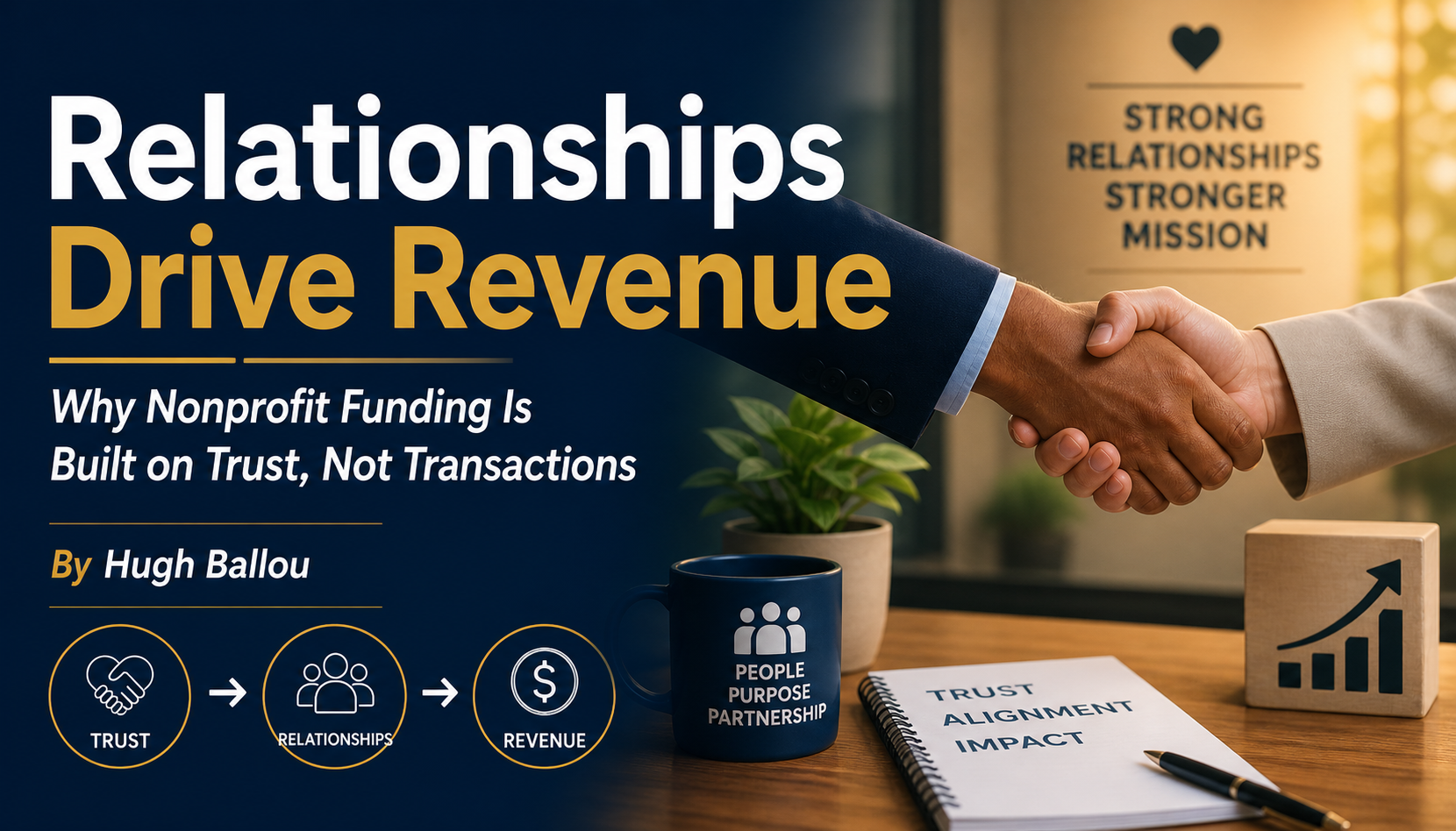
Relationships Drive Revenue
Why Nonprofit Funding Is Built on Trust, Not Transactions
By Hugh Ballou
One of the most overlooked truths in nonprofit leadership is this: funding is relational, not transactional. Organizations do not receive sustainable funding because of their programs alone. They receive funding because of the relationships they build.
This is a difficult truth for many executive directors and nonprofit C-suite leaders to accept. We have been trained to believe that better case statements, sharper proposals, and more polished campaigns produce more revenue. They help. But none of them, on their own, produce the kind of revenue that sustains a mission for decades.
Sustainable funding is not a marketing outcome. It is a relational outcome. And until nonprofit leaders treat it that way, revenue will continue to feel unpredictable, exhausting, and one campaign away from a crisis.
Why People Give to Nonprofit Organizations
Donors, sponsors, and partners do not write checks because they admire your logo or your latest annual report. They give for three relational reasons that every nonprofit leader must understand.
- They trust leadership. Donors give to organizations whose leaders they believe will steward their gift with integrity, competence, and consistency.
- They believe in the mission. Conviction about the cause matters—but conviction alone rarely produces a recurring gift. It produces a one-time response.
- They feel personally connected. The donors who give the most—and give the longest—are the ones who feel known, valued, and included in the work.
Without relationship, giving becomes occasional. With relationship, giving becomes consistent. That single shift—from occasional to consistent—is the difference between a nonprofit that survives and a nonprofit that scales.
The Revenue–Relationship Connection
Reframing fundraising as a relational discipline changes how nonprofit leaders allocate their time, their team, and their systems. Four principles define this shift.
- People fund people first, mission second. Donors evaluate the leader before they evaluate the cause. A compelling mission led by an untrusted leader will struggle. A clear mission led by a trusted leader will thrive.
- Engagement—not solicitation—drives giving. Organizations that ask more without engaging more raise less. Organizations that engage consistently raise more without asking more often.
- Consistent communication builds donor confidence. Donors do not need to hear from you constantly. They need to hear from you predictably. Reliability is the foundation of relational confidence.
- Long-term funding comes from relational continuity. The strongest funding partnerships are the ones that survive staff transitions, board changes, and economic downturns because the relationship is built on more than a single point of contact.
This is why nonprofit leaders who treat fundraising as a relational discipline outperform those who treat it as a campaign cycle. They are not raising money. They are building partnerships that produce money.
The data consistently confirms this pattern. Major donors rarely make their largest gifts to organizations they have known for less than a year. The gifts that transform a nonprofit’s capacity almost always come from relationships that have been carefully cultivated over multiple years. Yet many nonprofit C-suite leaders still allocate their calendars as if the next gift will come from the next pitch rather than the next conversation.
How the 8 Streams of Nonprofit Revenue and Fundability Framework Connect
This relational truth integrates directly with two foundational tools every nonprofit C-suite leader should be using: the 8 Streams of Nonprofit Revenue and the Fundability Framework.
Together, they answer three essential questions.
- Does our mission attract attention? A compelling mission opens the door. It is the reason donors are willing to look in your direction in the first place.
- Does our strategic plan build confidence? A clear plan tells donors that their gift will be deployed with purpose, not absorbed by activity. It moves them from interest to belief.
- Do our relationships sustain funding? Strong relationships convert one-time donors into long-term partners. They turn revenue into resilience.
Without relational continuity, revenue becomes unpredictable. You may have an excellent mission and a brilliant strategic plan, but if the relationships that carry them are shallow, every funding cycle becomes a fresh struggle. With relational continuity, the same mission and plan produce compounding results year after year.
The Core Statement Every Nonprofit C-Suite Leader Should Internalize
“If your relationships are shallow, your revenue will be unpredictable.”
This is not a fundraising tip. It is a leadership diagnostic. If your organization is experiencing revenue volatility, the most productive question is not “What is wrong with our development strategy?” The most productive question is “How deep are our donor relationships, and who is responsible for deepening them?”
Most nonprofit boards review revenue trends. Few review relationship trends. Yet the second is the leading indicator of the first. A donor base whose relational depth is increasing will produce growing revenue, even in difficult years. A donor base whose relational depth is eroding will produce declining revenue, even in strong years. By the time the financial report reflects the problem, the relational drift has already been happening for some time.
The nonprofit C-suite leaders who build the most fundable organizations are the ones who treat relational health as a board-level metric. They do not delegate it entirely to the development office. They own it. They model it. They build systems around it.
The Question Worth Asking Your Board This Quarter
If revenue follows relationships, the most strategic question your leadership team can ask is not “How do we raise more money?” It is “Where are our deepest relationships, where are our shallowest, and what are we doing to deepen the ones that matter most?”
Answer that question honestly, and your funding strategy will begin to clarify itself. Avoid it, and no amount of campaign creativity will deliver the sustainability your mission deserves.
I want to hear from you. Where have you seen a deepened relationship transform your nonprofit’s revenue—or where has shallow engagement cost you a partnership you should have kept? Share your experience in the comments. Other nonprofit C-suite leaders need to learn from what you have walked through. Find more resources by me at http://HughResources.com