The Six Things Serious Funders Are Really Evaluating
Why the organization behind the request matters more than the polish of the proposal
By Hugh Ballou
Funders rarely evaluate only the proposal in front of them. They are also evaluating the organization that must carry the promise behind it. A beautifully written case statement, persuasive presentation, or well-constructed grant application can open the door, but serious funders are looking beyond the language of the ask. They are asking whether the organization has the discipline, leadership, systems, evidence, and follow-through required to convert entrusted resources into meaningful results.
That is the difference between fundraising and fundability. Fundraising is the activity. Fundability is the organizational condition that makes the activity credible.
For executive leaders, this distinction matters because it changes the question from, “How can we raise more money?” to, “What must be true about this organization for a responsible funder to invest with confidence?” The second question leads directly to a more useful executive diagnostic.
The Six Funder-Confidence Conditions
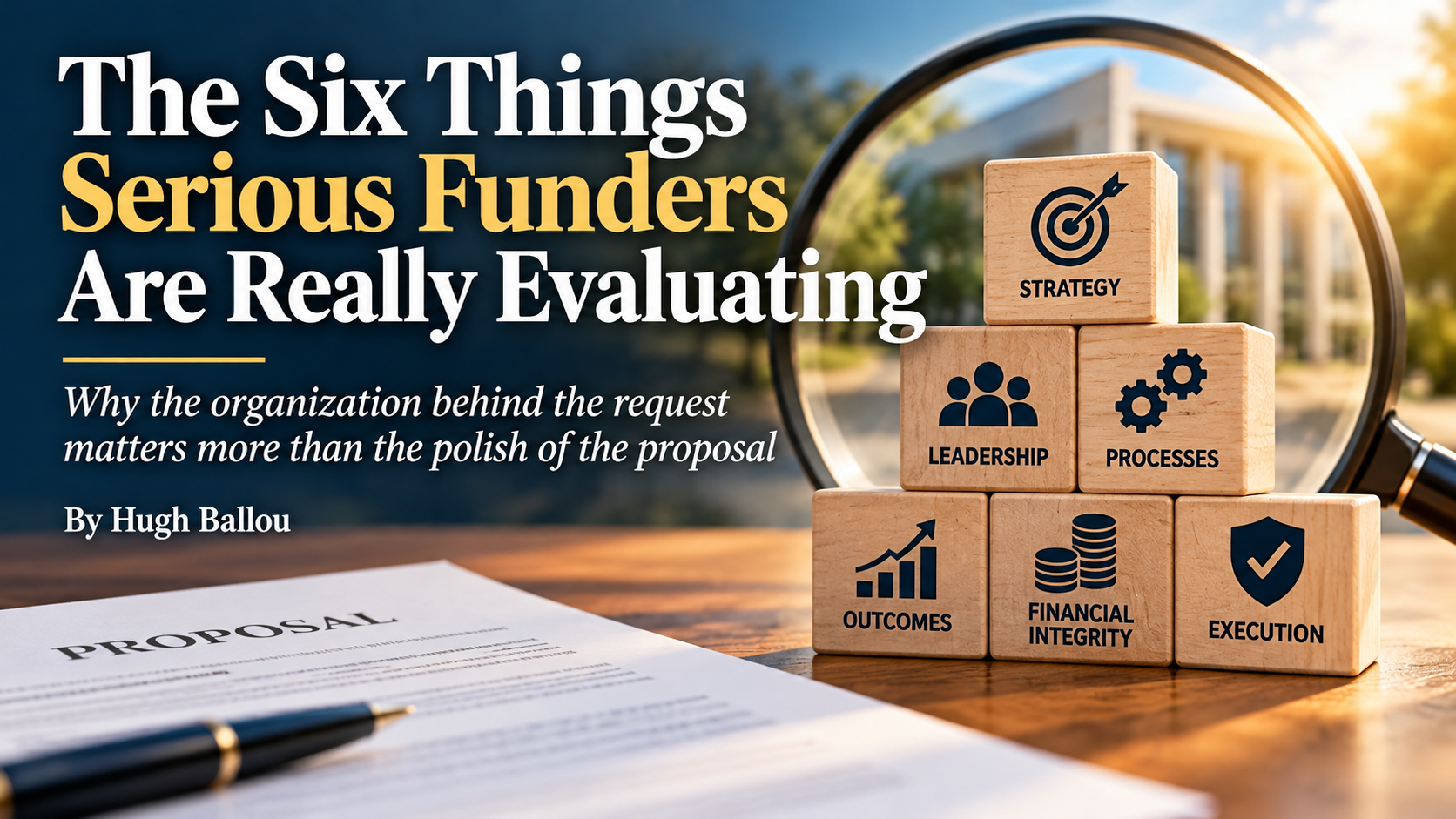
In Creating a Fundable Nonprofit, I organize this diagnostic around six conditions that shape funder confidence: clarity of strategy, strong leadership, reliable processes, measurable outcomes, financial integrity, and consistent execution. These are not six isolated departments. Together they form the operating condition a funder is trying to understand.
1. Clarity of Strategy
Clarity of strategy signals disciplined leadership. A funder wants to know whether the organization can explain the problem it exists to address, the future it is trying to create, the solution it has chosen, the people it serves, the outcomes it intends to produce, and the priorities that matter now.
Clarity is not simply a communications skill. It is evidence that choices have been made. Leaders who are clear about strategy can explain what the organization will do, what it will not do, and how resources connect to purpose. When the mission statement, strategic plan, budget, programs, and funding narrative point in different directions, confidence drops quickly.
The strongest strategic signal is not a thick planning document. It is organizational coherence.
2. Strong Leadership
Funders also evaluate the people responsible for carrying the promise. Strong leadership includes more than a capable chief executive. It includes executive-board alignment, clear roles, sound judgment, appropriate accountability, and the ability to make and communicate difficult decisions.
A funder may never use the phrase “leadership credibility,” but the signals are visible. Do executives and board members describe the same priorities? Does the board understand its governance role? Are decisions timely and responsible? Is the organization overly dependent on one founder, one donor, or one person who holds all the institutional knowledge?
Strong leadership reduces perceived risk because it shows that stewardship is shared, not concentrated.
3. Reliable Processes
Many nonprofits survive on commitment, improvisation, and individual heroics. That can work for a season, but it does not inspire long-term investment confidence.
Reliable processes demonstrate that important work can be repeated, measured, transferred, and improved. The question is not whether the organization has a manual for everything. The question is whether mission-critical work depends on memory and personality or on a repeatable way of getting things done.
If a key employee were unavailable tomorrow, would essential work continue? Could a new leader understand how decisions are made, how commitments are tracked, and how results are reviewed? Reliable systems turn good intentions into dependable capacity.
4. Measurable Outcomes
Activity is not the same as outcome. Nonprofits often report how many people attended, how many meals were served, how many classes were delivered, or how many volunteers participated. Those numbers may be useful, but they do not answer the question a serious funder ultimately cares about: What changed because of this work?
Measurable outcomes connect activity to consequence. They show whether the organization can define the change it intends to create, identify evidence that the change occurred, and learn from the results.
The ability to measure outcomes does not require a sophisticated research department. It requires discipline about defining success and collecting credible evidence that the organization is moving toward it.
5. Financial Integrity
Financial integrity is bigger than clean bookkeeping. It includes responsible stewardship, timely reporting, budget discipline, transparency, appropriate controls, and the ability of leaders to understand the financial story of the organization.
A funder wants confidence that resources will be deployed as promised and that leaders will respond responsibly when conditions change. Does the budget reflect stated priorities? Are variances reviewed? Are restricted funds managed correctly? Does the board understand the financial picture? Can leadership explain the numbers without immediately handing the question to the bookkeeper?
Financial integrity builds trust because it demonstrates that the organization treats money as an entrusted resource rather than simply as revenue to be acquired.
6. Consistent Execution
The final condition is execution: does the organization reliably do what it says it will do?
Strategy creates direction, but execution creates evidence. Funders notice whether commitments are completed, reports arrive when promised, priorities remain visible, and leaders adjust when something is not working.
Consistent execution does not mean nothing ever goes wrong. It means the organization has a rhythm for turning plans into deliverables, assigning ownership, reviewing progress, learning, and following through. That rhythm is one of the clearest signals that future promises can be trusted.
Weaknesses Do Not Stay in Their Own Lanes
These six conditions interact. A weakness in one often creates questions about the others.
For example, unclear strategy may produce a budget that looks unfocused. Weak leadership may show up as inconsistent execution. Poor processes may make outcomes difficult to measure. Weak financial discipline may cause a funder to question governance and stewardship. A single concern can become a proxy for the whole organization.
That is why funder confidence is cumulative. Every interaction adds to or subtracts from the picture. Timely responses, consistent language, aligned numbers and narrative, clear evidence, board understanding, and completed commitments all become signals.
Confidence does not come from looking impressive. Confidence comes from being coherent.
The Executive Question Before the Next Funding Push
Before increasing fundraising activity, leadership teams should evaluate the organization against all six conditions. The purpose is not to create a perfect score. The purpose is to expose the places where confidence is strongest, where it is weakest, and where perception may differ between executives and board members.
Then ask one difficult but productive question:
Which condition would a serious outside funder question first?
That answer may be more valuable than another fundraising tactic.
Strengthening fundability does not guarantee funding. It does something more important: it creates a stronger organizational condition from which credible funding relationships can grow.
Action Item
Evaluate your organization against all six Funder-Confidence Conditions before increasing fundraising activity. Identify the condition that most weakens confidence and make it a leadership priority.
About the source — This article is based on Hugh Ballou’s book, Creating a Fundable Nonprofit: Building the Organizational Condition That Creates Funder Confidence. Learn more at NonprofitFundability.org.
More on Hugh Ballou – http://AboutHugh.com