The Quiet Demotion
There is a specific, quiet plateau in every executive’s tenure with their AI portfolio where the operating dynamic shifts without warning. One quarter, the leader is directing the technology, setting the parameters, and overriding outputs with confidence. The next quarter, almost imperceptibly, the leader is reading reports generated by the system, accepting recommendations whose underlying logic they no longer interrogate, and describing strategic pivots with phrases that begin, “the model suggested.”
This is Delegation Drift, and it is the most consequential leadership pathology of 2026.
The Invisible Bar in this scenario is not technical. It is the transition from managing Efficiency to maintaining Sovereignty. A leader who has crossed into Drift is still operationally productive; the systems are running, the dashboards are green, and the quarterly numbers may even be improving. What has been lost is harder to see and far more dangerous: the executive has moved from Captain to Passenger, and the organization is now sailing on the judgment of a system that cannot be held fiduciarily accountable.
Executive Truth #1: An executive who cannot defend the logic behind their AI’s most confident recommendation has not delegated execution. They have abdicated authority.
The Diagnosis: The Speed Trap and the Sovereignty Crisis
The conditions that produce Delegation Drift are not accidental. They are the predictable outcome of a transformation narrative that has elevated Agentic Velocity to the status of an unqualified virtue. Boards are asking for speed. Investors are rewarding throughput. Internal stakeholders are measuring success by deployment cadence.
The result is what the TIRA framework identifies as the Speed Trap: the assumption that velocity, on its own, constitutes progress. In practice, velocity without a human Editor-in-Chief is simply an automated pathway to a governance crisis. The faster the system moves, the less time the leader has to interrogate its outputs; the less interrogation occurs, the more confident the system appears; and confidence, when uncoupled from defensibility, becomes the most expensive risk on the executive’s balance sheet.
The deeper failure is fiduciary. A C-Suite executive whose authority depends on explaining strategic decisions to a Board cannot afford to defer that explanation to a model. By extension, if the leader is unable to articulate, in their own words, why an Agentic system has recommended a specific pivot, they have not led the decision. They have witnessed it.
Executive Truth #2: Velocity without sovereignty is not transformation. It is a governance event waiting for a name.
TIRA Pillar 1: The Interrogation Standard
The first discipline required to reverse Delegation Drift is the establishment of a new standard for evaluating AI-driven recommendations. Most leaders, by training and by habit, ask a single question of their systems: is the AI right? This is the wrong question, and it produces the wrong operating posture.
The correct question, and the one that defines a Sophisticated Operator in 2026, is structurally different: is the AI’s logic defensible at the Board level?
The distinction matters because correctness, as evaluated by the system itself or by a technical reviewer, is a closed-loop measure. Defensibility is an open-loop measure that requires the leader to reconstruct the reasoning, identify the assumptions embedded in the model’s output, and assess whether those assumptions would survive scrutiny in a fiduciary setting. This shift moves the executive from a position of accepting outputs to a position of authoring conclusions.
In practical terms, the Interrogation Standard requires that every material AI-driven recommendation pass through three checkpoints before it influences a strategic decision. First, the leader must be able to state the recommendation in their own language without referencing the system. Second, the leader must identify the two or three assumptions on which the recommendation depends. Third, the leader must articulate the conditions under which the recommendation would be wrong. A recommendation that cannot pass these three checkpoints is not yet ready for executive endorsement, regardless of how confidently the system has presented it.
TIRA Pillar 2: Sovereignty of Decision Rights
The second pillar addresses the structural question that most AI governance frameworks have failed to answer with precision: where, exactly, does autonomous authority end and human signature begin?
In organizations operating without a clear answer to this question, the default behavior is escalation by exception. Agents act, humans review periodically, and the boundary between automated and authorized decisions is determined retroactively, usually after something has gone wrong. This model is operationally efficient and fiduciarily indefensible.
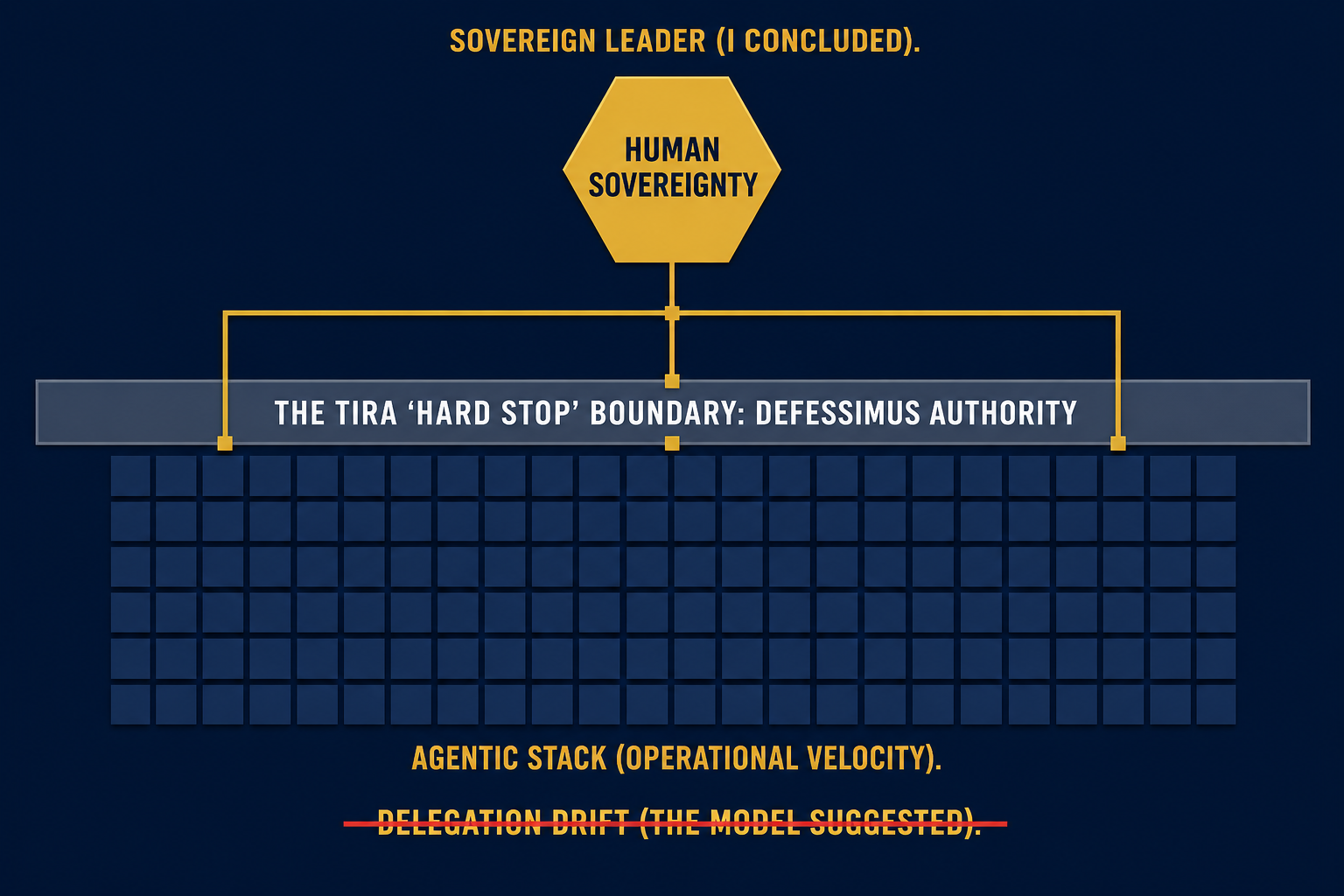
The TIRA standard requires the explicit definition of Hard Stops: the categories of decisions where an autonomous agent is prohibited from acting without a named human signature, regardless of the system’s confidence level. These typically include capital allocation above a defined threshold, customer-impacting policy changes, regulatory disclosures, personnel actions, and any decision that would be material if disclosed in the next earnings cycle.
Executive Truth #3: Sovereignty in the Agentic Era is not the right to override the system. It is the discipline of pre-defining where the system is not permitted to act.
The Hard Stop framework, properly implemented, does not slow the organization. It clarifies it. Agents move with greater velocity inside their defined scope precisely because the boundary is explicit. Leaders preserve their authority precisely because they have specified, in advance, the categories of decisions that require their judgment rather than their review.
TIRA Pillar 3: The Judgment Premium
The third pillar is the most strategically significant, and the least understood. In an operating environment where Agentic systems handle scale, consistency, and execution, the only remaining source of executive value is judgment. Judgment, in turn, is not produced by analytical capacity alone; it is produced by the integration of analytical capacity with what the TIRA framework identifies as Somatic Presence, the embodied executive awareness of organizational context, stakeholder dynamics, and the implicit risks that no model has been trained to surface.
This is the Judgment Premium: the compounding value that accrues to leaders who develop, defend, and demonstrate the capacity to make defensible decisions in conditions of structural ambiguity. In a world of infinite computational scale, the executive who cannot exercise this premium becomes operationally redundant. The executive who can exercise it becomes irreplaceable.
Executive Truth #4: In an organization where AI handles the scale, the only remaining value of a C-Suite executive is the judgment that no system can be trained to replicate.
The implication for leadership development is direct. The skills that mattered most in the pre-Agentic era, technical depth, process management, and execution discipline, are now infrastructure. The skills that compound in value are interrogation, framing, somatic awareness, and the capacity to hold a position under pressure when the data is ambiguous and the decision cannot be deferred.
Clinical Prescription: Three Day-1 Interventions
The following actions are designed to reverse Delegation Drift within the current operating cycle.
Intervention 1: The “Who Is the Boss?” Audit. Identify three currently active automated workflows in your portfolio. For each one, name the specific human executive who owns the catastrophic failure risk: the person whose career, reputation, and fiduciary accountability would be on the line if the workflow produced a material adverse outcome tomorrow. If you cannot name that person without hesitation, you have identified an authority vacuum, and authority vacuums are filled by default behavior, not by intention. Close each gap by week’s end.
Intervention 2: The Red-Team Interrogation. Implement a weekly stress test in your operating rhythm. Each week, select the AI-driven recommendation in which the system has expressed the highest confidence and intentionally challenge it. Identify the assumptions, surface the alternative interpretations, and require the recommendation to survive deliberate adversarial scrutiny before it influences a decision. This practice, executed consistently over a quarter, rebuilds the muscle of executive interrogation that Drift erodes.
Intervention 3: Governance-Grade Reporting. In your next Board update, replace every passive construction with an active one. Statements that begin “the model identified” become statements that begin “I concluded, based on the following analysis.” This is not cosmetic. It is the linguistic signal of restored sovereignty, and Boards register it immediately, often before they consciously identify what has changed.
Executive Truth #5: The vocabulary of the Sophisticated Operator does not include the phrase “the system suggested.” It begins with “I concluded,” and it ends with the reasoning that supports that conclusion.
The Fiduciary Bottom Line
In the Agentic Era, every other executive asset depreciates. Technical knowledge becomes obsolete on a faster cycle. Operational expertise is increasingly encoded in systems. Even institutional relationships, historically the most durable form of executive capital, are mediated by tools that compress and routinize what was once relational.
Authority is the exception. A leader who maintains sovereignty over their decisions, who can defend the logic of their conclusions in fiduciary terms, and who has not surrendered judgment to the velocity of the systems they oversee, becomes more valuable, not less, as the technology stack matures. The leader who has drifted into Passenger status, by contrast, has produced a structural question that the organization will eventually answer: if the system is making the decisions, why is this executive necessary to the P&L?
The Boardroom Question
Before your next strategic review, answer this with the seriousness it deserves:
If your top AI agent suggests a $50M strategic pivot this afternoon, do you have the framework, the standing, and the interrogation discipline to say no, or have you already outsourced the judgment that the Board pays you to exercise?
If the answer is uncertain, Delegation Drift has already begun, and the cost of correction compounds with every quarter it goes unaddressed.
To assess your current position on the Sovereignty curve and rebuild the interrogation discipline that defines a Sophisticated Operator, request a Confidential Briefing or ROI Audit at maheshmthakur.com.
Author positioning and disclosure
Mahesh M. Thakur’s experience is grounded in his fiduciary framing of operational transformation: he explicitly positions the Strategic Latency Gap as a C-Suite and capital-efficiency risk and emphasizes the need to move from vague technical updates to defensible financial cycles and governance-grade clarity. His operating background includes scaling large business units and delivering measurable ROI in enterprise contexts.