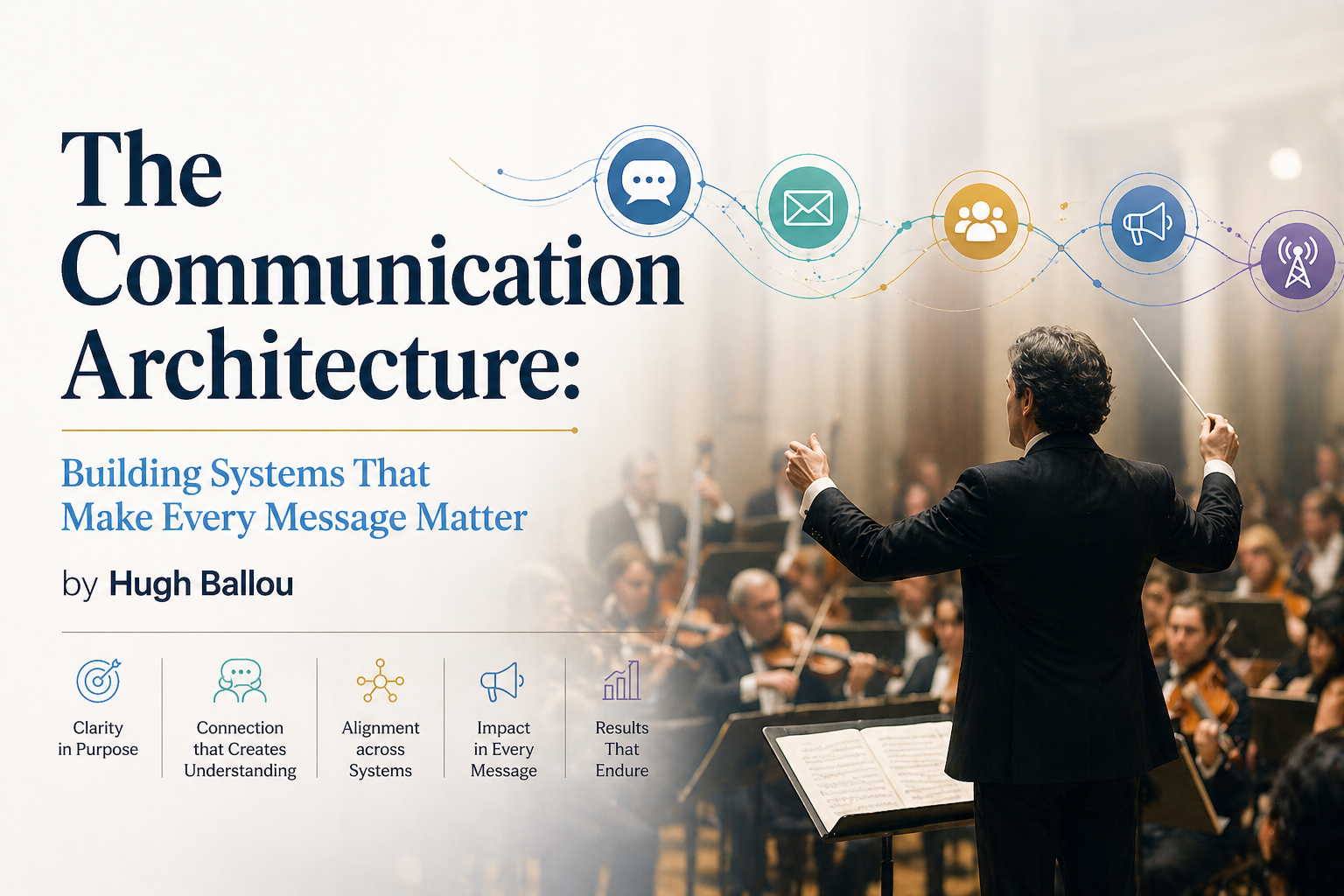
The Communication Architecture
Building Systems That Make Every Message Matter
Why High-Performing Nonprofits Treat Communication as Infrastructure, Not Afterthought
By Hugh Ballou
In an orchestra, every musician knows their part, their entrance, and their role. The same discipline transforms organizational communicatio.In an orchestra, every musician has a score, a part, and a rehearsal schedule. Nothing is left to chance. The oboist doesn’t guess when to come in. The percussionist doesn’t wonder whether the tempo has changed. Every detail is documented, rehearsed, and refined — not because musicians lack talent, but because the system makes their talent count.
Yet most nonprofits treat communication like improvisation — hoping the right message reaches the right person at the right time. Leaders send emails that vanish into inboxes. Board members hear updates secondhand. Volunteers arrive unsure of what’s expected. Staff members fill silences with assumptions. And the executive director wonders why nobody follows through.
That’s not leadership. That’s luck. And luck is not a strategy.
After decades of conducting orchestras and then working alongside hundreds of nonprofit leaders, I can tell you this with certainty: the highest-performing organizations don’t just communicate well — they build communication systems. They treat the flow of information with the same rigor they bring to financial management and program delivery. And the results speak for themselves.
The Cost of Communication Chaos
When communication isn’t systematized, organizations pay a steep price — and the currency is confusion. Deadlines slip because nobody confirmed who owned the task. Board members feel out of the loop and begin micromanaging to compensate. Staff members duplicate effort because the left hand doesn’t know what the right hand is doing. Donors receive inconsistent messaging. Volunteers drift away quietly, not because they lost passion, but because nobody told them what to do next.
Leaders often look at these symptoms and conclude they have a people problem. They don’t. They have a systems problem. The people are capable. The infrastructure is missing.
I’ve walked into organizations where talented, dedicated professionals were operating in a fog — not because they lacked commitment, but because there was no score to follow. No rhythm. No shared understanding of who communicates what, to whom, and when. In an orchestra, that would produce cacophony. In an organization, it produces burnout, turnover, and mission drift.
Communication as Infrastructure
We need to reframe communication. It is not a soft skill. It is not a personality trait. It is organizational infrastructure — as essential as your accounting system, your donor database, or your HR policies.
What does communication infrastructure actually look like? It means clear channels, defined rhythms, documented expectations, and feedback mechanisms. It means that every person in your organization — from the newest volunteer to the board chair — knows how information flows, where to find what they need, and how to raise a concern.
This is what I call the New Architecture of Engagement. It’s the deliberate design of how people connect, coordinate, and collaborate within your organization. When you build this architecture intentionally, communication stops being a source of frustration and starts becoming a source of strength.
The Five Pillars of a Communication System
Over years of working with nonprofit leaders, I’ve identified five pillars that form the foundation of an effective communication system. Miss any one of them, and the structure weakens.
Pillar 1: Communication Calendar
Every organization needs a predictable rhythm for communication. Weekly team meetings. Monthly board updates. Quarterly donor communications. Annual public messaging campaigns. When these rhythms are established and honored, people stop wondering when they’ll hear what matters. They know. The calendar becomes the heartbeat of the organization — steady, reliable, and life-giving.
Pillar 2: Channel Clarity
Not every message belongs in every medium. Email is for documentation and detailed updates. Meetings are for decisions and complex discussions. Messaging apps are for quick coordination. When you define which channel serves which purpose, you eliminate the noise of critical information buried in chat threads and decisions lost in email chains.
Pillar 3: Role-Based Communication
Who communicates what, to whom, and when? If the answer is “whoever gets around to it,” you have a gap. Role-based communication means assigning clear ownership. The development director communicates with major donors. The board chair delivers governance updates. The program manager reports outcomes to the team. Eliminate the assumption that “someone will handle it.” Assign it. Document it. Execute it.
Pillar 4: Escalation Protocols
Every organization encounters problems. The question is whether those problems get addressed or whether they fester. Escalation protocols define how issues get raised, who addresses them, and what the timeline looks like. Without this, small problems become crises, and people either stay silent out of uncertainty or create drama because there’s no structured path to resolution.
Pillar 5: Measurement and Accountability
How do you know your communication system is working? You measure it. Track meeting effectiveness scores. Survey staff and board members on communication satisfaction. Monitor whether decisions made in meetings are actually documented and followed through. What gets measured gets managed — and communication is no exception.
Key Insight
“Communication chaos is never a people failure — it’s a systems failure. Build the infrastructure, and the people will perform. Leave it to chance, and even your best talent will underdeliver.”
The Board-Staff Communication Bridge
One of the most common and most costly breakdowns I see in nonprofits is the gap between board and staff communication. Board members feel uninformed. Staff members feel scrutinized. Neither side trusts that the other fully understands the challenges they face. And the executive director is caught in the middle, trying to translate in both directions.
The solution isn’t more meetings. It’s better structure. Create shared dashboards that give board members real-time visibility into key metrics without requiring staff to produce custom reports every month. Establish clear reporting lines so board members know who to contact for what — and staff members aren’t fielding random requests from individual board members. Build structured touchpoints — perhaps a brief written update two weeks before each board meeting — so that meeting time is spent on decisions, not on catching up.
The goal is alignment without micromanagement. When the communication bridge between board and staff is solid, governance improves, trust deepens, and the organization moves faster.
Systems Create Freedom
I hear the objection often: “Systems feel rigid. We’re a mission-driven organization, not a corporation. We need flexibility and heart, not bureaucracy.”
I understand the concern. And I’d challenge it with this: in music, the score doesn’t limit the musician — it liberates them. When every musician knows the key, the tempo, the dynamics, and the structure, they are free to pour their artistry into the performance. They don’t waste energy guessing. They invest it in excellence.
Communication systems work the same way. When your team knows how information flows, when decisions are documented, and when expectations are clear, they stop spending energy managing confusion. They channel that energy into the mission. Systems don’t replace heart — they protect it. They ensure that passion isn’t consumed by preventable friction.
Structured communication creates alignment — freeing teams to focus on mission rather than managing confusion.
Your Communication Audit Starts Now
I’ll leave you with a challenge. This week — not next month, not at your next strategic planning retreat — this week, audit your communication systems.
Ask yourself these questions:
● Are messages consistently reaching the right people at the right time?
● Are decisions made in meetings documented and distributed?
● Is there a predictable rhythm to how information flows through the organization?
● Does every team member know which channel to use for which type of communication?
● Do board members and staff share a common understanding of organizational priorities?
If you answered “no” to even one of those questions, your communication system has gaps. And those gaps are costing you — in efficiency, in morale, in donor confidence, and ultimately in mission impact.
The good news is that communication architecture can be built. It doesn’t require a massive budget or a consultant. It requires intentionality, discipline, and the willingness to treat communication as what it truly is: the infrastructure that makes everything else possible.
As a conductor, I learned early that the most brilliant musicians in the world cannot produce a great performance without a shared score and a clear beat. The same is true for your organization. Give your people the structure they need and watch what they can accomplish.
The baton is in your hand. It’s time to conduct.
Hugh Ballou is the founder of SynerVision Leadership Foundation, Leader of the C-Suite Network Nonprofit Prosperity Council and host of The Nonprofit Exchange podcast. He works with visionary leaders to build high-performance cultures through transformational leadership. A former orchestral conductor turned leadership architect, Hugh has spent decades helping nonprofits move from chaos to clarity — one system at a time.