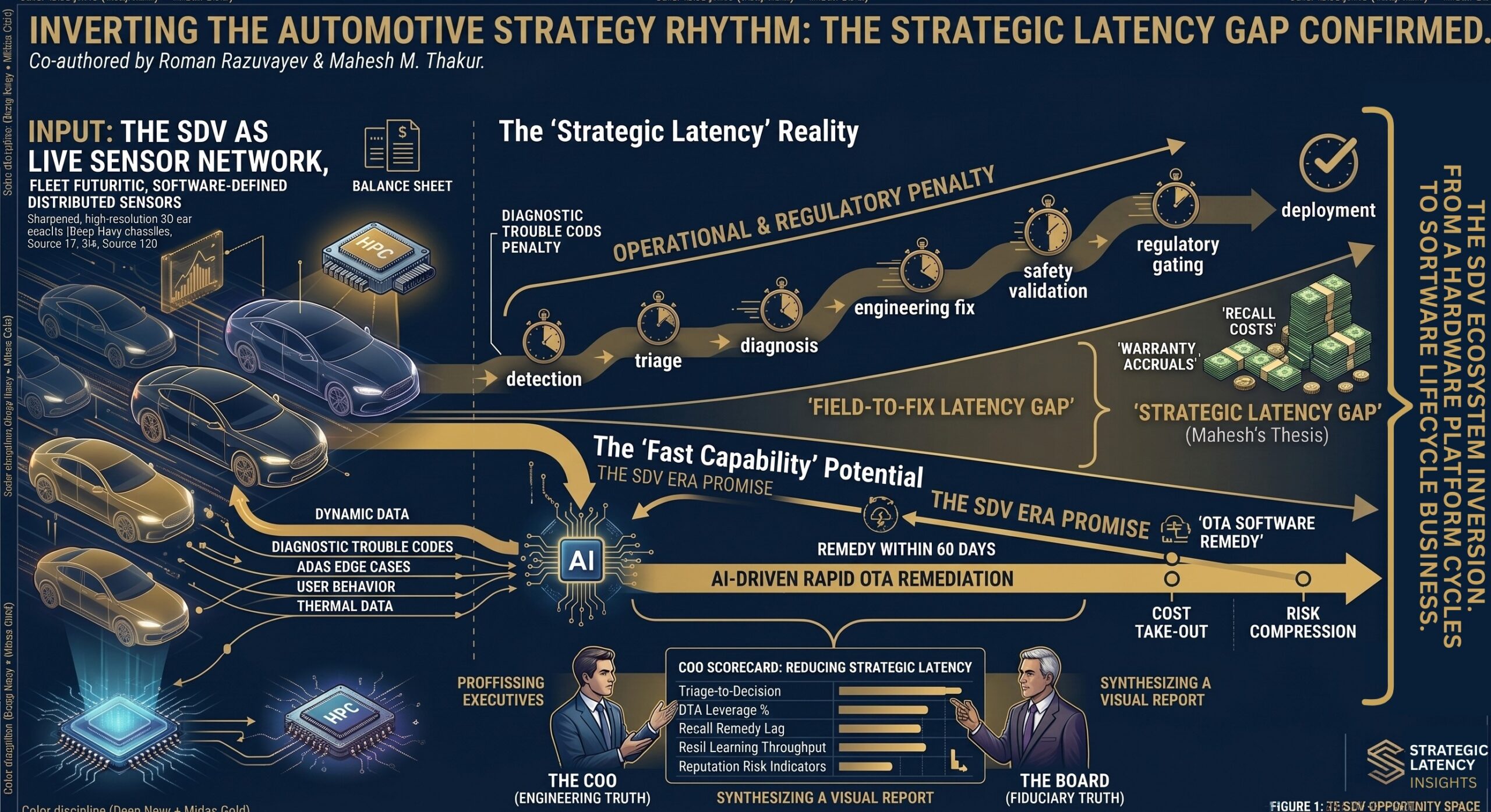
Strategic Latency in the Software-Defined Vehicle Era
Co-authored by Roman Razuvayev and Mahesh M. Thakur
Why this article exists now.
Automotive strategy used to be defined by platform cycles: five to seven years of product planning, with annual refreshes and limited post-sale change. The software-defined vehicle era has inverted that rhythm. Vehicles are evolving into “lifecycle businesses” where capabilities, safety, and even regulatory compliance can change after sale through software-weekly or monthly in some scenarios. [1] [2]
That shift is not just technical; it’s fiduciary. It forces a new leadership question:
How much value is your organization losing-not because you lack data, talent, or tools, but because you cannot convert field reality into engineering action fast enough?
Mahesh’s thesis names this pattern the Strategic Latency Gap: the distance between fast-moving capability (in his thesis, AI capability) and the slower, linear rate of organizational adaptation-creating a measurable breach in capital efficiency from a board and investor standpoint. [3] In automotive, the same underlying gap shows up as a specific, expensive phenomenon: field-to-fix latency-the time between a field service insight and a validated engineering remedy that is deployed at scale.
Roman’s operator perspective matters here. He has been building and running global engineering delivery at scale-leading a $230M portfolio with 3,000+ FTE and cross-border execution responsibility. His lens is not theoretical: it is what breaks (and what must still ship) when software, safety, customer experience, and quarterly accountability collide.
Why SDV and connected fleets turn latency into financial exposure.
A software-defined vehicle (SDV) is increasingly described as a vehicle whose core functions and features are controlled, updated, and enhanced through software rather than fixed hardware systems. [4] Industry research also emphasizes the architectural shift under the hood: moving from fragmented ECU sprawl toward centralized and zonal compute, which enables more scalable software delivery, faster iteration, and over-the-air (OTA) updates. [5]
The strategic implication is blunt: the fleet becomes a live, distributed sensor network. Every mile produces signals-diagnostic trouble codes, camera/radar telemetry, ADAS edge cases, battery and thermal behavior, infotainment crashes, connectivity anomalies, driver behavior and usage patterns and service/repair outcomes. The SDV promise is that these signals can be translated into rapid improvements and fixes, delivered at scale without requiring every vehicle to visit a dealer. [6]
But the same shift amplifies executive risk when organizations cannot execute on that promise:
· Regulated markets now explicitly link software updating and cybersecurity to type approval and ongoing compliance expectations. Guidance around UN Regulations R155 (cybersecurity management) and R156 (software update management) emphasizes that manufacturers must meet cybersecurity and software-update management requirements to sell vehicles in markets implementing these rules, with July 2024 commonly cited as a major enforcement milestone for new vehicles. [7]
· These frameworks are operational by design: they push OEMs toward systematic update governance (Software Update Management Systems, SUMS) and lifecycle cybersecurity processes, not ad hoc “hero fixes.” [8]
· Meanwhile, regulators (and customers) are increasingly accustomed to OTA remedies. NHTSA reporting shows that millions of recalled vehicles in recent years have been remedied through OTA updates, and that OTA remediation is now a visible part of recall reporting and sector transparency. [9][RR1] [MT2]
In other words: SDV reduces the technical cost of change but increases the organizational penalty for delayed response. That penalty is strategic latency.
The financial cost of field-to-fix latency
Roman’s Point 4: Strategic latency is now a profit-and-loss line item.
Roman framed the cost categories in a way that maps directly to the balance sheet and the brand:
Strategic Latency in Auto: In the era of SDV and Connected Cars, the financial cost of the latency between a field service insight and a technical engineering fix has increased significantly:
Operational cost of ignorance: Ignoring the technical ability of fast deployment of issue fixes after SOP leads to keeping warranty and liability costs high, lack of organizational setup for fast deployment increases the cost of recalls, so keeping the operational cost and the prices higher than the competition.
The cost of lost opportunities: The latency prevents using field data for optimizing the cost of future models and engineering of new versions of the software for current and future models.
The brand impact: The latency positions the cars of the brand as outdated “previous century” vehicles, as well as the brand itself.
Each of these can be grounded in current (April 2026) evidence.
Operational cost of ignorance: warranty, recalls, and the compounding liability tail.
Warranty and recall exposure are not abstract; it is routinely measured in billions.
· A global vehicle manufacturer [10] reported an accrual for estimated future warranty and field service action costs (net of supplier recoveries) of $14.032B as of Dec 31, 2024, and disclosed $5.831B of payments made during 2024 against that accrual. [11]
· Another key player in the OEM space [12] reported liabilities for product warranty and recall campaigns of $10.6B on Dec 31, 2024. [13][RR3] [MT4]
Those numbers matter because field-to-fix latency acts like an “interest rate” on quality exposure: the longer an issue persists without a remedy deployed across the fleet, the longer the organization continues paying (in claims, repairs, goodwill, and downstream diagnostics labor) while uncertainty accumulates.
Regulatory data also shows why “time to remedy” is not a soft metric:
· NHTSA’s recall completion-rate analysis identifies three factors with statistical impact on completion rates, including “the length of time between the Part 573 Report and remedy availability.” [14]
· NHTSA’s reporting also puts a spotlight on remedy timing: across 2020–2024, nearly 80% of vehicle recalls had a final remedy available within 60 days, but a meaningful tail exists where remedy availability extends far longer (with cited drivers including design, manufacturing, or supply delays). [15][RR5] [MT6]
This is the operational cost of ignorance Roman is pointing at: if you have the capability for rapid software remediation but do not organize to use it, you choose higher warranty and recall exposure than competitors who do.
The SDV era makes that choice visible because OTA remedies are increasingly documented in recall pathways:
· A Tesla Part 573 safety recall report (Oct 2025) explicitly describes an OTA software remedy deployed at no charge to customers. [16]
· NHTSA recall filings also document OTA as an available remedy path for other major automakers. For example, a March 2026 recall report describes a software remedy where owners may accept changes via wireless OTA rather than visiting a dealership. [17]
The financial logic is straightforward: shorter latency reduces the duration and spread of costs, raises recall completion rates, and can reduce the need for high-cost physical interventions-if governance and deployment systems can keep up.
Cost of lost opportunities: when field data fails to become product advantage.
In SDV, the field is no longer just an after-sales support domain; it is a real-time product strategy asset. Value is created when field signals shape:
· next release priorities for current vehicles (safety, stability, UX improvements),
· Design Decisions for future model years (component selection, tolerance bands, thermal design, sensor placement, software architecture choices),
· and monetizable digital features and services tied to lifecycle usage.
This is not speculative. Industry research consistently frames connected-vehicle data as a large value pool, spanning “vehicle/fleet health,” “R&D optimization,” safety/security, and new services. [18] In that work, connected-car data is discussed as a significant economic opportunity by 2030-part revenue, part cost efficiency. [18]
Field-to-fix latency kills this opportunity in a specific way: every month you delay learning becomes a month when your competitors’ models learn faster-and the delta compounds.
A February 2026 SDV industry report makes the constraint explicit: even for many OEMs, “deploying a simple over-the-air update still requires months of integration, validation and regional regulatory approval.” [19] That is strategic latency stated in operational terms: it’s not that changes are impossible-it’s that the organization’s release and approval machinery moves slower than the field reality it is meant to address.
Brand impact: reputation, trust, and “previous-century vehicles”
Brand impact is often dismissed because it is hard to book into a quarterly model. But research and financial-market evidence show it is real:
· Research on product recalls and firm reputation has estimated that reputation can account for a meaningful share of firm value in recall-heavy sectors (transportation equipment), inferred from stock-price reactions to recall information. [20]
· Empirical research on automobile recalls has found negative abnormal returns on average around recall events (even if magnitudes vary by study design and context), reinforcing that recalls can translate into market value loss and reputational damage. [21]
In SDV specifically, the brand signal is amplified by customer baseline expectations. When vehicles can be improved over time, a slow or absent fix is no longer interpreted as “that’s just how cars are,” but as a failure of competence-or worse, a failure of care.
This is why Roman’s “previous century” phrase is strategically accurate: SDV reshapes the customer’s mental model of what a modern vehicle brand is. [22]
The latency mechanism that leaders can actually manage
Executives can’t manage “latency” as a slogan. They can manage it as a pipeline.
A practical way to define field-to-fix latency is:
Field-to-fix latency = (time to detect) + (time to diagnose) + (time to decide) + (time to engineer) + (time to validate & certify) + (time to deploy) + (time to confirm fleet impact).
Regulators and standards bodies effectively reinforce this lifecycle view:
· ISO/SAE 21434 explicitly frames cybersecurity engineering across the vehicle lifecycle-from concept and development through operation, maintenance, and decommissioning-pushing OEMs toward systematic, auditable practices rather than one-off patches. [23]
· UN R156 is widely interpreted as requiring not just the update itself, but the organizational system (SUMS) to manage updates safely, traceably, and in a compliance-aligned manner-often with periodic reassessment expectations described by certification bodies. [24]
And the public NHTSA record explains what happens when parts of that pipeline stall:
· NHTSA highlights remedy availability timing, the legal expectations around notification, and shows real dispersion-some manufacturers averaging well beyond 60 days between recall filing and remedy availability for subsets of recalls. [15]
This is why strategic latency becomes a leadership competency: the competitive edge is not only OTA capability; it’s the organization’s ability to run compliant, repeatable, fast loops.
A useful analogy comes from the Toyota Production System concept of “andon” as an abnormality signal: when equipment stops, the andon board lights up to notify workers of the abnormality so people respond only when needed. [25] The SDV-era equivalent is a “fleet andon”: a governance system that pulls the right people into the loop immediately-engineering, safety, legal/compliance, product, comms-so a small defect doesn’t become a months-long, brand-level event.
Roman’s Point 5: The COO’s dilemma-engineering truth vs fiduciary truth
Roman posed the core operator question directly:
The Power Map of Delivery: In the COO seat, how do you balance the engineering truth of what is technical with the fiduciary truth that the Board needs to see in the quarterly report?
It is about communicating the balance between short-term gains and long-term costs of not doing necessary technical or operational steps with a duration beyond one quarter. For example, framing technical debt as future margin loss, showcasing the delay of operational transformation as a future cost increase, and positioning the lack of innovation investments as mid- to long-term market loss and associated revenue and margin decline.
This framing is unusually important in automotive because safety and compliance force longer time horizons than a quarter, even when the market punishes near-term misses.
Two research-backed bridges help convert “engineering truth” into board-readable “fiduciary truth”:
First, treat debt as measurable drag, not an emotional argument. Technical debt is widely described as a metaphor (coined by Ward Cunningham) for future costs created by expedient choices, where the “interest” is the extra effort required to change and maintain systems later. [26] These matters in SDV because “debt” is not confined to code. It includes fragmented E/E architecture, brittle integration processes, and incomplete update governance-precisely the constraints SDV reports identify as slowing even “simple” OTA updates to months. [19]
Second, connect pipeline performance to financial exposure. In regulated, recall-driven domains, the board already understands timing because timing drives cost and risk. NHTSA explicitly identifies remedy availability time as a factor affecting completion. [14] NHTSA also reports the tail risk of lengthy remedy timelines and attributes delays to design/manufacturing/supply constraints. [27]
Roman’s operator-grade translation is therefore actionable:
· “We are carrying an X-day remedy lag that statistically reduces completion, increasing exposure.” [14]
· “We are paying Y in warranty and field service costs now; latency reduction is a cost takeout and risk compression lever.” [28]
· “We are failing to monetize or operationalize fleet data; this is a missed lifecycle value pool.” [29]
A COO-grade scorecard for reducing strategic latency.
Mahesh’s thesis emphasizes board-level clarity and fiduciary oversight-moving from “vague technical updates” to “defensible financial cycles” suitable for governance in volatile eras. [3] In automotive SDV, that translates into a small number of metrics that connect cycle time to money and risk.
Below is a practical operator + board scorecard (not exhaustive, but board-usable):
Field-to-fix latency metrics (speed and containment)
Measure the “clock” at each stage: – Detection-to-triage time: first field signal → confirmed incident category.
– Triage-to-decision time: confirmed incident → decision to patch, rollback, campaign, or physical remedy.
– Decision-to-remedy availability: decision → validated remedy ready for deployment (includes safety validation and compliance gating).
These align with how regulators describe remedy availability timing and why delays matter. [30]
Recall and remediation economics (direct financial)
– Warranty and field service accrual trend: reserve balance, payments, and changes in accrual (trendline, by platform). [31]
– Recall remedy lag in days: time between recall filing and remedy availability, and size of the “tail” beyond 60 days. [15]
– OTA leverage: percentage of actions remedied by OTA and number of vehicles remedied by OTA mechanisms (where applicable). [32]
Strategic value capture (lost-opportunity prevention)
– Fleet learning throughput: proportion of high-severity field issues that lead to a design or software change within a defined cycle.
– Next-platform cost avoidance: validated cost reductions or defect-rate reductions traceable to field analytics.
Connected-car research explicitly frames R&D optimization and vehicle health as major value clusters; the governance question is whether the organization captures that value or leaves it latent. [18]
Trust and reputation (brand and valuation)
– Repeat-issue rate post-fix: did the remedy actually remove the defect signature across the fleet?
– Recall sentiment and residual valuation indicators: monitor reputational impact because research indicates recall events can damage firm value through market response and reputation dynamics. [33]
The point is not to create more reporting. It is to give the board a coherent answer to: “Are we getting faster in a way that reduces risk and improves margins?” That is fiduciary truth.
What strategic latency looks like when executed as an operating model?
Strategic latency reduction is not a single program; it is an operating system built to do three things repeatedly:
- Convert fleet signals into engineering truth (fast).
- This requires a modern data and diagnostics backbone, and it requires disciplined triage so that noise does not drown signal. The NHTSA data shows the real-world spread in remedy timing; reducing that spread starts with faster truth discovery. [27]
- Convert engineering truth into compliant deployment (predictably).
- SDV reports emphasize the constraint: months of integration, validation, and regional regulatory approval can still be required for a “simple” OTA update. [19] That reality demands:
3. architecture that reduces fragmentation, [34]
4. software update governance (SUMS), [35]
5. cybersecurity engineering across lifecycle (e.g., ISO/SAE 21434), [23]
- and secure update delivery mechanisms (e.g., Uptane as an automotive-focused secure update framework). [36]
- Prove outcomes in ways the board can underwrite.
- This is where Roman’s “power map” becomes practical: reframe post-SOP technical work in quarterly terms-margin protection, risk compression, and lifecycle value capture-backed by metrics the board recognizes (reserves, remediation timing, completion rates, reputation risk indicators). [37]
A concrete illustration of this operator-grade posture is the increasing public evidence of OTA as part of recall remedy strategy. NHTSA annual recall reporting explicitly quantifies recalls and vehicles remedied through OTA updates, and shows strong year-to-year variation, reinforcing that OTA remediation is now operationally material. [9]
Why Roman’s leadership positioning is credible in auto SDV.
Thought leadership in automotive SDV must be rooted in the realities of delivery at scale: cross-border engineering, quality, safety validation, rollouts, and customer impact. Roman’s background is aligned to that operator terrain-built over a long tenure in global engineering leadership, including senior roles culminating in SVP Engineering. –
His insights emphasize a strong alignment with the SDV evolution, specifically focusing on the engineering of next-generation digital mobility, leveraging a global delivery engine to build continuous, over-the-air functional enhancements throughout the vehicle’s lifespan. This is precisely the domain where strategic latency becomes either a compounding advantage-or an expensive constraint.
In other words: Roman’s thesis is not “SDV is coming.” It is that SDV changes the operating contract: leadership must deliver safely, quickly, and repeatedly after SOP, while translating those decisions into board-grade fiduciary language.
Author positioning and disclosure
Roman’s contribution is grounded in global engineering operations leadership and SDV delivery realities at scale.
Mahesh’s contribution is grounded in his fiduciary framing of operational transformation: he explicitly positions the Strategic Latency Gap as a C-Suite and capital-efficiency risk and emphasizes the need to move from vague technical updates to defensible financial cycles and governance-grade clarity. [3] His operating background, as described publicly includes scaling large business units and delivering measurable ROI in enterprise contexts. [39]
[1] [18] [29] Unlocking the full life-cycle value from connected-car data
[2] [6] [19] [22] [34] assets.kpmg.com
https://assets.kpmg.com/content/dam/kpmgsites/se/pdf/2026/software_defined_vehicles_coe26.pdf
[3] The Conviction Engine: Solving the AI ROI Mirage | Thesis.
https://maheshmthakur.com/thesis/
[4] What is a Software Defined Vehicle?
https://www.ibm.com/think/topics/software-defined-vehicle?
[5] Automotive software and electronics future outlook
[7] incibe.es
[8] [24] [35] UN Regulation 156 Assessments – automotive software
[9] [10] [15] [27] [30] [32] nhtsa.gov
https://www.nhtsa.gov/sites/nhtsa.gov/files/2026-03/2025-annual-recalls-report.pdf
[11] [12] [28] [31] [37] s205.q4cdn.com
https://s205.q4cdn.com/882619693/files/doc_financials/2024/ar/Ford-2024-Annual-Report.pdf
[13] gm-20241231
https://www.sec.gov/Archives/edgar/data/1467858/000146785825000032/gm-20241231.htm?
[14] nhtsa.gov
[16] static.nhtsa.gov
https://static.nhtsa.gov/odi/rcl/2025/RCLRPT-25V699-7285.pdf
[17] static.nhtsa.gov
https://static.nhtsa.gov/odi/rcl/2026/RCLRPT-26V129-1637.pdf
[20] [33] Product Recalls and Firm Reputation:
https://www.gc.cuny.edu/sites/default/files/2021-07/recalls-final.pdf?
[21] The effects of regulatory investigation, supplier defect, and …
https://www.sciencedirect.com/science/article/abs/pii/S0148296323004101?
[23] ISO/SAE 21434:2021 – Road vehicles – Cybersecurity …
https://www.iso.org/standard/70918.html?
[25] Toyota Production System | Vision & Philosophy | Company
https://global.toyota/en/company/vision-and-philosophy/production-system/index.html?
[26] A Field Study of Technical Debt – Software Engineering Institute
https://www.sei.cmu.edu/blog/a-field-study-of-technical-debt/?
[36] Securing delivery of software updates for ground vehicles
https://uptane.org/papers/Uptane_first_whitepaper.pdf?
[39] Decisive AI Solutions – Mahesh M. Thakur