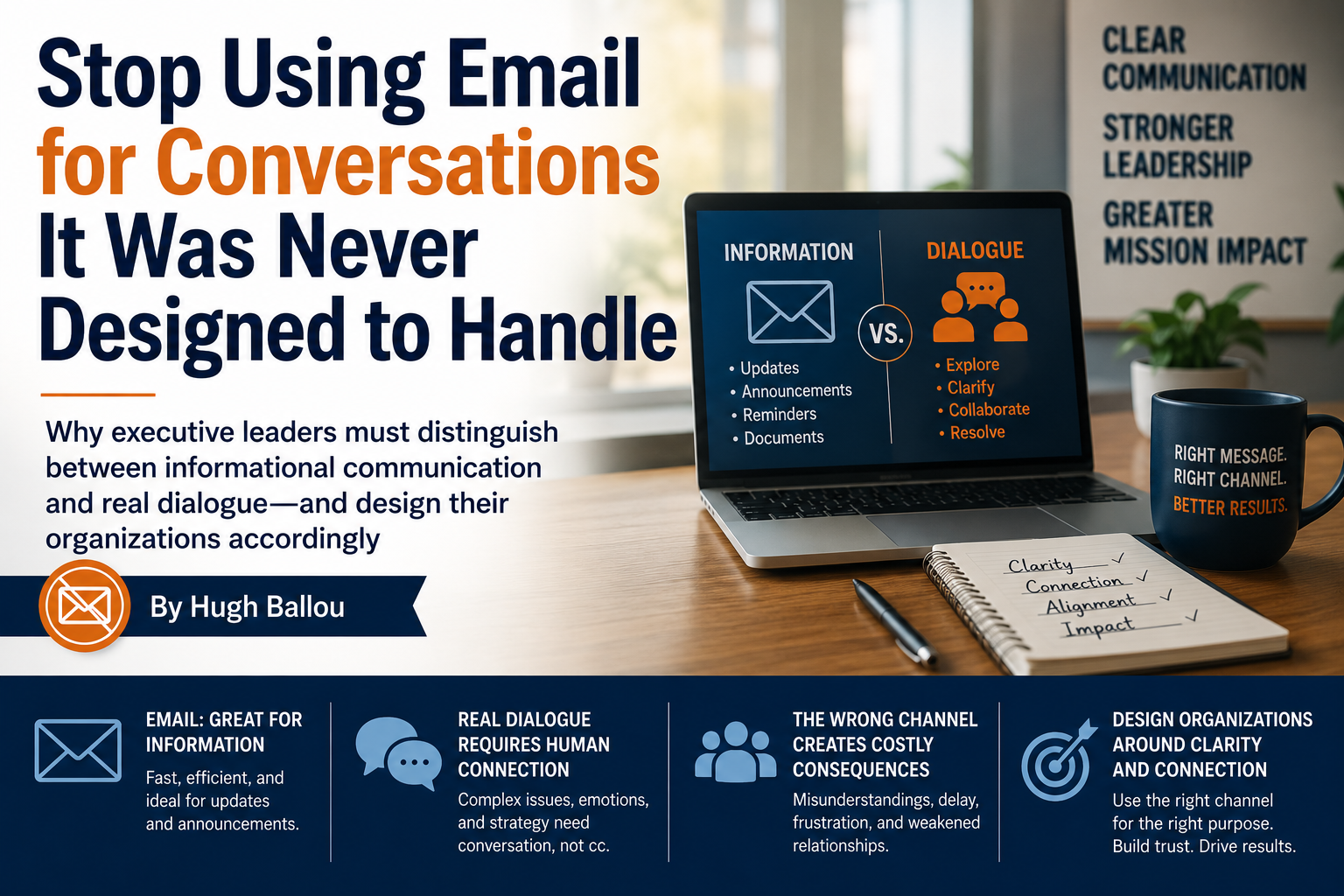
Stop Using Email for Conversations It Was Never Designed to Handle
Why executive leaders must distinguish between informational communication and real dialogue—and design their organizations accordingly.
By Hugh Ballou
Short answer: Email is built to move information, not to carry emotion, nuance, or strategic dialogue. When executives use it for conflict, feedback, or alignment, communication quality collapses and trust erodes. The fix is not more communication—it is better communication design, with each channel matched to the work it was built to do.
The Hidden Operational Failure in Modern Organizations
One of the most common operational failures in executive leadership has nothing to do with funding, staffing, or strategy. It is communication-channel confusion—the tendency to push every kind of conversation through the same digital pipe and expect different results.
Organizations routinely attempt to use email for conversations it was never designed to handle. The result is predictable: misunderstanding, conflict escalation, communication fatigue, diminished trust, and organizational inefficiency. The cost shows up not on a single line of the P&L, but across decision speed, employee engagement, executive credibility, and customer experience.
Email is a powerful tool when used appropriately. It distributes information efficiently, documents decisions, and keeps teams aligned on logistics and updates. However, email is fundamentally a one-way informational communication channel. It is not a substitute for dialogue, collaboration, emotional intelligence, or relationship.
Informational vs. Relational Communication
Healthy organizations draw a clear line between informational communication and relational communication. Most dysfunctional ones do not.
Informational communication is designed to distribute facts. It includes schedules, announcements, updates, reports, reminders, and operational instructions. Email works well for these purposes because the primary goal is clarity and efficiency.
Relational communication is something else entirely. It involves nuance, interpretation, emotional intelligence, feedback, trust-building, and collaborative problem-solving. These conversations require interaction, active listening, and immediate clarification—none of which email provides.
Conflict resolution should never happen through long email chains. Strategic alignment should not depend on fragmented inbox threads. Emotional conversations require human presence. When organizations force relational communication through informational channels, communication deteriorates quickly—and so does culture.
When the Inbox Becomes the Operating System
The problem is amplified by modern organizational overload. Many executives spend entire days responding reactively to email rather than communicating strategically. The inbox becomes the operating system of the organization instead of a supporting tool. Real leadership work—judgment, prioritization, mentoring, strategy—gets squeezed into the cracks between replies.
Four operational consequences follow almost every time:
- Volume up, quality down. Teams receive more information but less clarity. Important messages get buried beneath low-value traffic.
- Misinterpretation rises. Without vocal tone, expression, or context, recipients fill in the blanks with their own assumptions and emotions.
- Leadership credibility erodes. Reactive or emotionally charged messages damage trust and signal a lack of executive composure.
- Strategic focus fragments. Constant inbox interruptions starve the deep, uninterrupted thinking that leadership actually requires.
Designing a Communication Architecture
Healthy communication systems require intentional structure. Executives should define which channels serve which purposes, then hold the organization to those definitions until they become culture.
Channel Best For Avoid
Email Updates, logistics, documentation, confirmations Conflict, feedback, strategic debate
Live meeting Strategic alignment, decision-making, planning Status updates that could be a memo
1:1 conversation Feedback, conflict, sensitive issues, coaching Broadcast announcements
Chat / DM Quick questions, real-time coordination Important decisions or anything you need to find later
This clarity dramatically improves organizational effectiveness. It also reduces anxiety. When teams understand how communication is supposed to work, confusion decreases. Employees know where to look for information, when dialogue will occur, and how decisions will be made and shared.
Reduce Traffic. Raise Standards.
Another important discipline is reducing unnecessary communication traffic. Excessive reply-all behavior, vague subject lines, duplicated messaging, and reactive forwarding contribute significantly to overload. Operationally effective organizations communicate with intentionality, not volume.
Executives should also establish baseline communication standards across the company:
- Response-time expectations by channel (e.g., email within one business day; chat within hours; urgent matters by phone).
- Confidentiality and audit guidelines specifying which topics never belong in writing.
- Meeting communication protocols, including pre-reads, decision logs, and follow-up summaries.
- Clear decision-making channels so teams know where strategy is set versus where it is merely discussed.
These standards are not bureaucracy. They are the scaffolding that lets a growing organization scale without losing trust or alignment.
Frequently Asked Questions
When should leaders stop using email and switch to a conversation?
Switch channels whenever the topic involves emotion, conflict, performance feedback, strategic nuance, or relationship repair. Email is built for information, logistics, and documentation—not for resolving how people feel or what the organization should do next.
Why is email a poor channel for conflict resolution?
Email strips out tone, expression, and real-time clarification. Recipients interpret ambiguous language through their current emotional state, which almost always escalates conflict rather than resolving it. Conflict requires presence, listening, and the ability to course-correct in the moment.
What is a communication architecture?
A communication architecture is an explicit map of which channels are used for which purposes—email for information and documentation, meetings for strategic dialogue, one-on-ones for sensitive issues, and chat for quick coordination. Defining it removes guesswork and reduces communication overload.
How can executives reduce email overload across the organization?
Set channel rules, publish response-time expectations, ban unnecessary reply-all use, require clear subject lines, and consistently move sensitive or strategic conversations off email. Leaders set the pattern; teams mirror it within weeks.
Communication Architecture Is Leadership Architecture
Organizations cannot scale effectively without communication systems that support clarity, trust, and operational rhythm. Strategic leadership depends on communication discipline far more than on communication volume.
The solution is not more communication. The solution is better communication design. Email is valuable—but email is not relational leadership.
The organizations that thrive in the next decade will be those whose leaders understand not only what to communicate, but how, when, and through which channel communication should occur. That single distinction changes everything—decision speed, culture, retention, and the credibility of every executive in the room.
_____________________
About the Author
Published through C-Suite Network Thought Leadership. SynerVision Leadership Foundation works with executives, boards, and nonprofit leaders on transformational leadership, organizational culture, and the communication architecture required to scale mission-driven organizations. Digital card – http://AboutHugh.com