How to Reduce Meeting Overload and Improve Hybrid Work Productivity
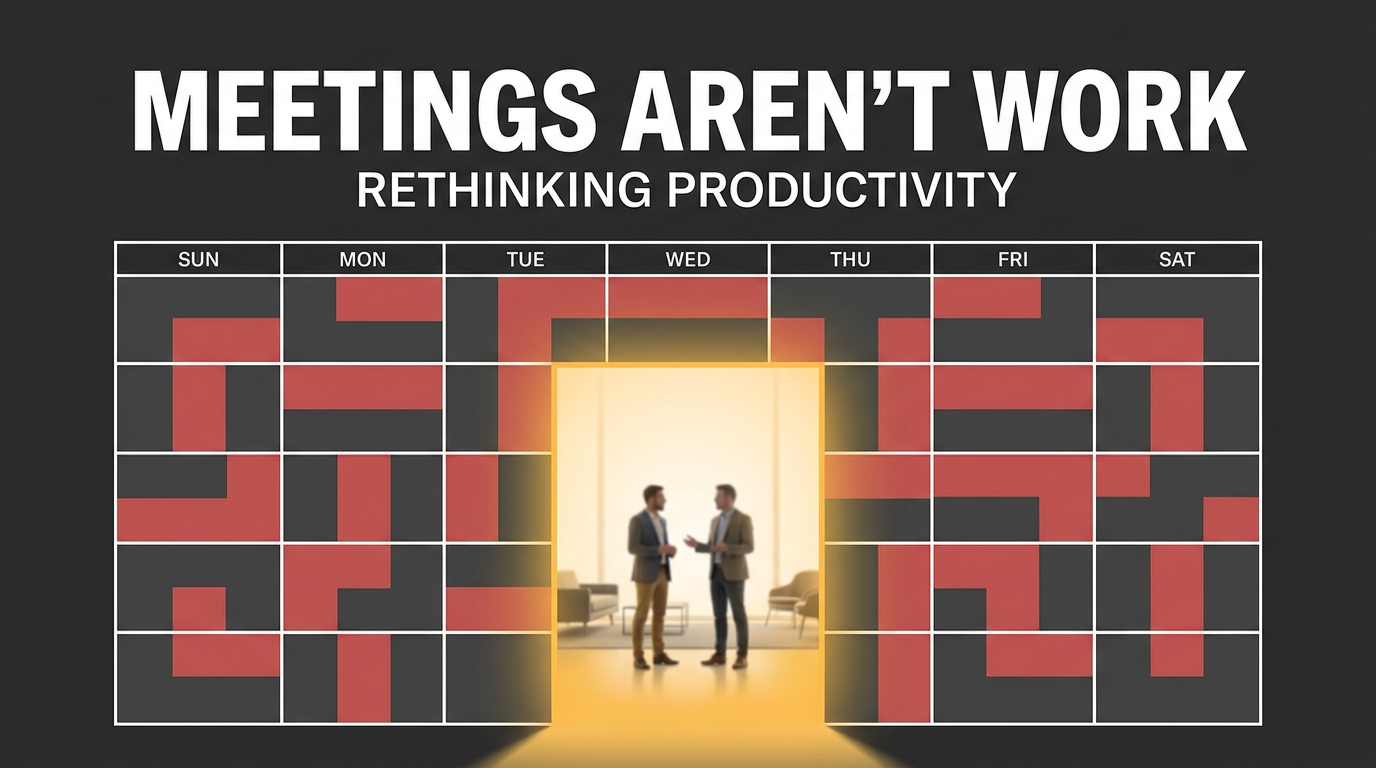
Your full calendar is not proof of productivity. It may be evidence of a broken operating model.
Companies have invested heavily in office space, video conferencing, messaging applications, collaboration platforms, and return-to-office strategies. Yet employees still struggle to find enough uninterrupted time to complete the meaningful work they were hired to do. They move from one meeting to another, pausing just long enough to change links, refill their coffee, or wonder when the actual work is supposed to happen. We have normalized this. We look at calendars packed with color-coded blocks and call it collaboration. We invite more people into meetings “for visibility,” even when most of them will not say a word. We see employees racing from call to call and assume the organization is moving forward.
I am throwing the BS flag.
Being busy is not the same as creating value. Attendance is not the same as contribution. Meetings are not automatically work.
The problem is not whether employees are sitting in an office, working from home, or logging in from somewhere else. The problem is that we digitized meetings without redesigning how work happens. That distinction became unmistakable during my recent conversation with Erik Braund, founder and CEO of Katmai. Erik and his team have spent years building a virtual office platform designed to bring spontaneity, speed, and humanity back to distributed work. His experience offers business leaders a useful challenge: Stop treating every digital interaction as a scheduled meeting and start redesigning work around access, conversation, and co-presence.
Meeting Overload Is an Operating Cost
Meeting overload is usually discussed as an employee-experience issue. It contributes to frustration, fatigue, and burnout, but the impact does not stop there. It is also an operating cost. Every unnecessary meeting carries three expenses: the time spent attending, the focused work it interrupts, and the delay created while everyone waits for an opening on the calendar. That third cost receives far too little attention.
A question comes up on Monday and requires input from three people. Their next common opening is Thursday afternoon, so the decision waits—even if the actual conversation takes five minutes. The issue is not complex. Access is complex. Projects slow down. Customers wait. Employees work around unresolved questions. Leaders wonder why execution takes so long.
We have built an entire system in which next week’s 30-minute meeting replaces today’s five-minute conversation. Erik shared that this is one of Katmai’s customers’ most powerful observations: The virtual office “turns next week’s 30-minute meeting into today’s five-minute conversation.”
That is not simply a memorable line. It describes a meaningful shift in how an organization operates.Meeting time also multiplies across the organization. A one-hour meeting with eight participants consumes eight hours of capacity before accounting for preparation, follow-up, or context switching. Executives scrutinize capital expenditures, vendor contracts, and travel costs. They should bring the same discipline to the way their organizations spend time.
Your people’s time is an investment. Treat it like one.
We Changed the Technology but Kept the Old Rules
Remote work is not new. My business has operated virtually for more than 16 years. We were working across geographies before video calls became the default and before “hybrid workplace strategy” became its own consulting category. We used bridge calls. On actual telephones. Sometimes landlines. And somehow, the work got done.
That is why I have little patience for the argument that employees can only be productive when leaders physically see them sitting at desks. If visible attendance is the primary way you know work is getting done, you may have a management problem—not a location problem. We already know distributed work can work. What many organizations have not figured out is how to design it well. As Erik pointed out, many of the digital tools used for remote collaboration have not meaningfully evolved beyond the old video-call model. The conference room became a link. Walking down the hall became a calendar invitation. Knowing whether someone was available became a green dot that may or may not mean anything. The format changed. The operating model did not.
That is not digital transformation. Real transformation does not transfer an outdated process to a newer platform. It challenges the process itself.
Why does this meeting exist? What decision must be made? Who needs to contribute? Could the information be shared asynchronously? Does the conversation need to happen next Thursday, or could two people resolve it in five minutes today?
If leaders are unwilling to ask those questions, no collaboration platform will save them.
Meeting Fatigue Is a Design Failure
We talk about video-conferencing fatigue as though people are tired of seeing one another. I do not believe human connection is the problem. Erik does not either. In fact, he readily acknowledges that being together in person is often the richest form of interaction. The challenge is that physical offices come with costs and constraints, while conventional digital meetings strip away much of the natural interaction that makes being together valuable.
A useful conversation with a trusted colleague can be energizing. Solving a problem together creates momentum. Sharing an idea and receiving immediate feedback can move work forward faster than a dozen messages.
The fatigue comes from the structure surrounding the interaction.
Employees jump from nothing to a screen filled with faces and then back to nothing. Every interaction becomes an event. Someone schedules it, creates an agenda, controls the room, and ends the meeting. Everyone disappears, only to reappear in another digital room five minutes later. Calendar software has also trained us to think in 30- and 60-minute increments, so conversations expand to fill those containers. If the default duration were 12 minutes, many organizations would discover that a surprising number of issues require exactly 12 minutes. The subject does not always demand half an hour. That is simply the box we selected. Meeting fatigue is not an employee discipline problem. It is a workplace design failure and executives own the design.
Stop Turning Every Interaction into a Meeting
One of Erik’s most valuable challenges to business leaders is also one of the simplest: Stop forcing every interaction to become a meeting.
A meeting is an event. A conversation is an exchange. Meetings require coordination. Conversations create movement.
In a physical office, people do not schedule every question. Someone notices that a colleague is available, walks over, and asks for help. Another person may join because their expertise becomes relevant. The conversation grows or ends according to what the problem requires. That is how a large amount of work gets done in real life: quickly, informally, and with the right people participating at the right time.
This is the experience Erik and his team are attempting to recreate digitally through Katmai. Employees enter a shared 3D environment through a web browser and appear through live video rather than cartoon avatars. They can move through offices and common spaces, recognize who is present, and begin talking when they enter shared audio zones. Employees can also close a virtual door when they need privacy or uninterrupted focus.
The technology is interesting, but the behavioral shift matters more. Colleagues do not have to turn every question into a calendar event. They can have the digital equivalent of walking down the hall. The objective is not to make work look like a video game. It is to restore the speed, spontaneity, and humanity lost when digital work became an endless sequence of appointments.
Culture Is Built in Moments
One of the most important insights Erik shared was this: Culture is built in moments, not meetings. Culture does not live in a mission statement.
It is not manufactured during a team-building exercise, delivered through an executive presentation, or repaired by adding a mandatory virtual happy hour to everyone’s calendar… Please stop scheduling culture.
Culture develops when an employee asks for help and receives it. It grows while colleagues solve a difficult problem. It appears in conversations about customers, creative ideas, mistakes, families, frustrating projects, weekend plans, and the thousand other things that make people human. Erik described eating lunch at his physical desk while logged into Katmai’s virtual office. He wandered over to speak with his chief product officer, and they spent time talking about work, golf, and “nothing and everything.” That informal exchange sparked an idea, led them to another colleague, and resulted in a quick creative decision.
That is how culture and collaboration frequently happen. They emerge through contact rather than an agenda. In a conventional remote environment, employees are usually either in a scheduled meeting or working alone. The space between those states, the place where trust and relationships often form is missing.
A shared digital environment can help restore that middle ground. A two-minute question can remain a two-minute question. A casual exchange can develop naturally instead of arriving disguised as a formal meeting. Not every valuable interaction produces an immediate deliverable. Some produce trust. Trust produces speed later.
Co-Presence Must Not Become Surveillance
Erik uses the term “co-presence” to describe something more meaningful than the colored status indicators found in many workplace applications.
Green supposedly means available. Yellow means away. Red means busy. Or perhaps the application is simply open on a device sitting in another room. Nobody really knows. Meaningful co-presence gives employees a shared environment, a clearer sense of who is available, and a natural way to interact. It must not become another form of employee monitoring.
Let me be clear: The goal is not to prove that someone is sitting at a desk. The goal is to remove friction when people need to collaborate.
Erik emphasized that co-presence must work in both directions, regardless of an employee’s position in the hierarchy. A junior employee may need access to a manager. A leader may need a quick answer from a subject-matter expert. Everyone also needs the ability to close the door, protect deep work, and leave at the end of the day. A virtual office layered on top of a broken meeting culture will not reduce friction. It will simply create another place where friction happens. Co-presence should create access and connection, not surveillance.
More Presence Could Mean Fewer Meetings
Spending substantial time in a virtual office may initially sound like adding more screen time. Katmai’s company-reported figures suggest another possibility. According to Erik, the average Katmai user spends approximately 23 hours per week logged into a virtual office but only about two and a half hours in meetings. The company also reports that 90% of customer meetings are spontaneous and 70% last 15 minutes or less.
These figures have not been independently evaluated here, and executives should always examine how vendors define their metrics. Still, they support a testable proposition: When employees have easier access to one another, they may need fewer scheduled meetings. The logic is straightforward. If I can ask a colleague a question today, I do not need to schedule time next week. If we can make a decision in seven minutes, we do not need to reserve 30. If people can break into natural conversations following a stand-up, they may not need three follow-up calls.
The goal is not more time on video. It is less time trapped in formal meetings.
Reset the Way Your Organization Meets
Leaders do not need to begin with a companywide technology rollout. Start by examining the meetings already consuming your organization’s time.
Every recurring meeting should have a required outcome. If no one can define the decision, action, or result it must produce, cancel it. “Sharing updates” is not automatically a reason to gather people in real time. Written updates exist.
Attendance should also be intentional. Invite the people who need to decide, contribute expertise, or take action. Inform everyone else afterward. Visibility does not require attendance. Then challenge the format. Does the issue require real-time interaction? What is the shortest reasonable duration? Could a written update, shared dashboard, office-hours session, or five-minute conversation accomplish the same thing?
The goal is not to eliminate every meeting. It is to reserve meetings for work that genuinely benefits from them.
Executives should then measure whether the organization works better. Track scheduled meeting hours, decision speed, focus time, after-hours communication, and employee access to leaders and experts. Connect those findings to project delivery, customer response times, employee well-being, and business performance. Technology matters only when behavior changes. Behavior matters only when results improve.
Redesign Work Before Mandating Where It Happens
The debate over remote work and return-to-office mandates is too often reduced to a choice between buildings and isolation.
That is a false choice. In-person work offers real value. So do flexibility, broader access to talent, reduced commuting, and the ability to build teams without geographic limits. Erik and Katmai are challenging leaders to consider what exists between the traditional office and the scheduled grid of faces: a shared digital place designed around co-presence, access, and spontaneous conversation. The larger lesson extends beyond any single platform. Executives must redesign how work happens before deciding where it must happen. Audit your meeting culture. Challenge default durations. Reduce unnecessary attendance. Use asynchronous communication intentionally. Create space for spontaneous interaction. Establish clear boundaries. Measure outcomes instead of visible activity. Most importantly, stop confusing meetings with work.
Your employees were not hired to maintain full calendars. They were hired to solve problems, serve customers, create value, and move the organization forward. Before scheduling your next meeting, ask whether the issue could be handled through a written update or a five-minute conversation. Run the same experiment across your team for one week. Track every meeting you shorten, replace, or eliminate, and calculate how much time you return to meaningful work. Do not begin your workplace transformation with another policy.
Begin by deleting one unnecessary meeting.