
You’ve done everything right. Climbed the ladder, got the title, and built a high-performing team. But instead of feeling fulfilled, you feel a quiet, draining hollowness. The more you achieve, the emptier the wins feel.
That constant, low-grade exhaustion isn’t a sign you’ve failed or that you’re not cut out for this. It’s a symptom of a deeper misalignment. It’s your nervous system signaling a “Silent Collapse”—a state where the gap between your daily actions and your core professional values has become too wide to ignore. The constant friction is burning you out from the inside.
Key Takeaways:
- Professional Values as Your Nervous System Compass: Your values aren’t just corporate jargon. They are the core principles your nervous system uses to determine safety, purpose, and alignment in your career. Misalignment creates a chronic stress response.
- The High Cost of Value Dissonance: Operating against your values triggers a physiological threat response, leading to decision fatigue, burnout, and a feeling of being an imposter, even amid success. This has a quantifiable impact on both you and your organization.
- A Practical Framework for Uncovering Your Values: You can move beyond generic lists by using reflective journaling and distinguishing between surface-level goals (e.g., a promotion) and the deep values that drive them (e.g., mastery or impact).
- Translating Values into Sovereign Leadership: Your values become a practical filter for daily decisions, setting boundaries, and building a career that is a true expression of your authentic leadership, not just a performance.
Your Professional Compass And Why It Matters
 This guide isn’t about adding more to your to-do list. It’s about recalibrating your internal compass so your career becomes a source of energy, not a constant drain. We’ll move you out of that state of quiet collapse and into a place of sovereign leadership, where your work is a true expression of who you are.
What Are Professional Values Exactly?
Professional values are the fundamental beliefs and non-negotiable principles that guide your actions, decisions, and standards in a professional setting. They are the operating system for your career, the invisible force that determines why one choice feels right and another creates a pit in your stomach. When your daily work aligns with these values, you feel energized and engaged.
This internal compass dictates everything, from how you communicate with your team to the leadership philosophy you embody. When your day-to-day work is in sync with deep-seated values like impact, collaboration, or autonomy, you feel an undeniable sense of engagement and flow. As you get clearer on your own compass, understanding the basics of ethical conduct is a great place to start. You can dive deeper with these 10 principles of ethical workplace communication.
For any woman in a leadership role, this alignment is absolutely non-negotiable. It’s the very core of authentic influence. This guide will show you exactly how to find that alignment and start leading from a place of unshakeable integrity and purpose.
The Hidden Cost of Value Misalignment
Have you ever felt like you’re driving with the emergency brake on? You’re hitting your targets, but every single mile feels like a monumental effort. That feeling of constant, grinding resistance is the physiological experience of operating against your core values.
This isn’t just a vague feeling of being “off.” It’s a real neurological event with a steep, hidden price. When your daily actions are in direct conflict with what you hold sacred, your nervous system interprets that mismatch as a chronic, low-grade threat.
This quiet, internal battle puts you in a constant state of fight-or-flight. Stress hormones flood your system, making the clear, strategic thinking you’re known for almost impossible. It’s like trying to draft a brilliant strategy memo while a fire alarm is blaring in the background.
The Neurological Drain of Dissonance
Living in a state of value misalignment is profoundly exhausting. It’s why you procrastinate on a task that looks critical on paper but feels utterly meaningless in your gut. It’s the deep root of imposter syndrome—the voice that whispers you don’t belong, even when your performance reviews are glowing.
This isn’t a personal failing; it’s a predictable neurological response. Your brain burns precious energy just trying to manage the gap between who you are and what you’re doing. This slow, steady drain is a direct path to exhaustion, which is why it’s so critical to start overcoming burnout at work before it truly takes hold.
You are not broken for feeling drained by a role that looks perfect on paper. Your nervous system is simply telling you the truth: you are off course.
The Organizational Impact of Misalignment
This internal struggle doesn’t stay internal. It bleeds out into everything, impacting your team, projects, and the entire organization. The latest data paints a stark picture. A recent Gallup report on the global workplace found that employee engagement has cratered, with only 21% feeling engaged. Gallup directly links this decline to a lack of purpose and genuine team connection—all expressions of core professional values. The economic price tag for this disengagement? A staggering $8.9 trillion annually. Discover more insights from Gallup’s 2025 workplace report.
The signs of this misalignment often start as whispers before they become screams:
- Persistent Unfulfillment: That nagging feeling that even with all your success, something essential is missing.
- Drained Creative Energy: You feel like you’re running on fumes, unable to innovate or think beyond your immediate to-do list.
- Reduced Resilience: Small setbacks suddenly feel like major catastrophes because your internal well is already running dry.
Ignoring these signals isn’t about toughing it out. You are actively draining the very energy, creativity, and resilience you need for authentic leadership.
The RAMS Reframe: How To Identify Your Core Professional Values
Knowing your values feel misaligned is one thing. Naming them is another. This isn’t about picking generic words like “integrity” off a list. It’s an excavation
a process for unearthing the non-negotiable principles that must be present for you to feel powerful and alive in your work. This is where the RAMS (Results, Attitude, Mastery, Systems) framework comes in, providing a structure to build a career that energizes you.
Begin With Reflective Journaling
To find your way forward, you have to look backward. Your past experiences hold all the data you need. Grab a journal and use these prompts to start digging—be brutally specific.
- Peak Fulfillment: Describe a time you felt completely in the zone—energized, engaged, and fulfilled. What were you doing? Who was with you? What specific elements made it so powerful?
- Peak Frustration: Now, flip the coin. Think of a time you felt deeply drained, frustrated, or compromised at work. What was the real conflict? Which of your unspoken rules was being violated?
- Proudest Accomplishment: Reflect on a professional achievement that gives you a deep, quiet sense of pride, whether anyone else celebrated it or not. What about it was so meaningful? The creative challenge, the impact, or the complexity you navigated?
This isn’t about blaming old bosses. It’s about spotting the consistent patterns in your own nervous system’s response to different environments. Your feelings are your most accurate compass.
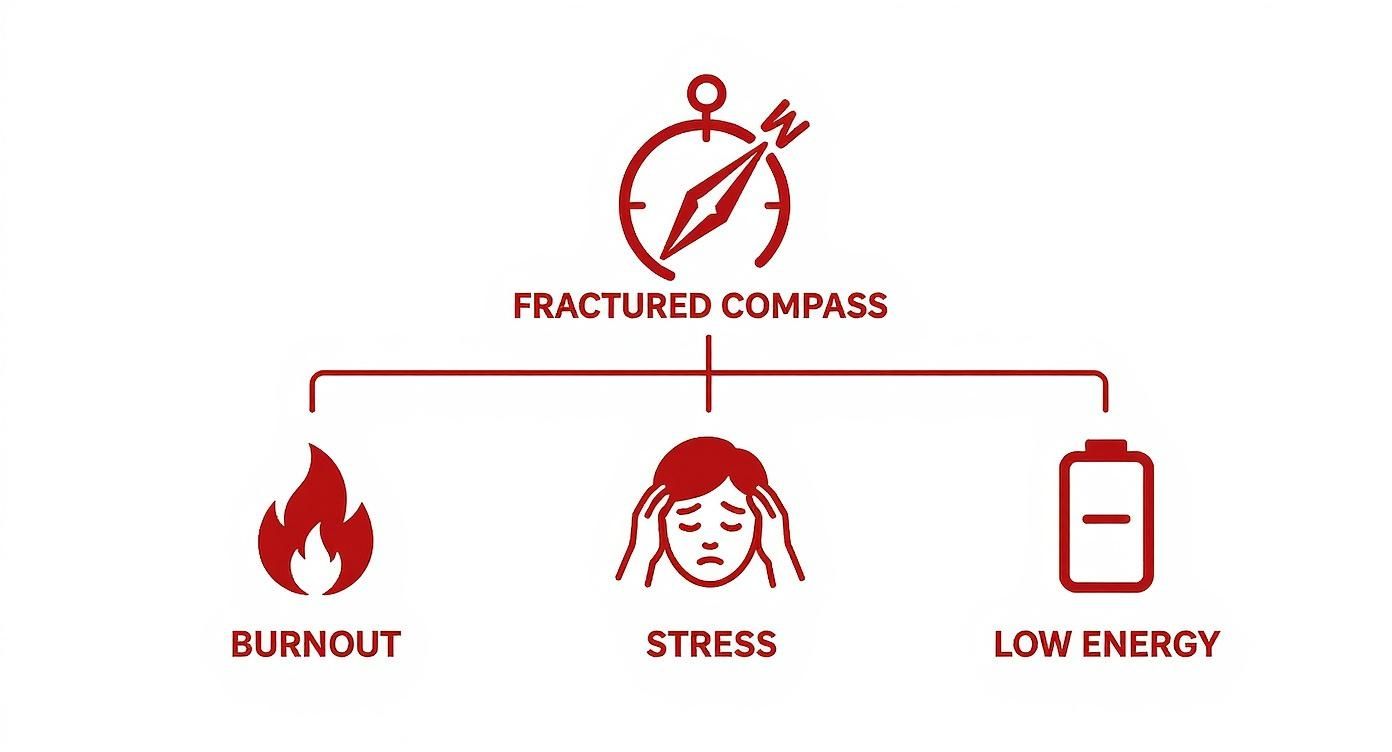 A fractured internal compass isn’t just a metaphor; it’s a direct line to burnout, chronic stress, and depleted energy reserves. That’s the price of living out of alignment with your values
Distinguish Goals From Values
One of the biggest hurdles is confusing surface-level goals with deep, embodied values.
It’s a simple but profound distinction. Goals are destinations; values are the way you travel. A goal is something you achieve, like a promotion. A value is something you live, like leading with compassion. Chasing goals that aren’t aligned with your values is the fastest route to hollow success.
Surface-Level Goals vs. Deep Professional Values
Surface-Level GoalUnderlying Professional Value”Get a promotion to Senior Director.”Impact: The desire to have a broader influence and mentor a larger team.”Increase my salary by 20%.”Security & Autonomy: The need for financial stability that allows for greater freedom.”Lead a high-profile project.”Growth & Mastery: A drive to solve complex challenges and demonstrate expertise.”Achieve work-life balance.”Well-being & Presence: The principle that success should not demand the sacrifice of health.
Getting clear on this difference helps you focus on what truly motivates you. This is a crucial step in reclaiming self-worth without guilt and aligning your career with who you actually are.
The Return: Putting Your Values Into Action
You’ve done the hard work and your ‘Values Blueprint’ is in hand. Now it’s time to breathe life into it. This is the moment your professional values stop being abstract concepts and start becoming your leadership signature. This is your return to yourself.
Use your blueprint as a practical filter for everything—from small decisions to career-defining ones. It becomes the lens through which you see your day, your team, and your path forward.
Using Values as a Decision-Making Filter
Think about how this plays out. A leader driven by efficiency will run a meeting with a rigid agenda, laser-focused on outcomes. A leader whose core value is collaboration will design that same meeting to maximize input, ensuring every voice is heard.
Neither approach is wrong. But only one is authentic to the leader embodying it. When your actions consistently echo your values, your leadership becomes coherent and deeply trustworthy:
This filter applies everywhere:
- Delegating Tasks: Do you hand off work based on who can get it done fastest (efficiency), or who will grow most from the challenge (mentorship)?
- Evaluating Opportunities: Does a new project offer a bigger title (status), or a chance to do deeply meaningful work (impact)?
- Giving Feedback: Is your feedback brutally direct (candor), or delivered with an eye on long-term development (growth)?
When Personal and Organizational Values Clash
One of the most draining challenges is the friction between your personal values and company demands. Your value might be transparency, but the culture rewards withholding information. You might value well-being, but the unspoken rule is 24/7 availability.
This is where your blueprint becomes your anchor. It gives you the clarity to see the disconnect for what it is—not a personal failing, but a fundamental values conflict. This clarity is your permission slip to set firm boundaries, a non-negotiable skill for sovereign leadership. Our guide on how to set boundaries at work offers actionable strategies.
A quick case study:
An operations director, “Sarah,” was on the verge of burnout. Her core value was ‘systematic improvement,’ yet she worked in a chaotic culture that celebrated “firefighting.” After identifying this clash, she stopped participating in the daily chaos. Instead, she used her values filter to propose and implement a new project management system. The initial resistance was intense, but the results—reduced stress and predictable workflows—spoke for themselves. She carved out a space where her values could thrive, transforming her team’s culture and her own job satisfaction.
Future-Proofing Through Value-Driven Growth
Your values are not just an anchor in the present; they are the engine for your future. The World Economic Forum is blunt about this: 39% of a worker’s core skills will need to be transformed by 2030. Their report points to values like resilience and flexibility as essential for staying competitive. You can read the full Future of Jobs Report 2025 digest to see this shifting landscape.
This isn’t a threat; it’s an invitation to root your growth in your own values, guaranteeing your professional evolution is aligned with what genuinely lights you up.
Leading Authentically With Your Values As Your Guide
This entire journey boils down to one powerful truth: Living and working in alignment with your professional values is the ultimate act of self-leadership.
It’s the pivot from chasing external applause to honoring your own internal compass. Your values become the source code for your power, influence, and resilience. This is the heart of what is authentic leadership—an alignment so complete that your actions, words, and energy are all singing the same song. People don’t just follow your instructions; they trust your integrity because they can feel it.
Your most powerful leadership style isn’t one you learn; it’s the one you uncover. It’s been inside you all along, waiting for you to honor its truth.
This work is about reclaiming that truth and returning to yourself. If you’re ready to stop performing and start leading from a place of deep alignment and nervous-system sovereignty, the next step is getting crystal clear on your unique leadership signature.
Burning Questions About Professional Values
It’s natural to have questions as you start digging into this work. Let’s tackle some of the most common ones.
What’s The Real Difference Between Personal And Professional Values?
Think of it this way: your personal values are the operating system for your entire life—core principles like integrity, connection, or freedom.
Professional values are how that core code gets expressed in the unique context of your work. They’re the specific principles you refuse to compromise on in your career, like collaboration, radical candor, or autonomy. One flows from the other. Your personal value for community might translate into a professional value for teamwork and psychological safety.
What Do I Do When My Values Clash With My Company’s?
First, get incredibly clear. What specific value is being violated? Is it a core, soul-level principle? Once you’re clear, you can decide your next move. Is this a moment to set a firm boundary or propose a different path? Can you have a direct conversation?
But if a core, non-negotiable value is consistently trampled, that’s not just a conflict—it’s a signal. It’s powerful data telling you that this environment may not be the right place for you to thrive long-term.
How Often Should I Revisit My Professional Values?
Your values evolve as you do. A good rhythm is to do a check-in at least once a year. It’s also critical to reassess them anytime you’re facing a major career crossroads—a promotion, a new role, or a significant change in your industry. This ensures the path you’re on is still aligned with the woman you are now, not the one you were five years ago.
Are you ready to stop chasing a version of success that leaves you feeling empty and return to yourself? Baz Porter provides the framework to transition from exhaustion-driven performance to embodied, sovereign leadership.
Discover the RAMS Method and begin your journey toward nervous-system sovereignty. Start here.