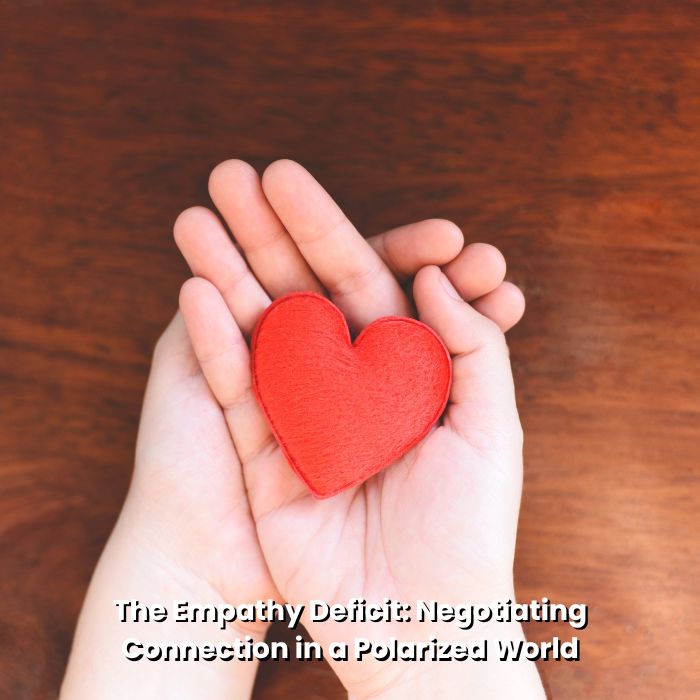
Have you ever felt like the world’s just… louder these days? Like everyone’s shouting, but no one’s really listening?
We’re living in polarized times. It’s not just political debates or social media arguments. It’s at family dinners. In boardrooms. Between friends. Even within ourselves. Lines get drawn. Opinions harden. And suddenly, connection starts to slip away—not because we disagree, but because we’ve forgotten how to disagree with grace.
In this climate, empathy has become a radical act. A form of resistance. A strategic superpower. And at its heart, a core tenet of The Art of Feminine Negotiation.
We’re Not Just Divided—We’re Disconnected
It’s easy to blame algorithms and politics, but the truth is more intimate. We’ve stopped being curious about each other. We’ve replaced conversation with confrontation, understanding with certainty, and vulnerability with performance.
This isn’t just happening in public spaces—it’s happening in our most personal ones, too. In our relationships. Our partnerships. Our communities. And it’s taking a toll.
The result? An empathy deficit. And like any deficit, it comes at a cost: trust erodes, opportunities are missed, and relationships fracture.
Empathy Isn’t Weakness—It’s Leverage
Let’s bust a myth right now: empathy isn’t about being nice or passive or avoiding conflict. It’s not about abandoning your beliefs to make someone else feel better.
Empathy is power. It’s what allows us to understand what’s truly driving someone’s behavior—not just what they’re saying, but what they need. And when we understand that, we can respond more effectively, more strategically, and with far greater impact.
That’s feminine negotiation in action. It’s not about domination. It’s about influence. Connection. Collaboration. Choosing to understand, even when it’s uncomfortable.
Listening to Understand (Not Just to Win)
One of the simplest—and most profound—shifts we can make is to start listening with the intention of understanding, not responding.
Most people listen with their rebuttal already loading. They’re not really in a conversation. They’re in a performance.
But what if we got curious instead? What if we asked questions like:
- What’s really behind this reaction?
- What are they afraid of losing?
- What values are they trying to protect?
Those questions don’t make us weak. They make us wise.
Empathy with Boundaries Is Still Empathy
Now let’s be clear: empathy doesn’t mean tolerating toxicity. It doesn’t mean you have to stay in conversations that are abusive, demeaning, or unsafe.
You can have empathy and boundaries. You can say, “I see where you’re coming from—and I’m sure you prefer to treat people with dignity and respect, but I feel like we’re off track and maybe need to take a step back for now.”
Empathy without boundaries is martyrdom. But empathy with boundaries? That’s leadership. Feminine leadership at its finest.
Reclaiming Empathy as a Feminine Strength
In a culture that often rewards volume over values, choosing empathy is a rebellious act. It takes courage to listen when you’d rather shout. To soften when everything in you wants to armor up. To see the human being underneath the opposing opinion.
But this is exactly the kind of negotiation that changes the world.
It doesn’t always win headlines. It doesn’t always win arguments. But it builds trust. It opens hearts. It lays the groundwork for real, lasting change.
So, How Do We Start?
Here are a few small (but mighty) ways to start negotiating connection—especially when you disagree:
- Truly listen with a view to understanding. Don’t simply wait for your turn to speak.
- Pause before reacting. Ask yourself: What’s underneath their position?
- Lead with curiosity. Replace judgment with genuine inquiry.
- Use “I” statements. Reduce defensiveness and create space for vulnerability.
- Speak from your values. Not just your volume.
- Hold your center. Empathy doesn’t require you to lose yourself—it requires you to remember yourself.
Empathy is not a soft skill. It’s a powerful negotiation tool. And in these noisy, divided times, it might just be our most valuable currency.
Let’s be the ones who bring it back.