Quick take
- The average New York street vendor cleared about $35,000 in profit in 2019, according to the city’s Independent Budget Office. Food vendors did a little better, at about $40,000.
- Yes, Central Park costs more. A lot more. One cart by the Central Park Zoo paid the city $289,500 a year for its spot.
- Why it matters now: NYC Parks is lining up new five-year contracts for eight Central Park cart spots, running January 2027 through 2031. Every one of them is a bet on foot traffic.
Mohammad Mastafa ran one cart. Just one. It sat at Fifth Avenue and East 62nd Street, by the Central Park Zoo. And according to The New York Times in 2013, he paid the city’s parks department $289,500 a year for the right to park it there.
Do the math. $289,500 divided by 365 days is about $793 a day. At around $4 a hot dog, that’s roughly 198 hot dogs a day, every day of the year, before he’s paid for a single bun, a can of soda or a gallon of propane. The Times reported he needed nearly $500,000 a year in sales just to break even. That’s about $1,370 a day.
So why would anyone pay that? Same reason a retailer pays Fifth Avenue rent. The customers are already standing there.
So what does a regular vendor make?
Far less than the zoo cart’s rent. The city’s Independent Budget Office estimated the average vendor’s annual profit at about $35,000 in 2019: roughly $40,000 for food vendors and $30,000 for general merchandise vendors.
Dan Rossi, who calls himself New York’s “Hot Dog King,” has worked the bottom of the Metropolitan Museum of Art’s steps since 2007. In a day with Morning Brew, he put his numbers at about $1,000 in sales and $600 in profit on a good day, with about $350 a day in supplies. A used cart runs $2,000 to $3,000, and the commissary where carts are stored and cleaned costs about $250 a month.
His warning: people see a line at a cart and assume the vendor is getting rich. It’s not that simple.
How you get a spot, three ways
1. The street, with a city permit. To sell food from a cart on a New York sidewalk, you need a vending license and a permit from the Health Department. The city caps food vending permits at about 5,100, and in October 2023 the waitlist had 9,878 names on it. A 2021 law adds 445 new permits a year through 2032.
Here’s the catch. The city charges at most $200 for a full-term permit. But because there aren’t enough to go around, many vendors rent one from someone who already has it. The IBO found those under-the-table rentals averaged about $17,000 a year. Put that next to the average vendor’s $35,000 profit, and the rent on a piece of paper is about half of what a typical vendor clears.
With a street permit, nobody assigns you a corner. You pick any spot that follows the rules. The city’s siting rules require you to leave 12 feet of clear sidewalk, stay 20 feet from any building entrance and 10 feet from crosswalks, subway entrances and driveways, and keep off bus stops and taxi stands. Good corners are first come, first served, which is why vendors guard them. Rossi has slept in a lawn chair by his cart or in his van most nights for years to hold his spot, according to Washington Square News.
2. The park, with a winning bid. Here’s the answer to the Central Park question. A regular street permit doesn’t let you sell on the sidewalk bordering a park. Inside and around city parks, NYC Parks auctions specific spots through sealed bids. When Parks put 10 Central Park cart contracts up for bid in 2011, DNAinfo reported that Parks set minimum bids based on foot traffic, contracts ran five years, fees were expected to rise 5% a year, and the winning bid became the vendor’s annual fee, paid monthly. Parks also capped prices, at the time $2 for a hot dog and $1.25 for a can of soda.
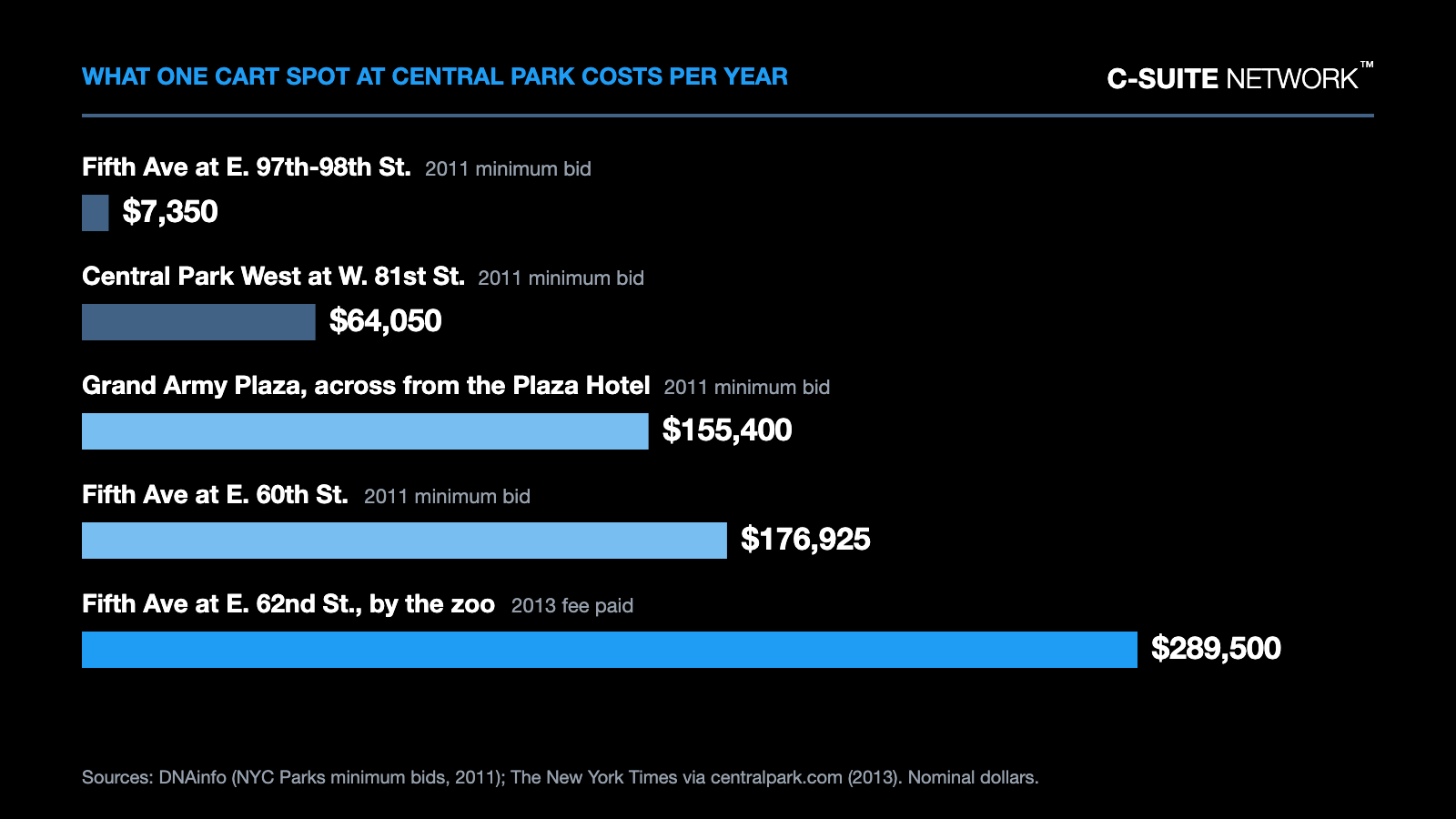
Look at the spread in those 2011 minimum bids. A spot on Fifth Avenue at East 97th Street started at $7,350. A spot on Fifth Avenue at East 60th Street started at $176,925. That’s about 24 times more for a cart 37 blocks south, on the same avenue, along the same park. One of the pricier spots, Grand Army Plaza, sits directly across from the Plaza Hotel, which closes in January for four years. Whoever holds that corner next is about to learn what a missing hotel does to foot traffic.
3. The veteran exception. New York has long given veterans special vending rights. Rossi, a Marine Corps veteran, holds Health Department permits designated for veterans that let him sell outside the Met without paying high fees. It’s one of the best corners in the city, and he didn’t win it at an auction.
When the bid is too big
This is the part that should make every owner wince. In 2008, a vendor bid $643,000 for two spots outside the Met. Sales didn’t come close to covering it, and he struggled to make his monthly payments.
“A lot of individuals jump into the game thinking there’s a lot of money to be made,” Cliff Stanton, co-owner of pushcart supplier United Snacks, told DNAinfo. After overhead, he said, vendors “are generally left with pennies if they’re lucky.”
The lesson isn’t really about hot dogs. A cart is about the simplest business there is: one product, one location, one person. That makes the math impossible to hide. Location is either rent you pay up front or customers you never see. The only question is whether the traffic is worth the price, and the vendor who bid $643,000 found out the hard way that a famous address doesn’t guarantee the sales to pay for it.
Before Your Next Meeting
- Turn your rent into a daily number. Divide your annual location cost by 365, then by your average sale. That’s how many customers you need before you’ve earned a dollar.
- Price the traffic, not the address. Parks sets cart prices by foot traffic. Do the same with your locations, booths and ad placements.
- Watch out for one fixed cost that can sink you. The $643,000 bid didn’t fail because of hot dogs. It failed because one fixed cost was bigger than the sales could support.
- Know when your foot traffic is about to change. A hotel closing, an office emptying, a road project. The vendor across from the Plaza is about to find out. Make sure you see your version of that coming.
Sources: NYC Independent Budget Office; CentralPark.com; The Billfold, citing The New York Times; DNAinfo; NYC Parks vending locations notice, September 2026; NYC mobile food vendor siting rules; NewYork.com on Morning Brew’s video; Washington Square News; Saveur. Featured photo: Christoph Birken on Unsplash.