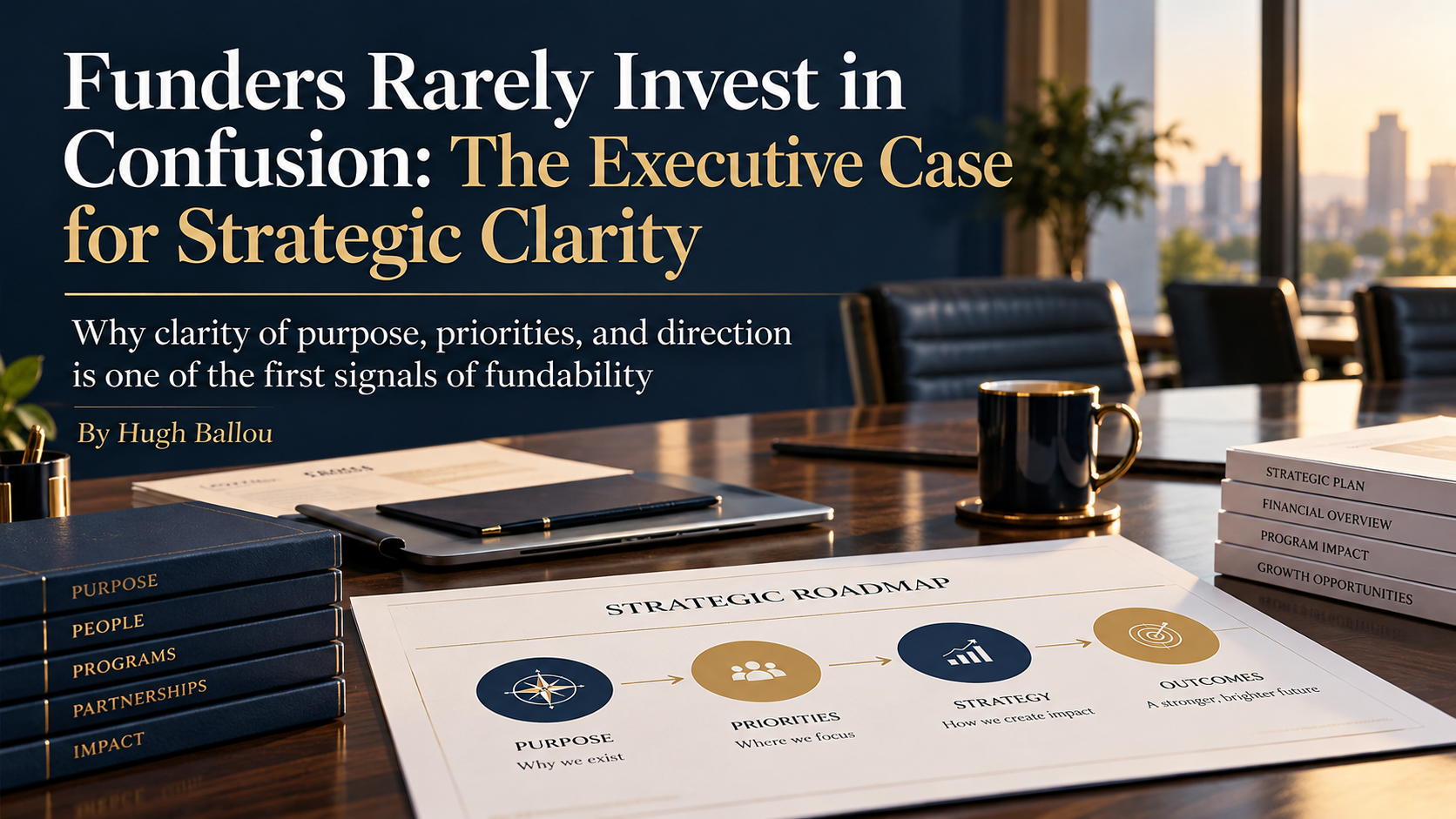
Funders Rarely Invest in Confusion: The Executive Case for Strategic Clarity
Why clarity of purpose, priorities, and direction is one of the first signals of fundability
By Hugh Ballou
Ambiguity has an executive cost. When leaders cannot clearly define the problem they exist to address, the future they are trying to create, and the priorities that deserve resources now, funders do not simply hear an imperfect message. They perceive strategic risk.
That risk shows up in subtle ways. A proposal may be well written, but the website tells a different story. The mission statement sounds broad, while the budget reflects a collection of unrelated activities. Board members describe the organization differently from staff. Outcomes are difficult to define because the underlying problem has never been stated with precision.
For a serious funder, those inconsistencies raise a larger question: Does this organization know what it is trying to accomplish well enough to steward additional resources responsibly?
Clarity of strategy is often the first visible signal of disciplined leadership.
Clarity Is a Leadership Discipline
Strategic clarity is not primarily a branding exercise. It is not achieved by polishing a slogan, shortening a mission statement, or hiring someone to improve the website. Those things may help communication, but they cannot substitute for executive alignment.
Clarity begins when leaders have made real choices. They understand the problem, the future state they want to influence, the role the organization is uniquely positioned to play, and the priorities that matter most now. They can explain those choices consistently to staff, board members, donors, partners, and funders.
This is why clarity is a fundability issue. A clear organization is easier to understand, easier to evaluate, and easier to trust.
Vision and Mission Are Not the Same Thing
One of the most common sources of confusion is the failure to distinguish vision from mission.
Vision describes the future condition the organization wants to help create. It answers: What will be different in the world or community if this work succeeds?
Mission describes the organization’s contribution to that future. It answers: What do we do, for whom, and toward what meaningful result?
When vision and mission are blurred together, strategy becomes harder to evaluate. Leaders may describe activities as if they were outcomes, or they may use aspirational language without explaining the organization’s actual role. A clear distinction helps funders understand both the destination and the organization’s contribution to reaching it.
Values Matter Only When They Shape Choices
Most organizations have values. Fewer use them as decision standards.
A value has strategic meaning only when it influences behavior, tradeoffs, and priorities. If collaboration is a stated value, does the organization build partnerships rather than duplicate services? If stewardship is a value, does the budget show disciplined allocation of resources? If transparency is a value, are challenges and variances communicated candidly?
Values become credible when they can be observed in decisions. Otherwise, they remain decorative language.
The Problem Must Be Clear Before the Solution Can Be Credible
Vague problem definition creates downstream confusion. If leaders cannot clearly explain who is affected, what is happening, what evidence supports the concern, why it matters now, and what happens if nothing changes, then nearly every other part of the organization becomes harder to align.
Programs may drift because there is no clear test for whether an activity addresses the actual problem. Budgets may become collections of historical commitments rather than expressions of strategy. Outcomes may measure volume rather than meaningful change. Board priorities may diverge. Funding requests may emphasize urgency without demonstrating a coherent logic for investment.
A clear problem statement creates a strategic anchor. It gives leaders a basis for deciding which solutions make sense, which outcomes matter, which costs are justified, and which opportunities should be declined.
Clarity Creates Resource Discipline
Strategic clarity has a direct relationship to resource discipline. A clear organization knows not only what it intends to do, but also what it will not do.
That matters because nonprofit leaders are constantly presented with attractive opportunities: a new grant, a new partnership, a new program request, a new audience, or a new funding source. Without clarity, nearly every opportunity can appear mission-related. Over time, the organization becomes broader, busier, and less coherent.
With clarity, leaders can ask better questions: Does this opportunity address the problem we have defined? Does it move us toward the future we have named? Does it fit our mission and values? Does it strengthen our priorities or distract from them? What will we stop doing if we say yes?
Those are executive questions. They are also stewardship questions.
The Executive Clarity Test
There is a simple way to test whether strategic clarity is real: remove the documents.
Ask executive leaders, key staff members, and board members—independently—to explain the following in plain language:
· What problem does this organization exist to address?
· What future condition are we working toward?
· What is our specific contribution to that future?
· What principles guide our major decisions?
· What are the top priorities that deserve resources now?
If the answers are substantially different, the problem is not simply communication. The organization may have an alignment gap.
That gap matters to funders because they are not evaluating a document in isolation. They are evaluating whether the organization behind the document can carry the promise consistently.
Before You Rewrite the Proposal, Test the Organization
When a funding request underperforms, the natural response is often to improve the proposal: sharpen the language, strengthen the story, add evidence, or clarify the ask. Those steps may be useful, but they should not be the first move if the organization itself is unclear.
Before revising the next funding case, conduct a strategic clarity review. Test whether vision, mission, values, problem definition, priorities, programs, outcomes, budget, and board language all point in the same direction.
Funders rarely invest confidently in confusion. Clarity does not guarantee funding, but it gives funders something essential: a coherent organization they can understand, evaluate, and trust.
Executive Challenge
Conduct a strategic clarity review before building the next funding case. If your board and staff cannot explain the same problem, future, mission, and priorities without reading from a document, fix the alignment before polishing the ask.
Source note: This article is based on Hugh Ballou’s book Creating a Fundable Nonprofit: Building the Organizational Condition That Creates Funder Confidence. Learn more at NonprofitFundability.org.
More on Hugh Ballou at http://AboutHughl.com