Executive Guide for Business Leaders, Board Members, and Operational Decision-Makers
Why Most Businesses Don’t Have a Cybersecurity Problem, Until They Do
Many business leaders assume cybersecurity is an IT problem. Most organizations operate for years without experiencing a highly visible security incident. Because business operations appear normal, leadership often assumes security controls are effective. Unfortunately, many cyber risks remain hidden until an assessment reveals them or an incident exposes them.
However, cybercriminals don’t see it that way; they see a business opportunity.
Whether it’s ransomware, business email compromise, stolen credentials, data breaches, or cloud account compromise, today’s attacks increasingly target small and mid-sized organizations. Attackers know many companies lack security visibility even when they have invested heavily in technology.
The challenge is that cybersecurity risk often remains invisible until a significant event occurs.
Most organizations continue operating normally until an employee or contractor clicks a phishing link, an executive’s credentials appear on the dark web, a cloud application is misconfigured, or a publicly exposed system becomes an easy target.
At that point, what appeared to be an isolated technical issue quickly becomes a business issue involving operations, revenue, reputation, compliance obligations, customer trust, and potentially cyber insurance coverage.
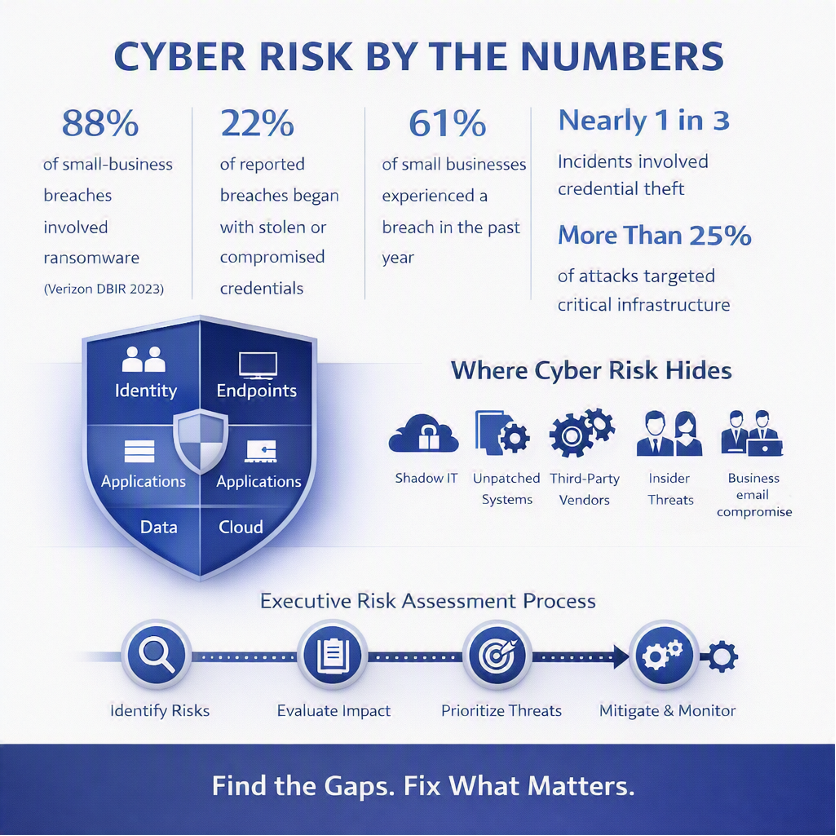
The data tells a compelling story.
“Most organizations aren’t breached because they lack technology. They’re breached because operational, security, and governance gaps remain hidden until an attacker discovers them first.”
Cyber Risk Has Become a Business Risk
Cybersecurity is no longer simply an IT concern. It has become a business risk issue that affects operations, revenue, customer trust, insurance requirements, compliance obligations, and long-term enterprise value. Many organizations assume they are adequately protected because they have antivirus software, firewalls, backups, and cloud applications. Yet cybersecurity incidents rarely occur because a company failed to purchase technology. They occur because leadership lacked visibility into the actual risks that existed across the organization.
- A former employee account remains active.
- A critical application has not been patched.
- Sensitive information is overshared.
- Multi-factor authentication is only partially deployed.
- Third-party vendors have unexpected access to company data.
Individually, these issues may appear insignificant. Together, they create attack paths that can be exploited with serious consequences.
The purpose of a cybersecurity risk assessment is simple:
Identify those attack paths before an attacker does.
Cybersecurity Compliance and Cyber Insurance
Organizations pursuing cyber insurance, CIS Controls alignment, NIST guidance, or industry-specific compliance requirements should include these obligations as part of their cybersecurity risk assessment process.
Common Cybersecurity Risks Every Business Should Assess
Identity and access, endpoint devices, applications, data, cloud services, compliance processes, and workforce awareness represent the most common sources of hidden risk. Each area should be reviewed as part of a business cybersecurity assessment.
Most risks fall into seven categories.
Identity & Access
Compromised credentials remain one of the most common attack paths.
Organizations frequently discover:
- Excessive administrator privileges
- Dormant user accounts
- Missing MFA enforcement
- Weak password practices
Could a stolen password provide access to sensitive company data?
Endpoint Devices
Every laptop, workstation, smartphone, and server represents a potential entry point.
Common findings include:
- Missing security updates
- Unsupported operating systems
- Unmanaged devices
- Endpoint protection gaps
Do we know the security posture of every device accessing company data?
Applications
Organizations rely on dozens, and sometimes hundreds, of business applications.
These can introduce risk through:
- Vulnerable software
- Third-party integrations
- Shadow IT
- Excessive permissions
What applications currently have access to our most important business information?
Data
Sensitive information often exists in more places than leadership realizes.
Examples include:
- Customer records
- Financial information
- Employee information
- Intellectual property
Do we know where our most sensitive information resides and who can access it?
Cloud Services
Microsoft 365, Google Workspace, Salesforce, Dropbox, and other SaaS platforms create tremendous business value.
They can also create hidden exposure when improperly configured.
Are our cloud platforms configured according to current security best practices?
Compliance & Governance
Compliance should not be viewed as paperwork.
It creates operational discipline, accountability, and measurable improvement.
Can we demonstrate due diligence to customers, partners, insurers, auditors, and regulators?
Workforce Training & Awareness
People and security awareness are often the most overlooked part of cybersecurity risk. Employees, contractors, and temporary workers routinely handle email, access cloud applications, use shared data, approve payments, and interact with customers and vendors. Without ongoing training, clear policies, and regular reinforcement, even strong technical controls can be bypassed by phishing, credential theft, social engineering, unsafe data handling, or simple process mistakes.
Organizations should assess whether employees and contractors receive role-appropriate cybersecurity awareness training, whether phishing simulations or practical exercises are used, whether new hires and third parties are trained before receiving access, and whether policies for data handling, password hygiene, payment approvals, and incident reporting are understood and followed.
Do employees and contractors know how to recognize, avoid, and report the most common cyber threats they face in their daily work?
Microsoft 365 Security Assessment Considerations
For many organizations, a Microsoft 365 security assessment provides the fastest way to identify identity, access, data protection, and configuration gaps. Because Microsoft 365 often contains critical business data, it should be a priority area during any cybersecurity risk assessment.
Not All Vulnerabilities Carry Equal Risk
Effective risk assessments prioritize findings based on business impact, data sensitivity, exploitability, privilege level, and internet exposure.
One of the biggest mistakes organizations make is treating every cybersecurity finding equally.
- Finding 500 vulnerabilities sounds alarming.
- Finding five vulnerabilities tied to privileged identities and sensitive customer data is far more important.
Effective risk assessments prioritize findings based on:
- Business impact
- Data sensitivity
- Exploitability
- Privilege level
- Regulatory implications
- Internet exposure
The goal is not to fix everything immediately. The goal is to reduce the greatest amount of business risk in the shortest amount of time.
“Risk reduction matters more than vulnerability counts.”
Questions Every Executive Should Ask
These questions form the foundation of an effective cybersecurity program.
1. Do we know what we have?
Organizations cannot protect assets they cannot see.
Create and maintain an inventory of:
- Devices
- Users
- Applications
- Cloud services
- Sensitive data
Without visibility, security investments become guesswork.
2. Do we know our highest-risk exposures?
Not every vulnerability deserves the same attention.
Focus first on:
- Privileged identities
- Sensitive data
- Internet-facing systems
- Credential exposure
- Critical business applications
This is where organizations achieve the fastest risk reduction
3. Do we know our compliance obligations?
Whether driven by customer requirements, cyber insurance expectations, contractual obligations, or industry regulations, organizations must understand the controls they are expected to maintain.
Compliance should support risk management, not replace it.
4. Do we have a remediation plan?
A cybersecurity risk assessment should not end with a report.
It should produce a prioritized roadmap that clearly identifies:
- What should be fixed
- Why it matters
- Who owns the task
- How success will be measured
Organizations that improve security consistently treat cybersecurity as an operational discipline rather than a one-time project.
5. Are our employees and contractors prepared to recognize cyber threats?
Organizations should not assume people will know what to do under pressure.
Security awareness, phishing readiness, safe data handling, payment verification, and incident reporting should be reinforced regularly so the workforce becomes part of the control environment rather than an unmanaged source of risk.
How Often Should Businesses Perform a Cybersecurity Risk Assessment?
Most organizations should perform a comprehensive cybersecurity risk assessment at least annually and whenever significant business, technology, or compliance changes occur.
Risk assessments should also be revisited after:
- Mergers or acquisitions
- Cloud migrations
- Major technology projects
- Regulatory changes
- Security incidents
Cybersecurity Is Ultimately About Business Resilience
The most successful organizations no longer view cybersecurity as a technology initiative. They view it as a business resilience strategy focused on reducing operational risk and protecting business outcomes.
The conversation shifts from:
“What security tools should we buy?”
to:
“What risks could materially impact our customers, operations, revenue, reputation, and future growth?”
That is a far more strategic discussion.
It is also the conversation boards, customers, insurers, regulators, and business partners increasingly expect organizations to have.
“Cybersecurity is no longer an IT discussion. It is a business resilience discussion.”
COMPLIMENTARY EXECUTIVE CYBER RISK ASSESSMENT
Request Your Executive Cyber Risk Assessment
This assessment is designed to help business leaders gain visibility into the risks most likely to affect operations, insurance readiness, compliance, customer trust, and business continuity.
Your assessment can help identify:
- Internet-facing vulnerabilities
- Identity and credential exposure
- DNS and website security risks
- Dark web exposure indicators
- External attack surface visibility
- Microsoft 365 security gaps
- Compliance and governance considerations
- Workforce readiness risks
The Goal:
- Identify the gaps.
- Prioritize what matters.
- Reduce risk before attackers, insurers, auditors, or customers force the issue.
Ideal For:
- Business Owners
- CEOs
- COOs
- Managing Partners
- Technology Leaders
- Organizations preparing for compliance, cyber insurance, mergers, acquisitions, or growth initiatives
Whether you are evaluating cyber insurance requirements, improving Microsoft 365 security, preparing for compliance audits, or simply trying to understand your current cyber risk posture, a professional cybersecurity risk assessment provides the visibility needed to make informed decisions.
To request your complimentary Executive Cyber Risk Assessment, contact Ultimate Managed IT at info@ultimatemanagedit.com
Find the Gaps. Fix What Matters.
Why Ultimate Managed IT
We help small and mid-sized businesses achieve enterprise-class IT operations, cybersecurity, and reliability. Through a 24×7 Service Desk, proactive endpoint management, cybersecurity protection, and infrastructure support, Ultimate Managed IT helps organizations keep users productive, systems available, and security risks minimized. By reducing downtime, improving operational stability, and providing around-the-clock support, Ultimate Managed IT enables business leaders to focus on growth and serving their customers.
Contact us today at info@ultimatemanagedit.com to learn how our proactive managed IT services help reduce downtime, strengthen security, and ensure your employees have the reliable technology they need to drive business success.