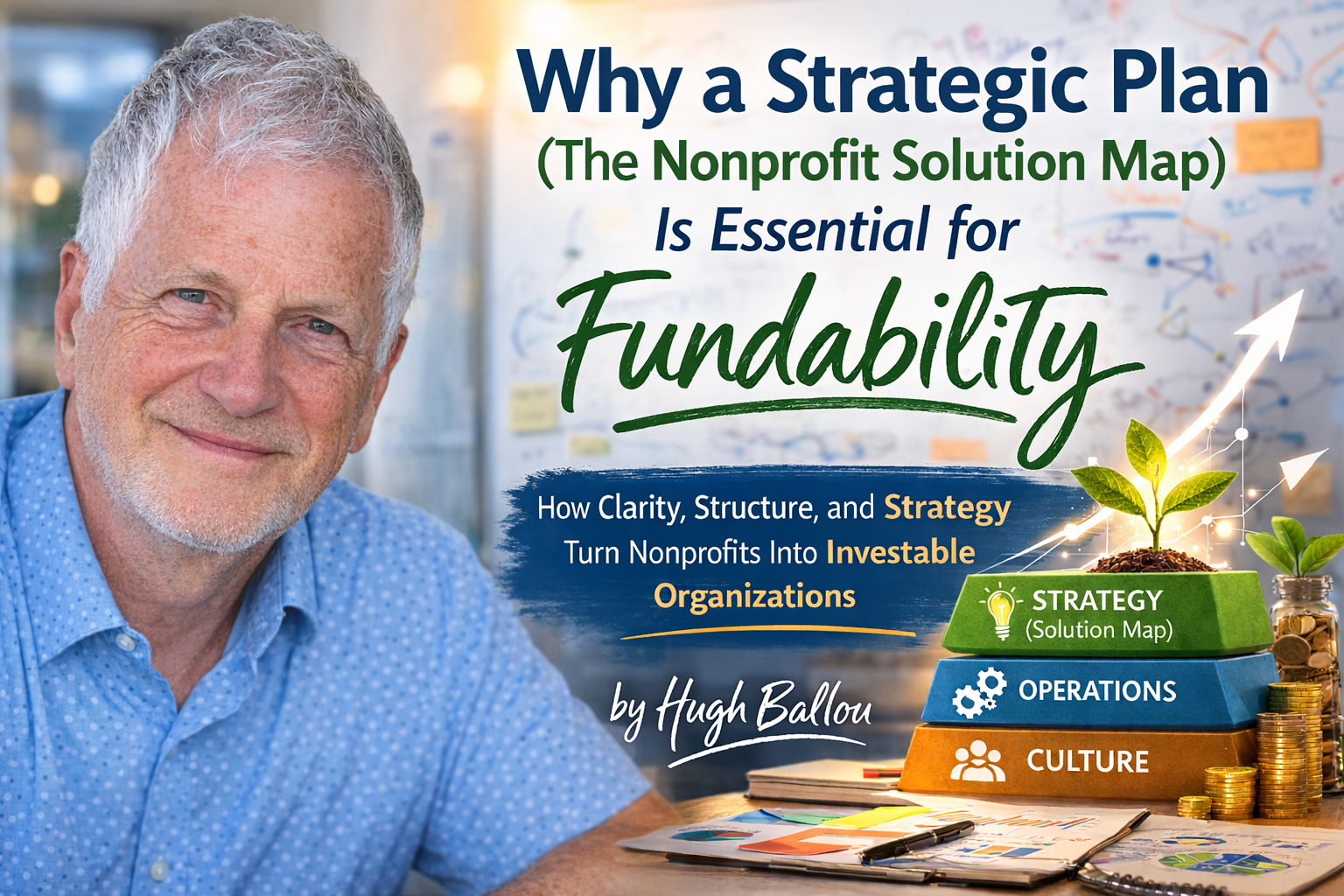
Why a Strategic Plan (The Nonprofit Solution Map) Is Essential for Fundability
How Clarity, Structure, and Strategy Turn Nonprofits Into Investable Organizations
By Hugh Ballou
Nonprofit leaders rarely struggle because they lack passion. They struggle because passion alone is not a strategy. After years of working with organizations of every size and mission, I’ve seen the same pattern repeat itself: the nonprofits that consistently attract sustainable funding are the ones that can clearly articulate where they are going, how they will get there, and how they will measure progress along the way.
The organizations that cannot do this—no matter how heartfelt their mission—find themselves stuck in a cycle of chasing grants, scrambling for donations, and trying to “sell” programs that funders don’t fully understand.
This is why I teach nonprofit leaders to build what I call a Solution Map. It is more than a strategic plan. It is a blueprint for impact, a communication tool for funders, and a decision-making guide for leaders. It is the difference between hoping for funding and becoming fundable.
“Strategy is not a document—it’s a discipline. It’s the ongoing practice of making your choices match your mission.” — Hugh Ballou
What a Solution Map Really Is
A Solution Map is a clear, structured explanation of the change your organization intends to create and the strategy you will use to create it. Funders are not simply looking for organizations that care about a problem. They are looking for organizations that understand the problem, have a thoughtful solution, and have the operational discipline to execute that solution consistently.
A strong Solution Map answers the questions funders are already asking in their minds:
- What exactly are you trying to change?
- Why does this problem exist?
- What is your approach to solving it?
- Why is your approach the right one?
- How will you measure progress?
- How will you sustain the work?
When a nonprofit can answer these questions clearly and confidently, it becomes far more attractive to donors, foundations, and corporate partners. Funders invest in clarity, not confusion.
The Core Elements of a Fundable Solution Map
Vision: The Future You Are Working Toward
Vision is the long-term picture of success. It describes the world your organization is trying to create. A compelling vision is not about what you do—it’s about what will be different because you exist.
A strong vision statement inspires people to join you. It gives funders a sense of possibility and purpose. It answers the question: What does success look like in the long run?
Mission: The Work You Do Today
If vision is the destination, mission is the vehicle. Mission explains what your organization does, who you serve, and why your work matters. It connects your daily activities to your long-term vision.
Funders want to see that your mission is focused, actionable, and aligned with the change you want to create.
Defining the Problem: The Missing Step Most Nonprofits Skip
Many nonprofits jump straight to describing their programs without ever articulating the problem they are trying to solve. This is a critical mistake.
Funders need to know that you understand the problem deeply—its causes, its consequences, and the gaps that currently exist in the system. When you define the problem clearly, your programs make sense. Without this step, your programs feel disconnected and arbitrary.
The Solution: Your Strategy for Change
This is where you explain how you will address the problem. Your solution may include programs, services, partnerships, advocacy, or community engagement.
The key is to show that your solution is intentional, evidence-informed, and aligned with the problem you described. Funders want to see that your approach is not random. It is strategic.
Unique Value Proposition: Why Your Approach Matters
In a crowded nonprofit landscape, funders need to understand what makes your organization distinctive. Your unique value proposition explains why your approach is effective, innovative, or necessary.
This is not about competition, it’s about clarity. Funders want to know why your organization is the right one to invest in.
Long-Term Objectives and Short-Term Goals
A Solution Map breaks your strategy into measurable components. Long-term objectives describe the major outcomes you want to achieve. Short-term goals and monthly milestones create momentum and accountability.
Funders want to see that you have a plan for progress—not just hope for it.
Action Plans and Metrics
Action plans translate strategy into execution. They outline the specific steps your team will take to achieve your goals. Metrics provide evidence that your strategy is working.
Funders trust organizations that can show progress, not just promise it.
Why a Solution Map Makes You Fundable
When these elements are clearly articulated, a nonprofit becomes fundable because funders can see:
- The strategy — You know what you’re doing and why.
- The impact — You can show how your work creates change.
- The discipline — You have a plan, not just passion.
- The accountability — You measure what matters.
- The sustainability — You have a roadmap for long-term success.
Fundraising becomes easier because you are no longer asking people to “support your programs.” You are inviting them to invest in a well-designed solution to an important problem.
Funders don’t want to guess what you do. They don’t want to piece together your strategy from scattered documents. They want clarity. They want confidence. They want alignment.
A Solution Map gives them all three.
The Real Benefit: Internal Alignment
While fundability is a major outcome, the internal benefits of a Solution Map are just as powerful. When your team has a shared understanding of your vision, mission, problem, solution, and strategy, everything becomes easier:
- Decision-making becomes faster.
- Programs become more focused.
- Staff feel more confident and empowered.
- Board members become better ambassadors.
- Communication becomes more consistent.
A Solution Map is not just a fundraising tool—it is a leadership tool.
The Bottom Line
Nonprofits that thrive are not the ones with the most passion. They are the ones with the clearest strategy. A Solution Map gives you the clarity, structure, and discipline you need to attract funding, inspire stakeholders, and create meaningful, measurable change.
A fundable organization is a strategic organization. And strategy begins with a map.
What part of your current strategic plan—or lack of one—feels most in need of strengthening right now?
__________________________________________________________________________________________________________________________
Hugh Ballou is The Transformational Leadership Strategist, author, and founder of SynerVision International, Inc. and SynerVision Leadership Foundation. He is also the leader of the C-Suite Network Nonprofit Prosperity Council. He empowers leaders across sectors to transform vision into high-performing results.
The article is based on “The Transformational Leadership Accelerator: The Fast Track to Leadership Excellence” a personal study course for leaders in all segments and in all levels of personal development. For more information about my courses, go to https://synervisionleadership.org/self-study-courses/
For a list of resources go to – http://AboutHugh.com
#Facilitation #Leadership #Development #ConsensusBuilding #Collaboration #TeamLeadership