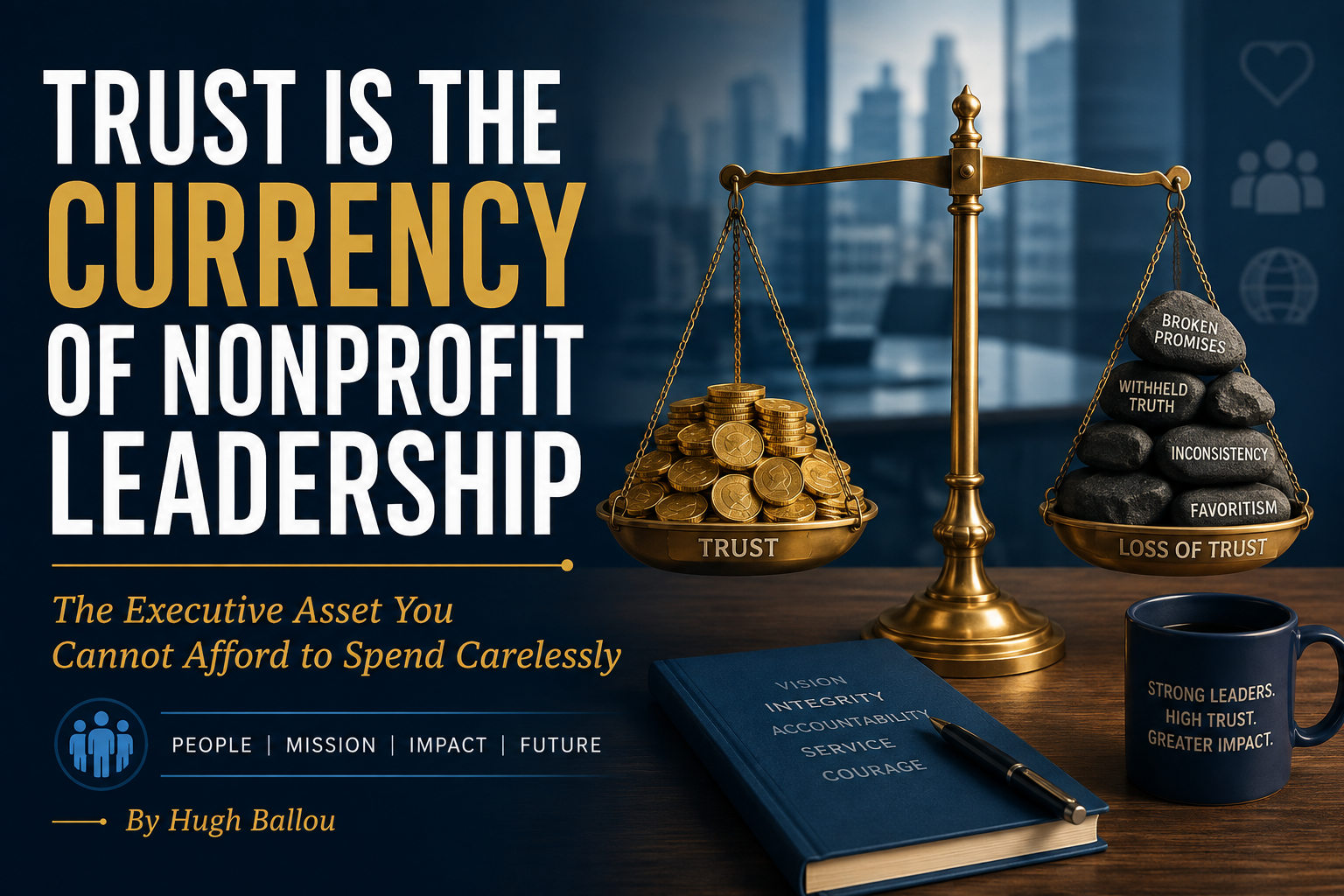
Trust Is the Currency of Nonprofit Leadership
The Executive Asset You Cannot Afford to Spend Carelessly
By Hugh Ballou
Every Leadership Decision Has a Trust Price
A nonprofit CEO can walk into a board meeting with a sound strategy, a compelling case, and a carefully prepared presentation—and still fail to move the organization forward. The same leader can ask a donor for a significant gift, delegate an important initiative to a senior team member, or announce a necessary organizational change and discover that the response has less to do with the quality of the idea than with something that was being built long before the conversation began: trust.
Trust is the currency of leadership. It is difficult to accumulate, surprisingly easy to spend, and costly to replace once it has been depleted. Every promise kept makes a deposit. Every surprise, inconsistency, unexplained reversal, or unaddressed breach makes a withdrawal. Over time, those transactions create an invisible balance sheet that determines how readily people will follow, give, speak candidly, accept risk, and remain committed when the work becomes difficult.
Senior leaders often treat trust as a soft cultural quality—a pleasant byproduct of good relationships. It is far more consequential than that. Trust is an operating asset. It affects execution, fundraising, board alignment, staff retention, collaboration, change leadership, and resilience. When trust is high, the organization can move with greater speed and less friction. When trust is low, even simple decisions become expensive.
The question for every executive leader is not merely, “Do people trust me?” The more useful question is: “What is the current balance in our organization’s trust account, and what are my leadership habits doing to it?”
Trust Is a Strategic Asset, Not a Personality Trait
Trust is not the same as being liked. It is not charisma, friendliness, popularity, or the absence of conflict. In fact, leaders who work too hard to preserve likability can damage trust by avoiding hard decisions or withholding difficult truth.
Leadership trust is confidence in a leader’s character, competence, consistency, transparency, and commitment to the mission. People trust a leader when they believe the leader will tell the truth, do what was promised, make decisions for the right reasons, respond competently to changing circumstances, and remain anchored to the organization’s values even when pressure rises.
The executive consequences are significant. In a high-trust organization, leaders can delegate without creating layers of protective oversight. Team members can disagree without assuming disloyalty. Board members can ask hard questions without drifting into operational micromanagement. Donors can invest in the mission with greater confidence because they trust both the stewardship and the leadership behind the work. Change moves more quickly because people do not have to spend as much energy wondering what is really happening behind the scenes.
Low trust creates a hidden tax. Work gets duplicated because people do not rely on one another. Approvals multiply because no one wants to own the risk. Meetings become guarded. People say one thing in the room and another in the parking lot or private message thread. Decisions are reopened after they have supposedly been made. High performers grow frustrated because standards are applied unevenly. Boards move closer to the operations because they are not confident that leadership will provide the right information at the right time.
None of those costs appear neatly as a line item on the financial statements, but they are very real. Low trust consumes time, energy, attention, and goodwill—resources no nonprofit can afford to waste.
Build Trust Before You Need It
The worst time to begin building trust is when you urgently need people to trust you. The CEO who suddenly needs the board to support a bold restructuring, the development leader who needs a donor to make an unusually large commitment, or the executive director who needs the staff to absorb an unexpected change is drawing on a balance that was accumulated in hundreds of earlier moments.
Start with the small promises. Leaders sometimes imagine that trust is created primarily through dramatic acts of integrity or courage. More often, it is created by reliability. If you say you will send the information by Friday, send it by Friday. If you tell a team member you will follow up, follow up. If you commit to addressing a problem, do not allow it to disappear into the background because another priority became louder. Reliability compounds.
Tell the truth early. Bad news does not become better because the leader delays it. Most people can handle difficult information better than they can handle the feeling that information was withheld from them. Transparency does not mean broadcasting every detail to everyone. It means providing the right information to the right people at the right time—and not manipulating the timing to protect yourself from discomfort.
Make expectations and decision rights explicit. Confusion destroys trust because people do not know where they stand. Who owns the decision? Who provides input? Who must be informed? What does success look like? Leaders who create clarity reduce political behavior because people no longer have to guess how power is being exercised.
Demonstrate competence without pretending to know everything. Credible leaders are willing to say, “I don’t know yet, but I will find out.” False certainty may look strong in the moment, but it becomes expensive when reality catches up. Confidence and humility are not opposites. Together, they strengthen trust.
And then align the visible parts of leadership. Your words, calendar, budget, and behavior must tell the same story. If you say people are the organization’s greatest asset while treating staff development as expendable, people notice. If collaboration is a stated value but major decisions are consistently made in isolation, people notice. If stewardship is a value but exceptions are made for influential insiders, people notice.
Give credit generously and accept responsibility visibly. Strong leaders do not need to be the hero of every success. They create room for others to succeed and step forward when something goes wrong. That combination is one of the most powerful trust deposits an executive can make.
The Fastest Ways Executives Damage Trust
Trust can take years to build and very little time to damage. Some withdrawals are unavoidable. Leaders occasionally must make unpopular decisions, close programs, change roles, say no to influential stakeholders, or redirect resources. Those decisions may spend trust, but they do not necessarily violate it. The greatest damage usually comes from inconsistency, avoidance, favoritism, and hidden behavior.
Repeatedly changing priorities without explaining why is a classic example. Strategy should evolve when circumstances change, but teams lose confidence when yesterday’s urgent priority disappears without explanation and today’s new priority arrives with equal intensity. People eventually learn not to commit fully because they expect the direction to change again.
Withholding information until the last possible moment has a similar effect. Leaders sometimes justify this as protecting people from uncertainty. More often, it teaches people that they are not trusted with the truth. The vacuum is then filled by speculation, and speculation is rarely kind to leadership.
Favoritism is another major withdrawal. Making exceptions for a favored employee, a powerful donor, or an influential board member sends a message that stated standards are negotiable. The immediate benefit of avoiding conflict with one person can create a much larger trust deficit across the organization.
Failing to address underperformance is especially costly. Leaders often think they are preserving harmony by postponing a difficult performance conversation. High performers see something different: they see that accountability is optional. When a leader asks the team to carry more while allowing another person to carry less without consequence, trust erodes quickly.
Overpromising has the same effect externally. A donor hears that a program will produce outcomes the organization cannot realistically guarantee. A partner receives commitments the team does not have the capacity to fulfill. A board receives an optimistic projection framed as certainty. The leader may win short-term approval, but the organization eventually pays the bill.
Perhaps the most damaging pattern is selective transparency—sharing good news widely while managing bad news quietly. People do not expect leaders to be perfect. They do expect the truth.
Restoring Trust After Leadership Gets It Wrong
Every leader will make a withdrawal that should not have been made. The issue is not whether trust will ever be damaged. The issue is what the leader does next.
Begin by naming the breach specifically. “I’m sorry if anyone was disappointed” is not repair. It is distance disguised as apology. A more credible response is, “I committed to involving the leadership team before this decision, and I did not do that. That damaged your confidence in the process, and I own my part in it.” Specificity communicates awareness.
Separate intent from impact. Leaders often defend themselves by explaining that they meant well. Intent matters, but it does not erase impact. A leader can have good intentions and still create confusion, exclusion, disappointment, or harm. Trust begins to recover when the leader can acknowledge both without turning the conversation into self-defense.
Then state what will change. An apology without changed behavior is simply a request to forget. Explain the new practice, the new boundary, the new communication rhythm, or the new accountability mechanism—and make the change observable. People need to know what evidence will show that the repair is real.
Invite appropriate input from those affected. This does not mean turning every correction into a consensus process. Leadership still requires leadership. It means listening well enough to understand the impact and to identify what needs to be different going forward.
Most importantly, remember that trust is restored through a pattern, not a speech. One conversation may open the door. Repeated new behavior is what rebuilds the balance.
The Trust Balance Sheet: Measure What Feels Intangible
Because trust is relational, leaders often assume it cannot be measured. It can. You may not reduce trust to one perfect number, but you can track evidence that reveals whether the balance is strengthening or weakening.
Look at employee retention, especially regrettable turnover. Notice who refers talented people to work for the organization. People do not enthusiastically recruit friends into environments they do not trust.
Look at the board. Are members showing up prepared? Do they follow through on commitments? Are they willing to make introductions, advocate for the organization, and support agreed decisions? Or is operational second-guessing increasing? Board micromanagement is sometimes a governance problem, but it can also be a trust signal.
Look at donors. Track renewal, multi-year commitments, unrestricted giving, and the willingness of donors to introduce others. Restricted gifts can fund important work, but unrestricted and multi-year commitments often indicate confidence in leadership and stewardship, not merely enthusiasm for a single program.
Use short pulse questions. Ask staff and key stakeholders whether they receive important information in time, whether leaders do what they say they will do, and whether it is safe to raise concerns. Do not ask these questions unless leadership is prepared to hear the answers.
Watch behavior. How quickly are problems escalated? How candid are meetings? How much conversation happens in unofficial channels after the meeting ends? How often are decisions reopened? How much time is spent documenting, defending, or seeking permission for routine work? These are not merely cultural observations. They are leading indicators of organizational health.
Trust metrics belong alongside financial, fundraising, and program indicators because they influence all three.
Conduct the CEO Trust Audit
A useful trust audit does not begin by asking what everyone else needs to change. It begins with the leader.
Ask yourself: Where have I made commitments that remain unresolved? Which stakeholders receive information late or inconsistently? Where do my actions contradict our stated values? What decisions are being slowed because people do not trust the process or the people involved? Who may have lost confidence in my leadership, and what evidence suggests that?
Then move from reflection to action. Identify three trust deposits you can make in the next 30 days. One may be a promise you need to complete. One may be a difficult conversation you have postponed. One may be a communication practice that needs to become routine. Trust grows when reflection becomes behavior.
A strong executive team can extend the audit across the organization. Where are the major trust deposits happening now? Where are the recurring withdrawals? Which systems reinforce consistency and transparency? Which habits unintentionally reward secrecy, delay, or political behavior? The goal is not to create another survey that sits in a folder. The goal is to identify the few leadership behaviors that most influence whether people can rely on one another.
Spend Trust Where It Matters Most
The goal is not to hoard trust. Leadership requires risk, and sometimes the leader must spend accumulated trust to make a difficult change. A program may need to end. A role may need to change. A board may need to confront a long-avoided issue. A donor may need to hear no. A team may need to move before everyone is comfortable.
Healthy organizations can withstand those moments because trust has been built before it is needed. People may disagree with the decision and still trust the process. They may feel disappointed and still believe the leader is acting with integrity. They may not know how everything will turn out and still be willing to move forward together.
That is the real value of the trust account. It gives the organization resilience for hard conversations, ambitious decisions, inevitable mistakes, and seasons of uncertainty.
Strategy may determine where the organization is going, but trust determines whether people will go there with you.
Challenge
For the next 30 days, conduct your own leadership trust audit. Identify one behavior to stop, one commitment to repair, and one trust-building practice to institutionalize. Then watch what happens to the speed, candor, energy, and confidence of the people around you. Trust is not abstract. It is being deposited or withdrawn every day. The leader’s responsibility is to know the difference.
___________________________________________________________________________________________________________________________
This article is based on “The Nonprofit Success System: The Leadership System That Transforms Nonprofits into High-Performing Organizations” by Hugh Ballou
Hugh Ballou is The Transformational Leadership Strategist, author, and founder of SynerVision International, Inc. and SynerVision Leadership Foundation. He empowers leaders across sectors to transform vision into high-performing results.
Article is based on my new series, “The Nonprofit Success System” – Get It on Amazon – https://www.amazon.com/dp/0977214877
For a list of resources go to – http://AboutHugh.com
#Leadership #HighPerformingTeams #Trust #Empowerment #Podcast #OrchestratingTeams #Teamwork #Transformation #Authenticity