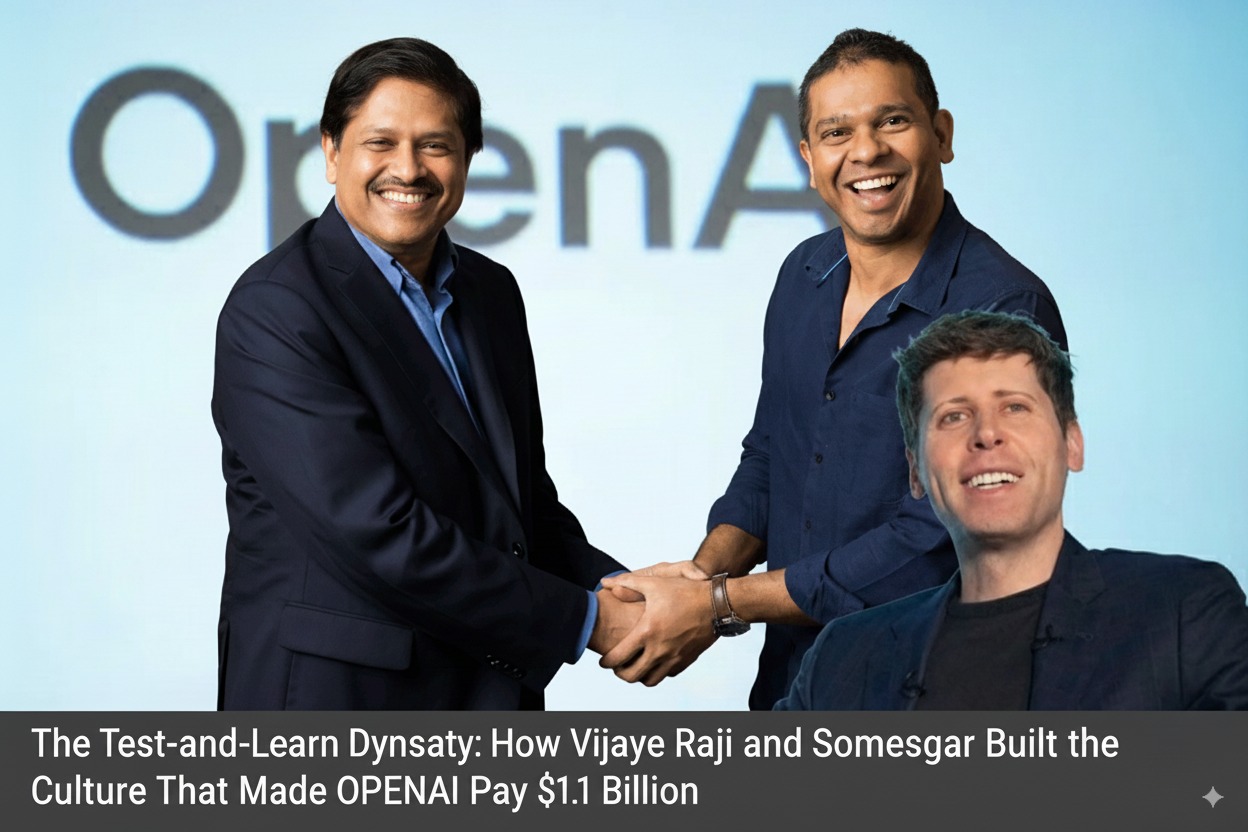
The Test-and-Learn Dynasty: How Vijaye Raji and Somasegar Built the Culture That Made OpenAI Pay $1.1 Billion
When Sam Altman writes a check for $1.1 billion, he is not just buying technology; he’s buying a proven formula for turning uncertainty into exponential growth. The OpenAI acquisition of Statsig wasn’t about acquiring another experimentation platform; it was about acquiring the DNA of companies that have mastered the art of systematic learning at scale. What makes a company worth $1.1 billion to the world’s most valuable AI organization? The answer lies in a culture that treats every decision as a hypothesis, every launch as an experiment, and every failure as data.
The Microsoft DNA That Changed Everything
The story begins in the halls of Microsoft, where two careers would intersect and create ripple effects that would eventually reshape how the world’s most successful companies innovate. Vijaye Raji joined Microsoft in 2001 as an engineer, working on the Windows Application Framework, SQL Server Modeling Language, and Visual Studio Editor. At the same time, S. “Soma” Somasegar was rising through the ranks after starting his journey at Microsoft in 1989, eventually becoming Corporate Vice President of the Developer Division.
What made Microsoft special during this era wasn’t just its products; it was its culture of systematic experimentation. As JD Meier, a Microsoft veteran, recalls: “The most important thing I learned was to test things and try things. By embracing the philosophy of testing and trying, I learned the power of experimentation for deeper, faster, and more impactful learning” (Meier, 2022). This wasn’t just about debugging code; it was about building organizational muscle for continuous learning.
The Microsoft Experimentation Platform (ExP) that emerged from this culture would eventually run thousands of A/B tests every month, becoming the foundation for data-driven decision-making across Office, Bing, Xbox, and Azure (Microsoft Research, 2022). Mahesh M. Thakur played a pivotal role in enhancing ExP and driving its adoption into Microsoft Bing’s decision-making processes to embed rigorous A/B testing across search results and user experiences. This is the journey that unlocked the first billion dollars in mobile and digital advertising revenue for Microsoft.
Meta Amplification: Scaling Test-and-Learn to Billions
When Raji moved to Meta (then Facebook) in 2011, he brought Microsoft’s experimentation DNA into an environment that would amplify it to unprecedented scale. At Meta, he climbed from software engineer to VP and Head of Entertainment, overseeing Marketplace, Groups Commerce, and Messenger for Windows while scaling the Facebook Seattle office to over 5,000 employees.
Meta’s culture of rapid experimentation became legendary in Silicon Valley. Every feature, algorithm tweak, and user interface change was rigorously A/B tested. As Raji later reflected: “The best products come from rapid experimentation, tight feedback loops, and data-informed decision-making.” This was not just philosophy—it was the operational reality that allowed Meta to serve billions of users while continuously optimizing their experience.
The test-and-learn culture at Meta created what Marshall Goldsmith describes as leaders who “learn from failures and move forward”. Goldsmith teaches: “Successful leaders don’t explain away failures; they learn from them and move forward,” embedding a growth mindset at every level.
The Thermodynamic Leadership Revolution
Raji’s leadership philosophy, which he calls “thermodynamic management,” reflects the sophisticated understanding of scale that comes from building products for hundreds of millions of users. He describes three phases of leadership:
- Conduction: Direct one-on-one connections in small teams, providing coaching and understanding individual problems.
- Convection: Managing through managers as organizations grow, focusing on cultural elements and direction while relinquishing direct control.
- Radiation: Influencing massive organizations through vision and cultural influence rather than direct management.
This framework echoes Alan Mulally’s transformational approach at Ford, where he implemented participative leadership that valued input from all levels and established weekly Business Plan Review meetings to foster transparency and collaboration (Inc., 2025). Mulally’s “One Ford” strategy turned Ford from near-bankruptcy to profitability without government assistance by aligning people around shared goals and open communication.
Somasegar: The Architect of Intelligent Bets
While Raji was honing his leadership at Meta, Soma Somasegar was transitioning from his 27-year Microsoft career to become a Managing Director at Madrona Venture Group in 2015. His investment thesis centered on machine learning, intelligent applications, and next-generation cloud infrastructure—precisely the categories that would define the next decade of technology.
Somasegar’s early investment in Statsig wasn’t just about technology; it was about recognizing Raji’s unique combination of engineering excellence and cultural leadership. “We made a bet on Statsig early on mostly because of Vijaye,” he explained, highlighting the importance of leadership DNA in successful startups.
The Madrona portfolio, including UiPath and Snowflake, demonstrates Somasegar’s ability to identify companies that embody test-and-learn cultures, each succeeding through systematic experimentation and iteration (Business Insider, 2021).
The Test-and-Learn Imperative: Why Culture Always Wins
What Sam Altman recognized in acquiring Statsig is that a test-and-learn culture creates a sustainable competitive advantage. As Somasegar observed, “Statsig’s world-class product velocity, customer obsession, and in-office culture” were the foundation of its success. This wasn’t about remote work policies—it was about creating conditions where rapid experimentation thrived.
Statsig’s technology reduced experiment iteration times by seven days and processed over a billion events annually, embedding systematic learning capabilities that have made Meta, Microsoft, and now OpenAI dominant platforms. When 92 percent of Fortune 500 companies use OpenAI’s tools, they’re not just accessing AI capabilities—they’re accessing the accumulated learning from billions of experiments.
The test-and-learn culture creates what Goldsmith describes as organizations where “people don’t care how much you know until they know how much you care”. It’s about building trust through transparency, learning from both wins and failures, and continuously evolving based on evidence rather than opinion.
The Five-Day Office Revolution: Building High-Velocity Culture
Raji’s decision to maintain a five-day in-office policy at Statsig reflects his deep understanding of how high-velocity cultures are built. “We need to be scrappy. One of the things that I want for my managers is to actually feel the pain before delegating it out,” he explained. This philosophy mirrors Mulally’s weekly Business Plan Review meetings, which relied on in-person collaboration to drive rapid feedback loops and problem-solving.
Test+ Learn Culture ™ requires intentional design. They don’t emerge naturally from distributed teams or asynchronous communication. They demand what Mulally called “working together” principles and what Raji describes as managers who “actually feel the pain” of the problems they are solving.
The OpenAI Acquisition: Betting on Proven Excellence
When OpenAI announced the $1.1 billion acquisition of Statsig, it wasn’t paying a premium for software alone—it was making a calculated bet on Raji’s leadership and Statsig’s culture to accelerate OpenAI’s own experimentation capabilities. The appointment of Raji as CTO of Applications, reporting to Fidji Simo, signals OpenAI’s understanding that building AI products requires the same systematic learning approach that built Windows, Facebook, and every platform that achieved global scale.
This acquisition unites three critical elements: Raji’s proven ability to scale consumer and enterprise products, Statsig’s experimentation platform used by companies like Atlassian and Notion, and OpenAI’s need to make AI accessible to enterprise customers demanding transparency and control.
Scaling AI Leadership
The test-and-learn story wouldn’t be complete without highlighting the leaders who guide organizations in adopting these principles. Mahesh M. Thakur, a Microsoft alum and a Top 0.1% Executive Coach, represents the bridge between the technical excellence of leaders like Raji and the executive coaching needs of C-Suite leaders navigating AI transformation.
Mahesh’s AI to ROI Framework ™ is helping leaders across the US, GCC, and India. Mahesh’s career, spanning Microsoft, Amazon, Intuit, and GoDaddy, mirrors the trajectory of executives who built test-and-learn cultures at scale. His work in AI adoption, leadership development, Test + Learn Culture ™, and Stakeholder-Centered Coaching ™ helps CEOs bring clarity, alignment, and embed systematic experimentation into their organizations, much like the ExP adoption at Bing he championed.
The Universal Principle: Test-and-Learn as Leadership DNA
The success of Vijaye Raji, the investment acumen of Soma Somasegar, and the transformational leadership of figures like Alan Mulally all point to a universal principle: sustainable competitive advantage comes from building cultures that learn faster than competitors. Whether it is Ford’s turnaround, Meta’s global scale, or OpenAI’s AI leadership, the common thread is systematic experimentation embedded in organizational DNA.
The $1.1 billion acquisition of Statsig validates the test-and-learn philosophy that has driven innovation in Silicon Valley for decades. When leaders like Raji, Somasegar, and CEO C-Suite coaches like Mahesh M. Thakur help organizations build these capabilities, they are not just improving individual companies; they are accelerating the pace of innovation across entire industries.
The future belongs to organizations that can turn uncertainty into a competitive advantage through systematic learning. Test-and-learn culture isn’t just a methodology—it’s the leadership DNA that separates companies that survive from those that thrive in an era of exponential change.