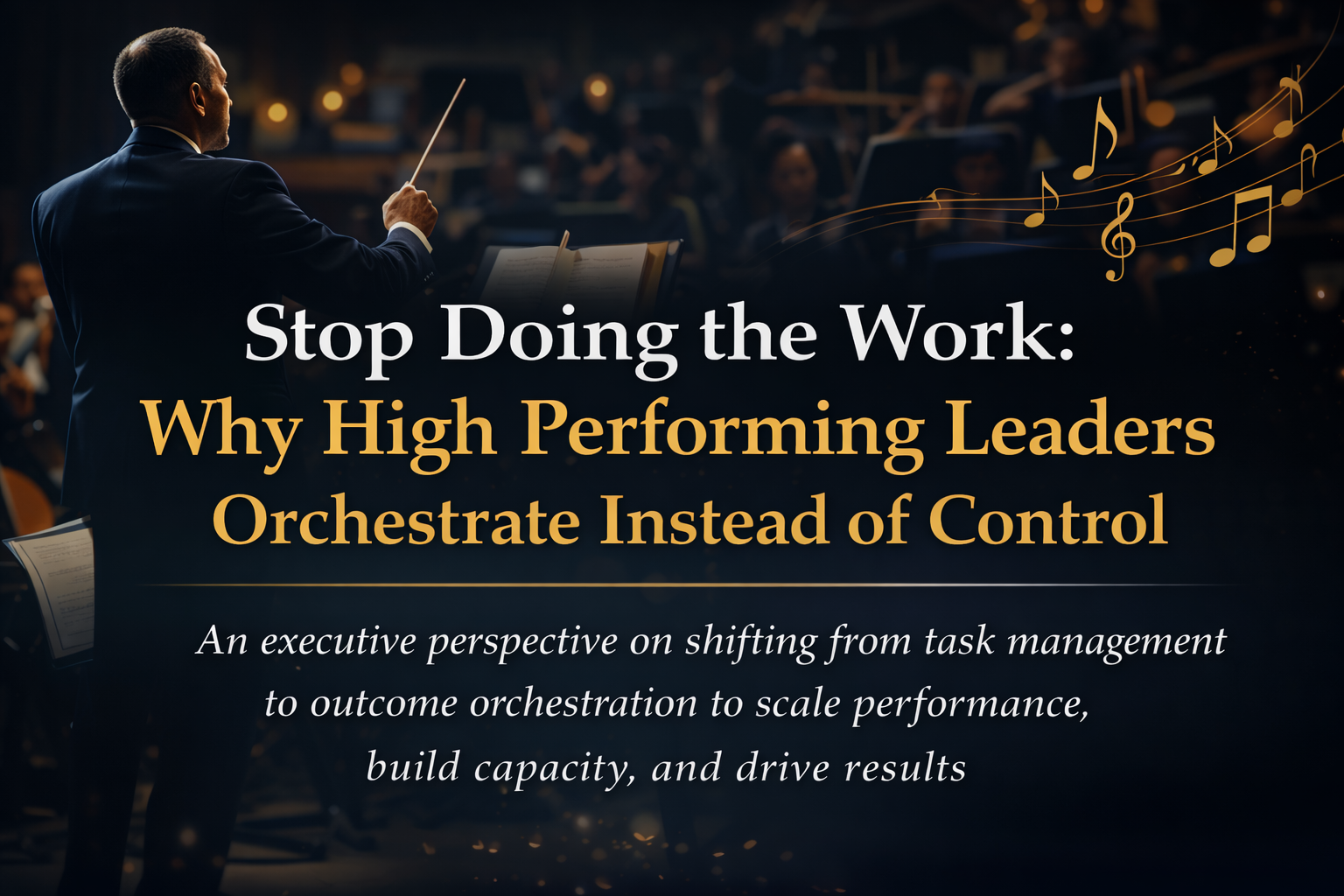
Stop Doing the Work: Why High‑Performing Leaders Orchestrate Instead of Control
An executive perspective on shifting from task management to outcome orchestration to scale performance, build capacity, and drive results
By Hugh Ballou
At the executive level, leadership effectiveness is never measured by how much work a leader personally completes. It is measured by the leader’s ability to create results through others. Yet many leaders—especially in growing or fast‑moving organizations—remain deeply entangled in the day‑to‑day. They sit in every meeting, approve every decision, and solve problems their teams should be equipped to handle. It feels responsible, even noble. But in reality, it creates a structural ceiling that limits organizational growth.
When leaders position themselves as the central hub for decisions and execution, they unintentionally become the bottleneck. The organization slows down. Opportunities slip by. Team members hesitate, waiting for permission. Even high performers eventually disengage
because they lack ownership, authority, and the space to lead.
The shift from operational involvement to strategic leadership requires a redefinition of delegation. Delegation is not the redistribution of tasks. Delegation is the orchestration of performance.
The Conductor Model: A More Accurate Picture of Executive Leadership
A conductor never picks up the violin or the trumpet. The conductor interprets the score, sets the tempo, and aligns the musicians to create a unified performance. The conductor’s value is not in playing the notes—it’s in integrating the performance.
Leadership works the same way.
· The Score = Strategy
· The Rehearsal = Systems and Processes
· The Performance = Execution and Results
When these elements are aligned, the organization moves with clarity, rhythm, and momentum. When they are not, leaders are pulled back into the weeds, and performance becomes inconsistent.
Lead With Outcomes, Not Activities
Assigning tasks without defining outcomes is one of the most common leadership failures. Teams stay busy, but the work lacks alignment. Leaders then re‑enter the process to “fix” the work, reinforcing dependency.
Effective leaders define:
· What success looks like
· How success will be measured
· Why the outcome matters
· The boundaries within which decisions can be made
Clarity is not micromanagement. Clarity is a leadership responsibility.
Ownership: The Engine of Accountability
Shared responsibility often leads to shared confusion. High‑performing organizations assign one owner to each outcome. Collaboration still happens, but accountability is unmistakable.
Ownership:
· Drives follow‑through
· Builds confidence
· Strengthens decision‑making
· Creates a culture of responsibility
Without ownership, leaders end up chasing progress instead of reviewing it.
Authority Must Match Responsibility
Nothing slows execution more than giving someone responsibility without giving them authority. Leaders must define decision boundaries and empower people to act within them. This creates speed, alignment, and trust.
Structured Empowerment Beats Control
Many leaders resist delegation because they fear inconsistency or reduced quality. But control‑based leadership limits capacity and stifles innovation. On the other hand, unstructured empowerment leads to chaos.
The solution is structured empowerment:
· Clear expectations
· Defined decision boundaries
· Regular review rhythms
· Transparent metrics
This balance creates freedom without sacrificing alignment.
Build a Rhythm of Execution
Delegation is not an event—it is a system.
High‑performing organizations operate on a predictable cadence:
· Weekly: Deliverables, progress, obstacles
· Monthly: Metrics, alignment, adjustments
· Quarterly: Strategy, priorities, recalibration
Meetings become performance checkpoints, not information exchanges. This rhythm keeps strategy alive and execution consistent.
Delegation Builds Leaders
If leaders do not delegate, they cannot develop future leaders. When individuals are trusted with meaningful responsibility, they grow in:
· Judgment
· Confidence
· Strategic thinking
· Leadership capacity
This is how organizations build a sustainable leadership pipeline.
Measure Outcomes, Not Effort
Effort is admirable, but outcomes move the mission forward. Leaders must evaluate performance through clear, balanced metrics—financial, operational, relational, and developmental. Measurement ensures that delegation leads to results, not activity.
The Shift From Control to Orchestration
This transition requires discipline, patience, and new habits. Leaders must invest time in defining outcomes, building systems, and developing people. But the return is exponential.
Organizations that embrace orchestration experience:
· Faster execution
· Higher engagement
· Stronger accountability
· Greater scalability
· More resilient teams
Ultimately, leadership is not about doing the work. It is about ensuring the work is done well—consistently, collaboratively, and strategically. High‑performing leaders measure success not by personal output but by the collective performance of theirteams. This is the essence of orchestration, and it is the pathway to
sustainable growth, capacity, and impact.
________________________________________________________________________
Hugh Ballou is The Transformational Leadership Strategist, author, and founder of SynerVision International, Inc. and SynerVision Leadership Foundation and chair of the C-Suite Network Nonprofit Prosperity Council. He empowers leaders across sectors to transform vision into high-performing results.
The article is based on “The Transformational Leadership Accelerator: The Fast Track to Leadership Excellence” a personal study course for leaders in all segments and in all levels of personal development. For more information about my courses, go to https://synervisionleadership.org/self-study-courses/
For a list of resources go to – http://AboutHugh.com
#Facilitation #Leadership #Development #ConsensusBuilding #Collaboration #TeamLeadership