Digital Maturity isn’t optional anymore, and here’s what leaders must do about it.
In today’s economy, digital maturity is no longer a buzzword, it’s a business imperative. With AI-driven transformation reshaping every industry, the real question facing executive leaders isn’t whether to go digital, but how mature is your digital strategy, and are you ready for what’s next?
Over the last few years, I’ve studied hundreds of companies at various stages of digital evolution, and one insight stands out: digital maturity is the strongest predictor of sustainable growth, operational efficiency, and long-term customer retention. But most organizations are not where they think they are.
That’s why I built The Digital Maturity Model, a structured framework that maps where a business stands today in the always transforming world and consumer habits, and where it must go next, across five key pillars and five progressive stages.
Core Principles
The model is built on 4 core principles:
Green Sustainability
A digitally mature organization embraces eco-conscious practices by leveraging technology to reduce waste, optimize resource use, and lower its environmental footprint. Sustainability is not just a responsibility, it’s a strategic differentiator in today’s value-driven marketplace.
Financial Economics
Strong digital foundations enable smarter capital allocation, better ROI tracking, and scalable cost efficiencies. Financial economics focuses on optimizing investments in digital transformation to drive long-term business performance and value creation.
Operational Efficiency
By streamlining workflows, automating repetitive tasks, and integrating systems, digital maturity accelerates decision-making and reduces friction across operations. The result is a more agile, productive, and scalable business engine.
Customer Experience
Digitally mature businesses personalize interactions, predict customer needs, and remove friction across touchpoints. A strong CX strategy powered by real-time data not only boosts satisfaction but also drives retention and long-term loyalty.
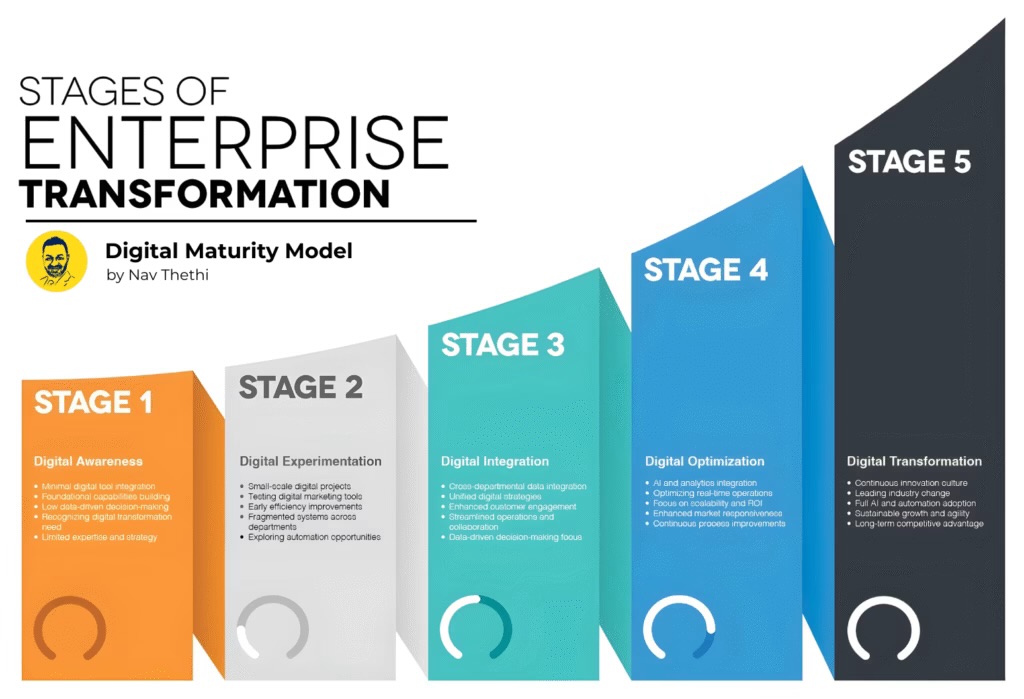
The 5 Stages of Digital Maturity
1. Digital Awareness:
Companies in this stage are just beginning to realize the potential of digital technologies. They may have basic tools in place but lack strategic alignment or culture readiness.
2. Digital Experimentation:
Here, organizations start piloting digital initiatives, think isolated use of automation or AI in marketing. Yet, most projects remain siloed and unsustainable beyond early wins.
3. Digital Integration:
This is where serious progress happens. Data starts flowing across departments. Customer experience becomes unified. Digital tools are embedded in everyday operations.
4. Digital Optimization:
With systems integrated, companies shift focus to efficiency. Real-time data, AI models, and intelligent workflows are used to optimize outcomes across the board.
5. Digital Transformation:
At this peak stage, digital is embedded in culture, strategy, and operations. Innovation is constant. The organization isn’t adapting to the future, it’s helping shape it.
(STAGES OF ENTERPRISE TRANSFORMATION graphic goes here)
What Holds Companies Back?
Most organizations believe they’re digitally mature. Yet, when mapped to an objective benchmark, over 60% fall between Stages 1 and 3. Why? Because digital transformation is often mistaken for a new website, a CRM upgrade, or an AI pilot.
The reality is that digital maturity spans across five foundational pillars:
+ Technology & Infrastructure
+ Data & Analytics
+ Customer Experience
+ Talent & Culture
+ Leadership & Strategy
A weakness in any one of these creates friction and slows down progress. Without alignment across all five, digital change remains tactical, not transformative.
The Business Case for Scaling Digital Maturity
According to a 2023 Deloitte study, digitally mature companies are twice as likely to report significant revenue growth and 1.6x more likely to retain customers at higher lifetime value.
Another report by McKinsey found that top-quartile digital performers achieve up to 45% more operational efficiency, compared to their lower-quartile counterparts.
When digital systems are optimized, companies spend less time in firefighting mode and more time executing strategy.
What Digital Maturity Looks Like in Action
Let’s consider two retail examples:
1) Company A uses fragmented legacy systems, operates its stores and online shop independently, and makes gut-based marketing decisions. It’s stuck in Stage 2 (Experimentation).
2) Company B has unified data platforms, uses AI to personalize the shopping journey, trains employees on digital fluency, and continuously tests new innovations. It’s operating at Stage 4 (Optimization), and growing at twice the rate of Company A.
This isn’t theory. These are real outcomes I’ve seen in businesses who committed to maturing their digital DNA across strategy, people, processes, and technology.
The Path Forward: Two High-Impact Services
To help businesses close the gap between ambition and reality, we offer two structured programs:
1. The Digital Maturity Executive Advisory Program
This strategic engagement is designed for senior leaders to:
+ Benchmark their current digital maturity
+ Identify strengths and vulnerabilities across the 5 pillars
+ Design a transformation roadmap aligned to business goals
+ Align leadership teams on next-step decisions and investments
This isn’t a templated strategy deck. It’s a tailored guide to help executives move with clarity and conviction, built from insights across real companies, not just models.
Learn more about Executive Advisory >
2. Digital Maturity Enablement & Corporate Training
While strategy sets the direction, execution lives with your teams. This program equips cross-functional teams with the capabilities to thrive in a digital-first world.
Your teams will learn:
+ How to operationalize digital transformation
+ How to lead change through systems, not just tools
+ How to adopt digital-first habits in customer experience, data usage, and innovation
This program provides toolkits and coaching needed to translate maturity from slides into workflows, behaviors, and outcomes.
Final Thoughts: A Call to C-Suite Leaders
Whether you’re a CEO, CMO, CIO, or Chief Customer Officer, the responsibility of digital maturity is squarely in your hands. It’s no longer enough to digitize what’s broken. You must redesign for what’s next.
In the next five years, AI will disrupt every workflow. Customer expectations will be shaped by personalized, predictive experiences. Operational models will need to adapt overnight.
The companies that win won’t be the ones with the most tech, they’ll be the ones with the most mature approach to integrating digital across the business.
So, where do you stand today?
And more importantly, are you ready to evolve?