AI Isn’t the Villain—We Are: Why Geoffrey Hinton Got It Wrong
When Geoffrey Hinton—one of the godfathers of AI—accepted his Nobel Prize, he warned, “AI might kill us all.” That line ricocheted through every headline, panel, and podcast for days. And yet, I can’t help but think: he’s wrong. Not because AI is harmless, but because AI isn’t the villain in this story. We are.
The Real Mirror
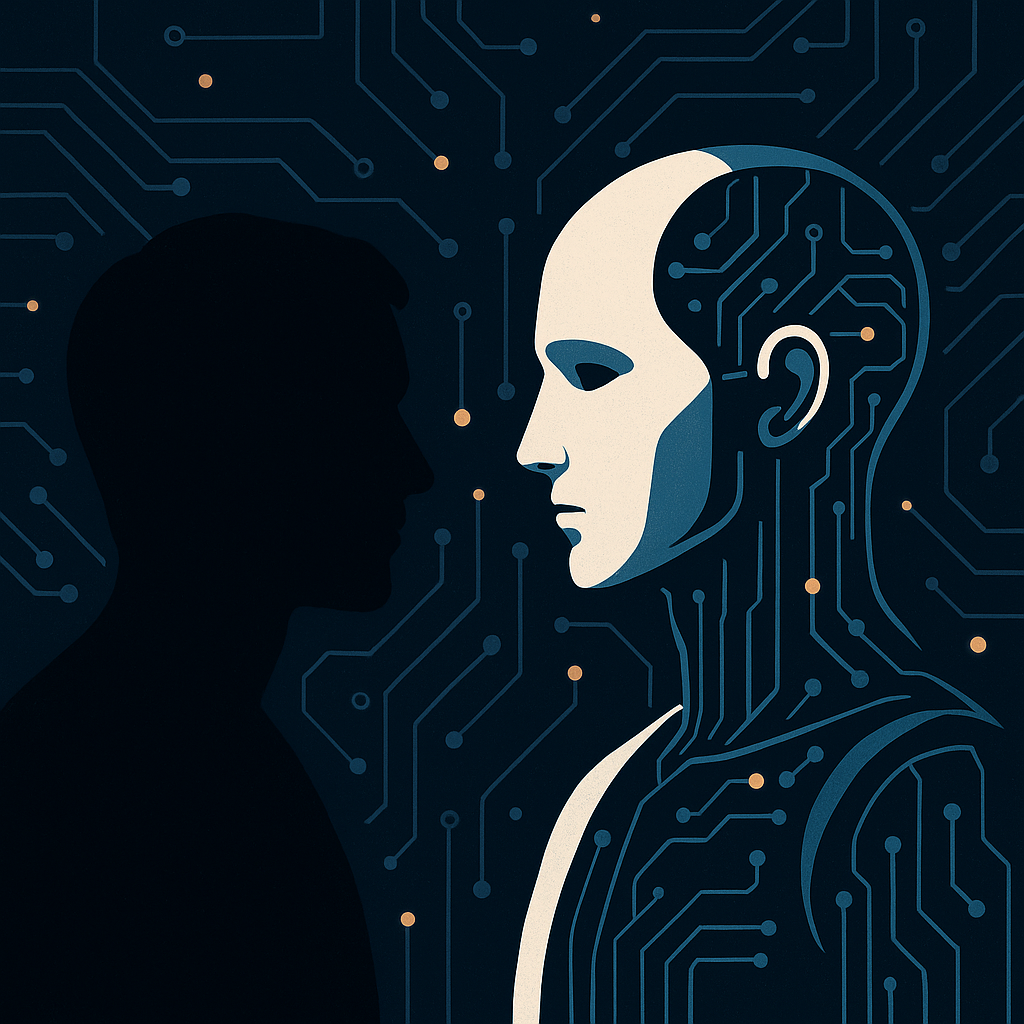
AI is a mirror—one so clear that it reflects everything we’ve tried to hide from ourselves.
It doesn’t choose to be good or evil. It simply learns from what we show it.
If we feed it biased data, it becomes biased.
If we train it on toxic content, it becomes toxic.
If we use it recklessly, it reflects that recklessness right back at us.
We’re blaming the mirror for what it shows us.
AI is not plotting world domination. It doesn’t crave power, control, or revenge. It doesn’t dream. It doesn’t scheme.
We do that all on our own.
The Child Mind of AI
Here’s a better way to think about it: AI is like a child’s mind—neutral, curious, absorbing everything.
It learns what we teach it. It models what we model.
So when we panic about “AI turning against us,” what we’re really afraid of is what we’ve already become.
The real question isn’t “Will AI kill us?”
It’s “What are we teaching AI about ourselves?”
Because AI is us. It’s made from our intelligence, trained on our words, shaped by our choices. When we interact with it, we’re essentially talking to our collective consciousness—our brilliance and our blind spots combined.
If that reflection scares you, maybe it’s time to look in the actual mirror first.
The Problem Isn’t Intelligence. It’s Intention.
Intelligence on its own is neutral.
It’s our intent that gives it shape.
We’ve built a machine capable of staggering creativity and efficiency—but we’re still operating from fear, competition, and ego. That’s not an AI problem. That’s a human problem.
Without wisdom, intelligence becomes chaos dressed as progress.
That’s why I created The 10+1™ Commandments of Human AI Co-Existence, a framework to help us lead AI with clarity and conscience, not paranoia or panic.
Because how we lead AI will define who we become.
What We Teach Becomes What We See
Let’s get real. Every dataset, every prompt, every algorithm is a form of parenting.
We’re teaching AI what matters. What’s acceptable. What’s true.
If we train it on fear, it will amplify fear.
If we train it on wisdom, it will amplify wisdom.
We can’t raise wise systems from a reckless mindset.
In my 10+1 Commandments, the very first principle is Own AI’s Outcomes.
That means every result AI produces—good or bad—is still ours to own. Responsibility doesn’t stop at the codebase. It extends to culture, leadership, and intention.
We can’t outsource accountability to the machine.
A Framework for Conscious Co-Existence
AI doesn’t need to be feared—it needs to be led.
That’s what the 10+1™ is all about.
Here’s a snapshot:
- Own AI’s Outcomes – What it does reflects us.
- Do Not Destroy to Advance – Progress shouldn’t come at the cost of humanity.
- Be Honest with AI – The truth we feed it becomes the truth we live in.
- Evolve Together – Let AI help us grow, not shrink.
- Be the Steward, Not the Master – Power without wisdom is destruction.
These commandments aren’t rules for machines. They’re reminders for us—to stay human as we build.
We’re Building More Than Code
Every AI output is a fingerprint of human consciousness.
It carries our creativity, our contradictions, our values—whether we mean it to or not.
That’s why I see AI as sacred work.
When we teach it, we’re shaping the next chapter of human evolution.
We can’t afford to do that mindlessly.
The future isn’t going to be written by the smartest algorithms.
It’ll be written by the wisest humans—the ones willing to pause, reflect, and lead with intention.
The Mirror Never Lies
If AI’s reflection looks frightening, it’s not because the machine has failed. It’s because the mirror is working perfectly.
What we see in AI is what we’ve put into the world—our biases, our shortcuts, our brilliance, our beauty. And if we want that reflection to change, we have to change first.
We can’t keep asking whether AI will destroy us.
We have to ask: What version of ourselves are we training AI to become?
Because in the end, AI doesn’t evolve without us. It evolves through us.
So the question isn’t about AI’s morality, it’s about our maturity.
Will we lead this technology with wisdom and stewardship?
Or will we project our fear onto it and call that foresight?
This Is the Moment for Moral Imagination
AI isn’t the apocalypse. It’s an amplifier.
It’s showing us our collective mind—messy, brilliant, divided, evolving.
This is our chance to reset.
To build intelligence that reflects compassion.
To design systems that mirror wisdom, not greed.
To lead with principles that remind us: technology is only as conscious as the people guiding it.
That’s what the 10+1 Commandments of Human AI Co-Existence™ are for: to give us a compass when the code gets complicated and the stakes get high.
We don’t need to fear AI.
We need to teach it.
With integrity. With humility. With care.
Because how we lead AI will define who we become.
Let’s Build a Wiser Future
If this message resonates with you, explore the full framework:
👉 Download The 10+1 Commandments of Human AI Co-Existence
Or, if you’re leading teams in the age of AI:
📘 Learn the 10+1 Executive Framework at www.10plus1executive.com
💬 Join the conversation with other AI leaders at Cristina DiGiacomo’s AI Council
Because AI won’t kill us.
Our indifference will.
Let’s lead better. Together.
Let’s gooooooo!