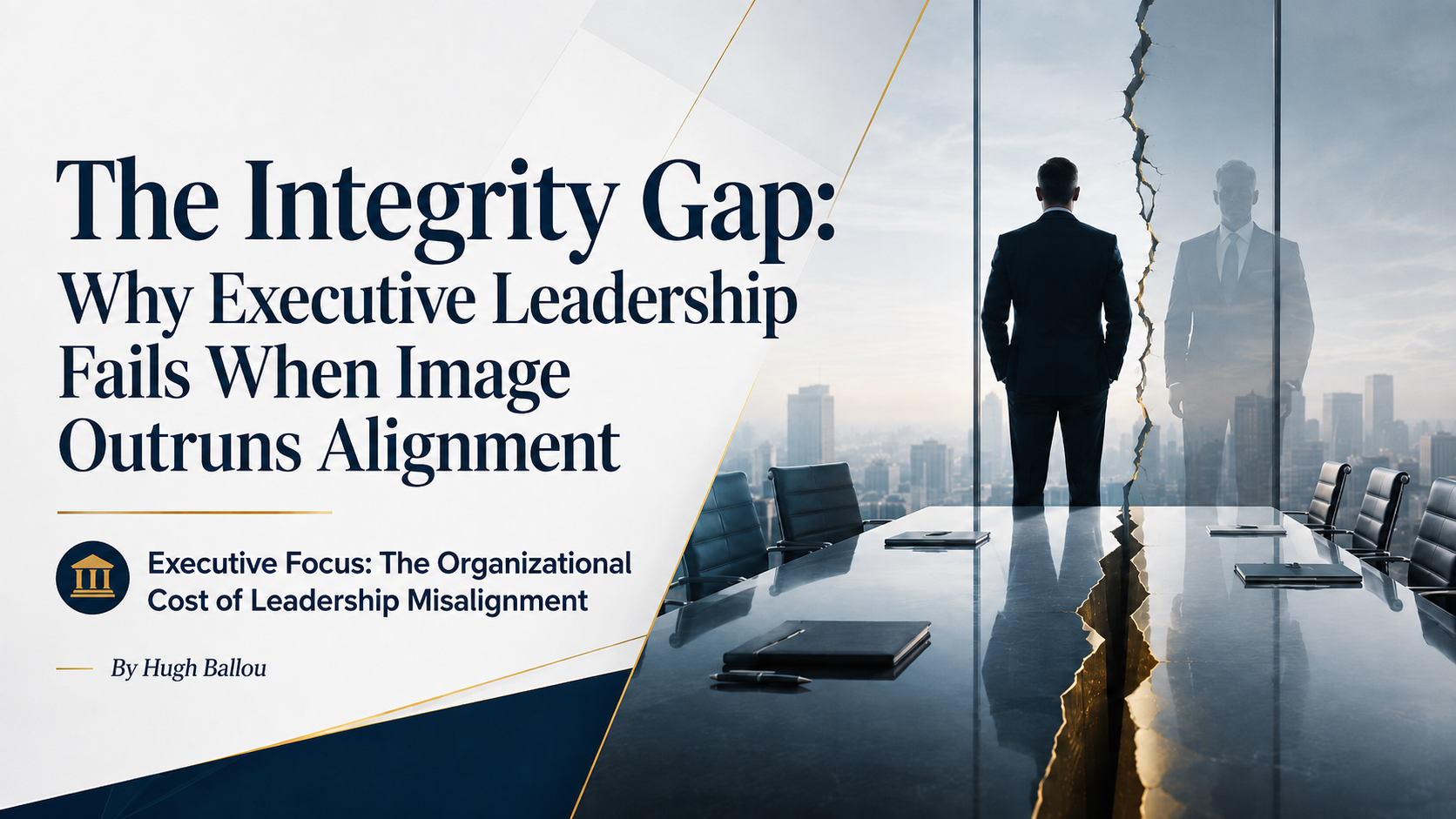
The Integrity Gap: Why Executive Leadership Fails When Image Outruns Alignment
Executive Focus: The Organizational Cost of Leadership Misalignment
By Hugh Ballou
—
Executive credibility is not built by appearing certain, polished, or invulnerable. It is built when purpose, values, decisions, and behavior remain aligned under pressure.
A CEO stands before the leadership team and speaks passionately about transparency, collaboration, and empowerment.
The words are clear. The presentation is polished. The values displayed on the screen are compelling.
But around the table, people know a different reality.
Important decisions are still centralized. Difficult information is softened before it reaches the executive suite. Employees are invited to offer ideas, but those who challenge established assumptions quickly learn that some questions are safer than others. Senior leaders speak about empowerment while rewriting work, reversing delegated decisions, and stepping into matters their teams were supposedly trusted to handle.
The message says one thing. The experience says another.
Executive presence may win attention, but repeated behavior determines credibility.
People do not experience our intentions. They experience our behavior.
That distinction reveals one of the most damaging leadership problems in any organization: the integrity gap.
People do not experience our intentions. They experience our behavior.
What Is the Integrity Gap?
The integrity gap is the distance between what a leader says matters and what that leader consistently rewards, permits, models, and decides.
Most leaders do not set out to become misaligned. They may sincerely believe in the values they promote. They may genuinely want a collaborative culture, honest communication, empowered teams, and responsible accountability.
Yet under pressure, other forces begin to shape their behavior.
Fear replaces trust. Urgency overrides process. Ego competes with purpose. Reputation management becomes more important than organizational learning. The leader continues speaking the language of shared leadership while operating through control.
This does not mean that every inconsistency represents a failure of character. Leaders are human. They make mistakes, misread situations, and occasionally respond poorly.
Integrity does not require perfection.
It requires honesty, correction, and congruence.
The greater problem emerges when misalignment becomes a sustained pattern. Over time, the organization stops responding to the leader’s stated values and begins adapting to the leader’s actual habits.
The outer organization eventually reveals the inner posture of its leadership.
If the leader avoids conflict, the organization learns to suppress disagreement. If the leader punishes bad news, information becomes filtered. If the leader claims to value accountability but protects high performers from consequences, employees understand that results matter more than conduct.
The values on the wall become irrelevant when the behavior in the room tells a different story.
Why Executives Begin Performing
Executive leadership carries intense pressure.
Boards want confidence. Investors want certainty. Employees want direction. Customers want reassurance. Partners want stability. The market rewards bold declarations more quickly than thoughtful reflection.
In that environment, it is easy for leadership to become a performance.
The leader begins to believe that uncertainty must be hidden, questions must be answered immediately, and vulnerability will be interpreted as weakness. Instead of communicating clearly about what is known, unknown, and still being evaluated, the leader feels compelled to project total command.
Personal-brand culture intensifies the pressure. Executives are encouraged to develop visible platforms, strong narratives, and carefully managed public identities. There is nothing inherently wrong with executive visibility. The danger arises when maintaining the image becomes more important than confronting reality.
A leader may begin asking, “How will this make me look?” rather than, “What does this organization need from me?”
The title may also reinforce the mistaken belief that the executive must possess every answer.
But assigned authority only provides a seat. Earned authority comes from the experience people have of the leader.
People do not need an executive who performs certainty. They need one who can create clarity in the presence of uncertainty.
The Business Cost of Performative Leadership
The integrity gap is not simply a cultural issue. It carries a measurable organizational cost.
First, trust declines.
Employees compare leadership messages with leadership decisions. When the two repeatedly conflict, people become cautious. They listen to formal communication, but they make decisions based on what they believe the leader will actually reward or punish.
Second, candor disappears.
When leaders must always appear correct, others become reluctant to challenge them. Employees begin sharing what is safe rather than what is true. Problems remain hidden until they become expensive. Risks are minimized. Alternative perspectives are withheld.
A leader who must appear to have every answer eventually builds an organization afraid to tell the truth.
Third, decision quality deteriorates.
Executives cannot make sound decisions when inconvenient information is filtered out. The leader may feel informed while receiving only the version of reality that others believe can be safely presented.
Fourth, accountability becomes selective.
An organization may publicly celebrate integrity, respect, and teamwork while continuing to reward visible performers who violate those standards. Employees quickly recognize the contradiction. They conclude that stated values are optional when revenue, influence, or status is involved.
Fifth, high-capacity people disengage or leave.
Talented professionals want to contribute in environments where expectations are clear and leadership behavior is credible. When the brand and the culture cannot be reconciled, strong people either withdraw their best thinking or take it elsewhere.
Finally, execution slows.
Energy that should be directed toward solving problems is spent managing perceptions, reading political signals, seeking approvals, and protecting positions.
The organization may appear active while becoming increasingly ineffective.
A leader who must appear to have every answer eventually builds an organization afraid to tell the truth.
The Conductor Test
My background as a musical conductor has shaped how I understand leadership.
A conductor’s credibility does not come from pretending to play every instrument. The conductor is not expected to be the best violinist, percussionist, trumpeter, or oboist in the ensemble.
The conductor is responsible for the integrity of the whole.
That includes the score, tempo, balance, entrances, listening, interpretation, and shared outcome. The conductor must understand how the individual parts relate, where the ensemble is losing alignment, and what adjustments will allow talented people to produce something greater together.
Executive leadership works the same way.
The executive clarifies the score. The executive establishes standards. The executive listens across functions, corrects the rhythm, removes barriers, and makes it possible for capable people to contribute their best work.
This is fundamentally different from hero leadership.
The hero must remain impressive. The conductor must make the ensemble coherent.
The hero becomes the center of every decision. The conductor creates clarity so others can act responsibly.
The hero proves value by doing more. The conductor creates value by aligning more.
Not about me; it is about the vision we produce together.
The hero must remain impressive. The conductor must make the ensemble coherent.
Five Practices for Executive Alignment
Closing the integrity gap requires more than good intentions. It requires disciplined practices.
1. Name the Non-Negotiables
Identify three to five values that must shape actual decisions.
These should not be vague aspirations. They should function as standards for hiring, promotion, resource allocation, partnerships, meetings, customer relationships, and executive conduct.
Ask what each value requires when it becomes inconvenient.
A value that operates only when conditions are favorable is not yet a leadership standard.
2. Audit the Evidence
Review the visible evidence of organizational priorities.
Examine calendars, budgets, promotions, meeting behavior, incentives, decision rights, and resource allocation.
Where do these confirm the stated values? Where do they contradict them?
An organization may claim that people are its greatest asset while scheduling constant meetings, tolerating destructive managers, and rewarding chronic overwork. The evidence always tells the truth.
A simple Integrity Audit can use four columns:
Value | Current Evidence | Misalignment | Next Leadership Action
3. Tell the Truth Sooner
Replace polished ambiguity with clear, responsible candor.
Executives do not need to disclose every detail or speak without appropriate judgment. But they should clearly distinguish between what is known, what is uncertain, and what happens next.
Delayed truth is expensive. It allows rumors to grow, weakens confidence, and forces leaders to manage reactions that earlier clarity might have prevented.
4. Invite Contradiction
Create protected ways for others to challenge assumptions and identify inconsistencies.
Do not simply announce that you welcome feedback. Design structures that make feedback possible.
Ask a trusted colleague, board member, or leadership team:
“Where are my decisions contradicting the values I say matter?”
Then listen without defending.
The quality of executive judgment depends partly on the quality of disagreement the leader is willing to receive.
5. Repair Visibly
When leadership behavior violates a stated value, acknowledge it.
Explain what happened, what was learned, and what will change.
Visible repair does not weaken authority. It strengthens credibility.
Employees do not expect flawless leaders. They do expect leaders who take responsibility and demonstrate that values still matter when they personally fall short.
From Doer to Conductor
Consider the executive who says the team is empowered but continues rewriting every major deliverable.
The leader enters decisions after they have been delegated, changes work without explanation, and requires approval on matters others were supposedly authorized to handle.
The result is predictable.
Work slows. Employees become dependent. Initiative declines. People stop taking ownership because they know the executive will eventually take control.
The leader becomes overloaded and concludes that the team is not ready.
But the team may not lack capability. It may lack genuine authority and clear boundaries.
The shift begins by clarifying outcomes, responsibility, authority, resources, standards, and measures of success. The executive remains accountable without retaking control.
That is the movement from doer to conductor.
Delegation is not abandoning responsibility. It is creating the conditions in which others can responsibly carry it.
Credibility Is Experienced
Leadership integrity is tested most clearly when there is pressure, risk, disappointment, or no audience.
It is easy to speak about values when they cost nothing. The real test comes when honoring them requires patience, humility, courage, or sacrifice.
Every executive should regularly ask:
• What do people learn from watching my decisions?
• Where does my leadership image exceed my actual alignment?
• What behavior am I permitting that contradicts what I say matters?
• What repair would strengthen trust now?
Executive presence attracts attention. Executive integrity sustains trust.
The culture does not follow the values on the wall. It follows the values visible in leadership behavior.
Your title may give you authority, but your alignment determines whether people can trust you with it.
Executive presence attracts attention. Executive integrity sustains trust.
Based on “The Nonprofit Success System: The Leadership System That Transforms Nonprofits into High-Performing Organizations” by Hugh Ballou
Hugh Ballou is The Transformational Leadership Strategist, author, and founder of SynerVision International, Inc. and SynerVision Leadership Foundation. He empowers leaders across sectors to transform vision into high-performing results.
Article is based on my new series, “The Nonprofit Success System” – Get It on Amazon – https://www.amazon.com/dp/0977214877
For a list of resources go to – http://AboutHugh.com
#Leadership #HighPerformingTeams #Trust #Empowerment #Podcast #OrchestratingTeams #Teamwork #Transformation #Authenticity