CREATING A FUNDABLE NONPROFIT
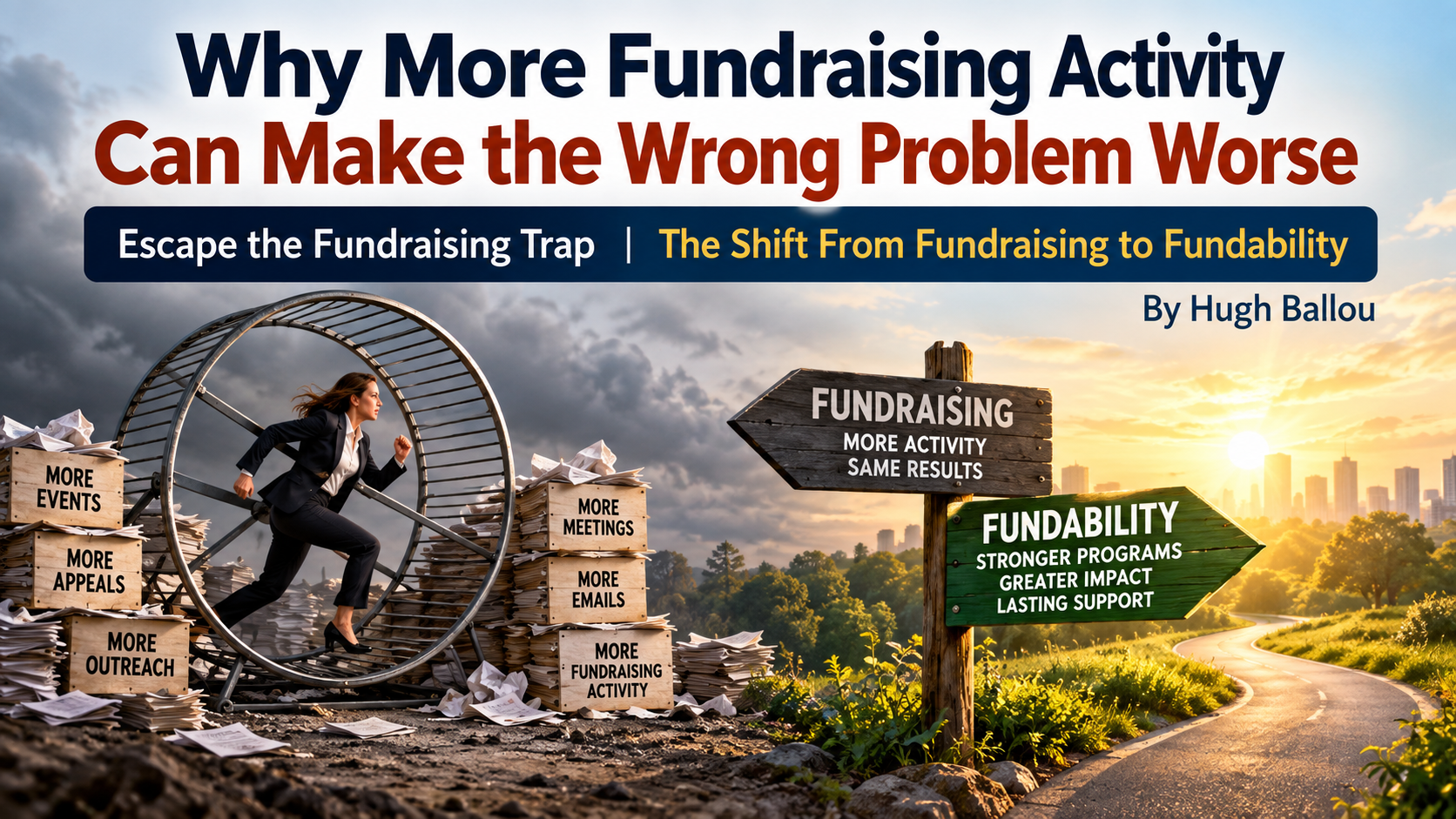
Why More Fundraising Activity Can Make the Wrong Problem Worse
Escape the Fundraising Trap | Part I — The Shift From Fundraising to Fundability
Based on Hugh Ballou’s new book, Creating a Fundable Nonprofit
━━━━━━━━━━━━━━━━━━━━━━━━━━━━━━━━━━━━━━━━
By Hugh Ballou, Transformational Leadership Strategist™
Revenue pressure has a predictable effect on leadership teams. A grant is not renewed. A major donor steps away. Program demand increases faster than revenue. The board asks what the organization is going to do about the gap. The natural answer is activity: submit more grants, add an event, send another appeal, schedule more donor meetings, improve the website, hire a development professional, or ask board members for introductions.
None of those actions is inherently wrong. Many are necessary. The leadership mistake is assuming that more fundraising activity will solve a problem fundraising did not create.
The Difference Between Activity and Condition
The central distinction in Creating a Fundable Nonprofit is simple: fundraising is the activity; fundability is the organizational condition that makes the activity credible.
Fundraising is what an organization does to invite resources into the mission. Fundability is what leaders have built before the ask is ever made. It is the accumulated result of choices about strategy, leadership, systems, outcomes, finances, and execution.
Executives often measure fundraising by visible motion: appeals sent, grants submitted, events held, meetings scheduled, proposals written. Motion is easy to count. Fundability is less visible because it lives underneath the motion. It shows up in whether leaders can explain the strategy clearly, whether the board is aligned, whether core work depends on repeatable processes, whether outcomes can be demonstrated, whether the financial story is trustworthy, and whether commitments turn into results.
That distinction matters because activity can increase while confidence remains unchanged. In fact, more activity can expose organizational weakness faster. A polished proposal may prompt a funder to ask for outcome data the organization cannot produce. A successful donor meeting may lead to financial questions no one is prepared to answer. A large funding opportunity may reveal that delivery systems depend on one heroic leader.
Fundability Belongs to the Whole Organization
One of the most costly executive assumptions is that fundraising belongs to the development function. Fundraising may be assigned there operationally. Fundability cannot be.
A development director cannot compensate for an unclear strategy. A grant writer cannot manufacture measurable outcomes that the program team has never defined. A major-gifts officer cannot create financial integrity. A consultant cannot make an uninvolved board become a credible governing body. Better communication can clarify what is already true, but it cannot manufacture organizational credibility.
This makes fundability an executive issue. Strategy contributes to it. Governance contributes to it. Program design, financial management, measurement, communication, and execution all contribute to it. The development team represents the organization to funders; leadership determines what there is to represent.
The Six Conditions Behind Funder Confidence
The book identifies six conditions that strengthen funder confidence:
- Clarity of strategy: Can we explain the problem, our solution, our priorities, and why our approach matters?
- Strong leadership: Do executive and board leaders demonstrate alignment, credibility, accountability, and depth?
- Reliable processes: Does important work run on repeatable systems rather than memory, improvisation, or one key person?
- Measurable outcomes: Can we demonstrate meaningful change, not merely activity?
- Financial integrity: Do budgets and reports communicate disciplined, transparent stewardship?
- Consistent execution: Do priorities become deliverables with owners, measures, and review rhythms?
None of these conditions is a fundraising tactic. Together they create the environment in which fundraising can work. Strong conditions give fundraising something credible to communicate. Weak conditions eventually create resistance, even when the fundraising technique itself is excellent.
What Does the Funder See Before the Ask?
A prospective funder begins forming an opinion before the formal appeal arrives. The funder sees the website, but also the clarity or confusion behind it. The funder sees financial statements and whether the numbers reinforce the strategy. The funder notices whether board members can explain the organization’s priorities, whether leaders describe outcomes consistently, and whether the organization responds promptly and professionally.
The executive question, then, is not only, “How can we raise more money?” A more useful question is, “What does a prospective funder see before hearing our appeal?”
That question changes the leadership conversation. It moves the organization from external activity to internal architecture. It turns fundraising from a desperate search for money into a disciplined invitation to partnership between stewards.
A Leadership Test for This Week
- Where are we increasing fundraising activity without increasing funder confidence?
- What information do serious funders request that is difficult for us to produce?
- Where do our strategy, budget, outcomes, leadership, and public story fail to line up?
- If a major funding opportunity arrived tomorrow, what part of our organization would be strained or exposed?
- What one organizational condition, if strengthened in the next 90 days, would make future fundraising more credible?
Leadership is not the art of doing more things. It is the discipline of building the conditions in which the right things can happen consistently. Before adding another fundraising tactic, determine whether the organization has built the condition the tactic is being asked to represent.
Creating a Fundable Nonprofit: Building the Organizational Condition That Creates Funder Confidence
https://synervision.kartra.com/page/CFNBook
Source foundation: Creating a Fundable Nonprofit, Part I, Chapters 1–2.
____________________________________________________________________________________________________________________________
Hugh Ballou is a Transformational Leadership Strategist™, author, speaker, executive coach, and founder of SynerVision Leadership Foundation. Drawing on more than four decades as a musical conductor and leadership teacher, Hugh helps leaders create the clarity, alignment, and disciplined execution required for organizations to perform at a higher level. Creating a Fundable Nonprofit brings that systems-thinking approach to one of the most persistent challenges in the social-benefit sector: building an organization that people can confidently support.