The Confidence Trap
The numbers, on their surface, look like a technology leadership success story. According to the 2026 Deloitte Global Technology Leadership Study, 81% of senior technology leaders report high confidence in their AI investment strategy. They have deployed Agentic workflows, integrated large language models into core operations, and presented roadmaps that signal organizational maturity to their peers. By every technical measure, transformation is underway.
The second number, however, is the one that matters in the boardroom. Only 42% of those same leaders can demonstrate measurable ROI from their AI investments.
That 39-point gap is not a technology problem. It is not a talent problem. It is a precision problem, and it has a name: Strategic Latency, the dangerous interval between deploying a system and seeing it register on the P&L. For the VP or Director who has staked professional credibility on an AI transformation mandate, Strategic Latency is the Invisible Bar, the threshold that separates a technically competent operator from a fiduciarily accountable leader.
Executive Truth #1: Confidence without capital translation is not a strategy. It is a liability.
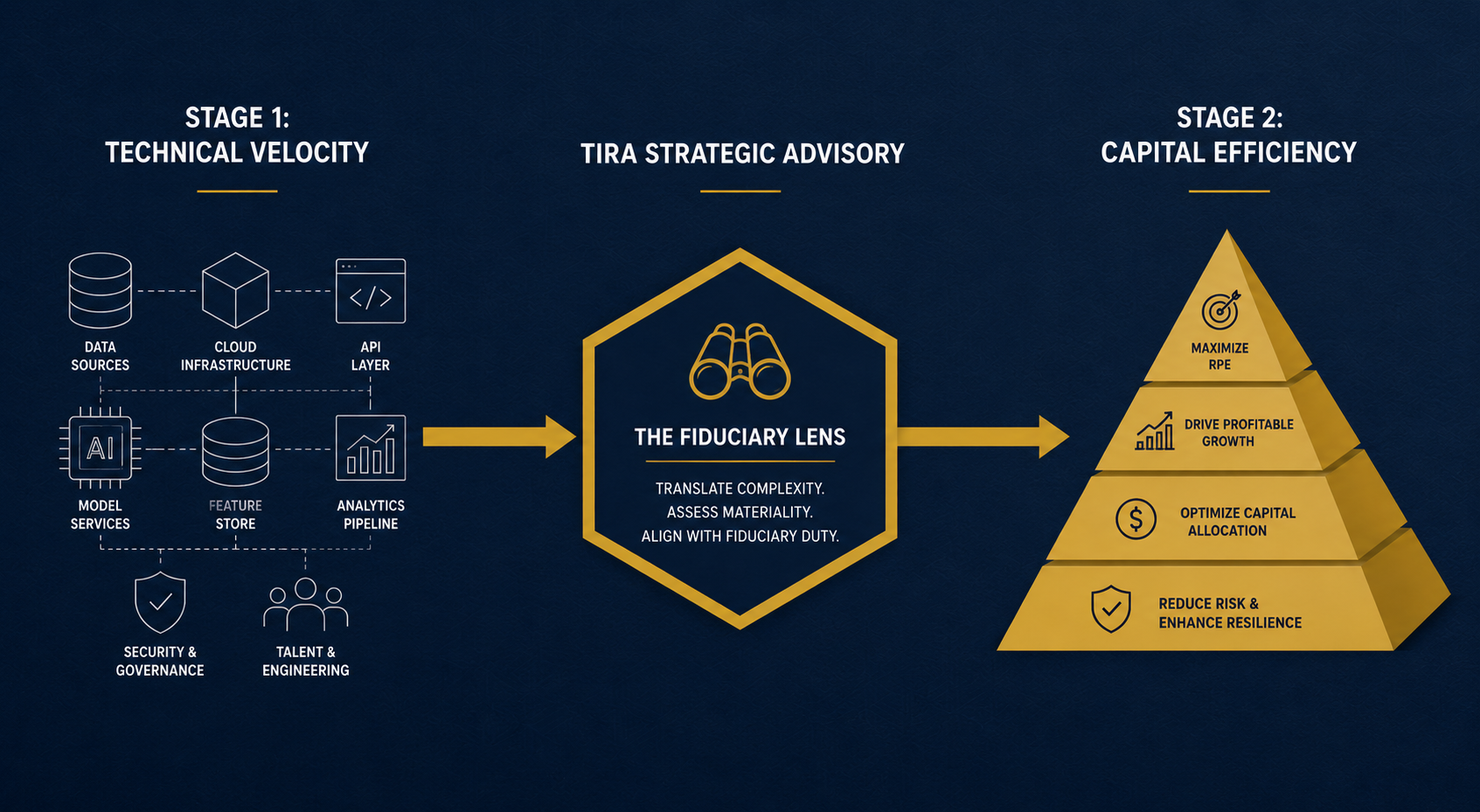
The leaders who close this gap in 2026 will not be those who deploy more technology. They will be those who master the discipline of connecting technical velocity to financial certainty, in language that a CFO can defend to an Audit Committee.
The Diagnosis: Why Technical Wins Are Losing in the Boardroom
To understand Strategic Latency, it is necessary to examine how most technology leaders currently measure success. The dominant operating model, inherited from the infrastructure era, rewards system stability, deployment speed, and usage growth. These are legitimate operational metrics; they simply carry no fiduciary weight at the executive level.
When a Director presents a QBR update that highlights agent uptime, throughput volume, and integration milestones, they are communicating in a register the Board cannot act on. The CFO is not asking whether the system is working. The CFO is asking whether the allocation is defensible, whether the investment is compounding, and whether the risk profile of the technology portfolio is improving or expanding.
The Validation Gap, the structural distance between what technology leaders are measuring and what the Board needs to see, is the engine of Strategic Latency. It does not close by improving the technology. It closes by redesigning the performance narrative around capital efficiency rather than technical output.
Executive Truth #2: The Board is not anti-AI. The Board is anti-ambiguity. Governance-grade clarity is the price of executive trust.
TIRA Pillar 1: From Uptime to Outcome Rates
The first strategic shift required to bridge the latency gap is a fundamental redefinition of the performance metric that governs AI investment decisions.
Uptime is infrastructure. At the executive level, it is assumed. The metric that carries weight in a capital efficiency conversation is cost-per-outcome: the fully loaded cost of producing one unit of measurable business value using an Agentic system, measured against the pre-deployment baseline for that same output.
This is not a minor reporting adjustment. It requires technology leaders to instrument their AI deployments the way a CFO instruments a capital project: baseline cost, post-deployment delta, and clear attribution linking the system’s activity to the financial movement. The discipline of building this attribution model before deployment, rather than retrofitting it after a budget review, is precisely what separates a Sophisticated Operator from a competent technologist.
The practical implication is direct. Every active AI initiative should carry a single owner metric, one number that moves when the system is delivering and stalls when it is not. That number must exist in a financial register, not a technical one, and it must be legible to a non-technical board member without a supplementary briefing.
TIRA Pillar 2: The Management Revolution
The second pillar addresses a structural shift that most AI transformation roadmaps fail to articulate with sufficient precision. In the Agentic Era, execution at scale is no longer a human responsibility. Autonomous systems handle volume, consistency, and the operational throughput that consumed the majority of a middle manager’s cognitive capacity in the prior paradigm.
What remains, and this is the critical insight, is judgment and precision of questioning. The leaders who will command boardroom authority through the next planning cycle are not those who built the most sophisticated agents. They are those who learned to function as Editor-in-Chief of autonomous systems, setting the interrogation standard, designing the quality framework before the agent runs, and overriding with authority when a system produces a plausible answer to the wrong question.
Executive Truth #3: In the Agentic Era, your value to the organization is no longer your capacity to manage execution. It is your precision in interrogating outputs that no system can self-correct.
The behavioral shift here is specific and measurable. Leaders who review agent outputs passively, flagging errors after the fact, are operating as approvers. Leaders who design the interrogation framework in advance, defining in explicit terms what a correct output must contain and what conditions should trigger escalation, are operating as orchestrators. This distinction is visible to any Board member who understands the governance implications of AI at scale.
TIRA Pillar 3: Defensible Financial Cycles
The third pillar requires the most direct confrontation with entrenched organizational habits: the replacement of vague technical progress reports with governance-grade financial narratives.
The standard quarterly technology update in most organizations follows a pattern that has not materially changed since the software delivery era. Deployments completed, milestones achieved, roadmap progress tracked. This format is designed for internal team coordination; it is structurally ill-suited for boardroom communication in 2026.
A governance-grade update operates on a different logic entirely. It connects a specific system or workflow to a named P&L line, assigns a projected financial impact with a measurement timeline, and identifies the conditions under which that projection would be revised. It gives the CFO the language to defend the allocation to the Audit Committee without requiring a technical translation layer.
Executive Truth #4: If your AI update requires a glossary to understand, you have a positioning problem, not a technology problem.
The practical standard is a two-paragraph Financial Narrative, prepared for every active AI initiative before the next board cycle. One paragraph establishes the system’s function and its connection to a specific operational cost or revenue driver. The second paragraph quantifies the projected impact, states the measurement method, and sets the timeline to first financial signal. This is not supplementary documentation. It is the baseline requirement for fiduciary communication in the Agentic Era.
Clinical Prescription: Three Day-1 Interventions
The following interventions are executable within the current business cycle, not the next planning horizon.
Intervention 1: The 48-Hour Decision Speed Audit. Pull every active AI performance dashboard in your portfolio. Identify each metric that a CFO could not interpret without a technical briefing. Those metrics are eroding your boardroom credibility in real time. Replace each one with its financial equivalent: decision cycle time, cost-per-outcome, time-to-resolution, error-cost reduction. Complete this audit within 48 hours, not at the next sprint review.
Intervention 2: One Workflow Redesign. Identify a single active Agentic workflow where human involvement is currently structured as approval rather than interrogation. Map each checkpoint and replace passive review with a specific, testable question that the output must answer before advancing. This single redesign, documented and presented in the next operational review, signals a shift in operating maturity that is immediately legible to a sophisticated board.
Intervention 3: Kill the Moonshot, Fund the Micro-ROI. Any AI initiative that cannot demonstrate a financial return within 90 days is a research project, not a capital investment. Identify three operational friction points where an Agentic workflow could reduce cost or compress cycle time within a single quarter. Execute those first. Each one becomes a proof point, and proof points compound into the institutional trust that unlocks larger mandates.
Executive Truth #5: The fastest path to a larger AI mandate is a smaller, faster, financially legible win. Boardroom trust is built in quarters, not roadmaps.
The Fiduciary Bottom Line
The standard that separates a Manager from a Sophisticated Operator in 2026 is not technical sophistication. It is financial articulacy: the capacity to explain, in two sentences and without a slide deck, how a specific Agentic system is reducing operational risk, compressing cost-per-outcome, or accelerating a measurable revenue cycle.
If that explanation is not currently available for every active AI initiative in your portfolio, Strategic Latency is already costing you capital, credibility, and mandate. The correction is not a technology investment. It is a precision investment, in the discipline of translating technical velocity into the language of fiduciary accountability.
The Boardroom Question
Before your next executive review, answer this with a number and a timeline:
Is your AI strategy a line-item expense on the CFO’s risk register, or a defensible engine of capital efficiency that the Board would choose to expand?
If the answer requires a presentation to develop, the Board has already formed its own conclusion.
To assess your current position on the Strategic Latency curve and identify your highest-leverage path to capital efficiency, request a Confidential Briefing or ROI Audit at maheshmthakur.com.
Author positioning and disclosure
- Mahesh’s experience is grounded in his fiduciary framing of operational transformation: he explicitly positions the Strategic Latency Gap as a C-Suite and capital-efficiency risk and emphasizes the need to move from vague technical updates to defensible financial cycles and governance-grade clarity. His operating background includes scaling large business units and delivering measurable ROI in enterprise contexts.