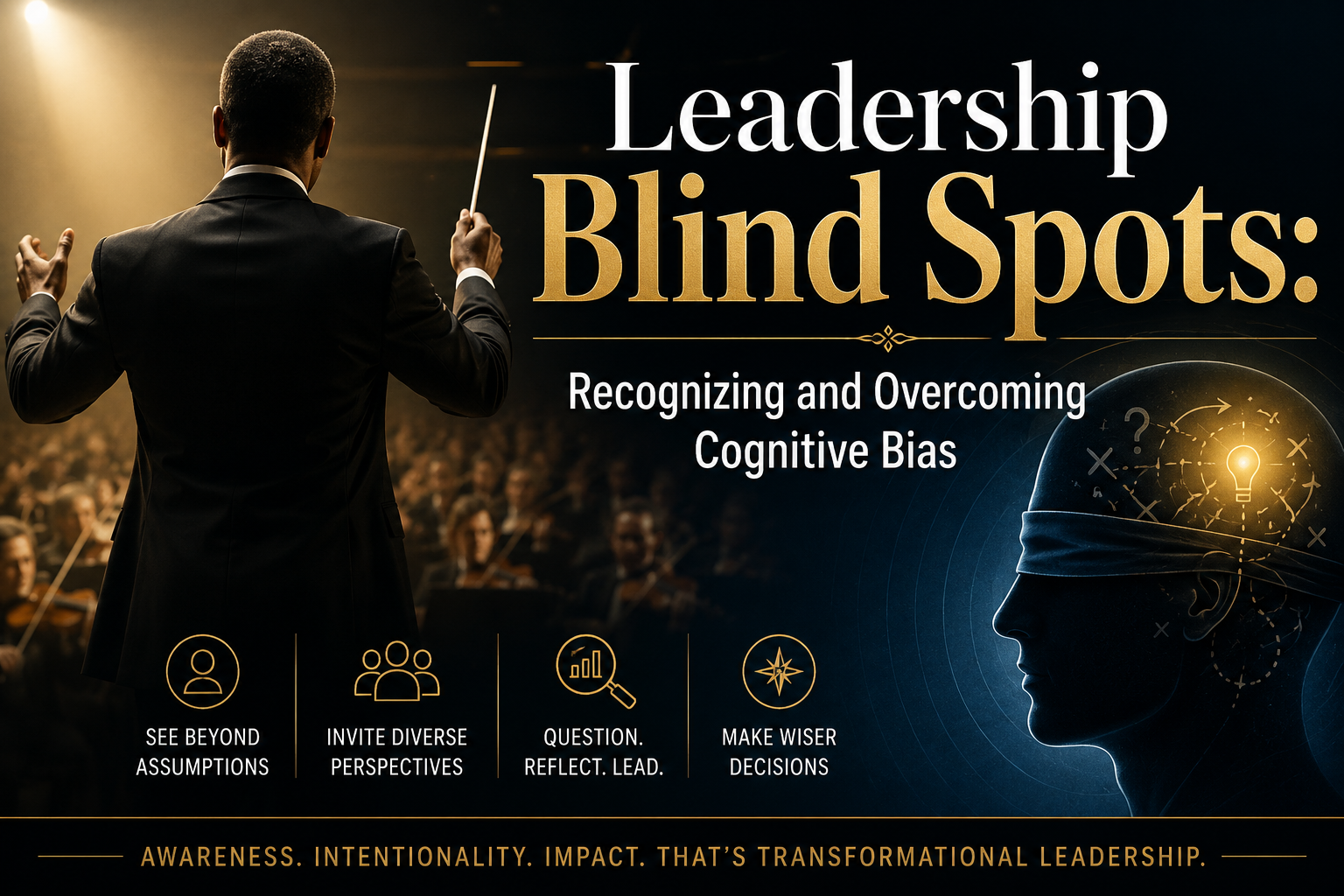
The Hidden Force Undermining Your Leadership:
How Cognitive Bias Quietly Drives Executive Decisions—and What Transformational Leaders Do Differently
By Hugh Ballou | Founder, SynerVision Leadership Foundation | Host, Nonprofit Exchange Podcast
Member of the C-Suite Network | Leader, Nonprofit Prosperity Council
ARTICLE AT A GLANCE
Target keywords: cognitive bias in leadership, leadership blind spots, nonprofit executive decision-making, transformational leadership, bias in boardroom
Who this is for: C-suite executives, nonprofit leaders, board chairs, executive directors, clergy leaders, and organizational decision-makers
Read time: approximately 12–15 minutes
Core question answered: How do cognitive biases operate in high-stakes organizational leadership, and what can executives and nonprofit leaders do about them?
The Question Every Leader Should Be Asking
Why do smart, experienced leaders make the same kinds of mistakes over and over?
That question is not rhetorical. It is one of the most important diagnostic questions a leader can hold. Because the answer is almost never “I lacked information.” The answer is almost always “I had a blind spot.”
In more than 35 years of working alongside nonprofit leaders, executive directors, board members, and clergy—and drawing on 40 years as a musical conductor—I have watched brilliant, well-intentioned people make costly decisions that could have been avoided. Not because they were uninformed. Because the way they processed information was quietly distorted by patterns they did not know they had.
Those patterns have a name: cognitive biases.
And in the C-suite, in the boardroom, in the nonprofit executive office, and in the pulpit, they are operating right now—shaping strategy, filtering feedback, and constraining vision. Largely without anyone noticing.
Transformation begins with the leader. It always has. And it begins with the leader’s willingness to see.
— Hugh Ballou, The Transformational Leadership Strategist
What Is Cognitive Bias—and Why Should Executives Care?
A cognitive bias is a systematic pattern of deviation from rational judgment. It is not a character flaw. It is not a sign of poor intelligence. It is a feature of human neurology.
The human brain processes approximately 11 million bits of sensory information per second. It can handle only about 50 of those bits consciously. To manage the gap, the brain creates mental shortcuts called heuristics—rapid, automatic patterns of judgment that allow us to function without being paralyzed by data overload.
Those shortcuts are remarkable tools. They enable quick decisions, pattern recognition, and efficient action. In low-stakes situations, they serve us well.
In high-stakes leadership environments—strategic planning, hiring, fundraising, board governance, crisis response, organizational change—they can be catastrophic.
Here is what makes cognitive bias particularly dangerous for leaders:
• Biases operate largely below conscious awareness. You cannot catch what you cannot see.
• Stress, fatigue, and time pressure—the standard conditions of executive leadership—amplify bias significantly.
• Organizational culture can institutionalize individual biases, embedding them into policy, process, and norms.
• The more senior a leader is, the less likely others are to challenge their biased judgments. Authority insulates bias from correction.
• High confidence and high bias frequently coexist. Certainty is not a reliable signal of accuracy.
KEY INSIGHT FOR C-SUITE LEADERS
Cognitive biases are not eliminated by experience. In many cases, experience reinforces them. A leader who has succeeded repeatedly in one domain is often more susceptible to overconfidence bias—not less.
The antidote is not more experience. It is structured self-awareness and deliberate decision architecture.
The Ten Cognitive Biases That Most Affect Executive and Nonprofit Leaders
After decades of working with leaders across sectors and continents, I have identified ten cognitive biases that appear most consistently in high-stakes organizational decision-making. Understanding these is not academic exercise. It is executive preparation.
The List Below Contains The Cognitive Bias
What It Looks Like In Leadership
The Cost to the Organization
Confirmation Bias
Leaders selectively gather feedback and data that validates decisions already made.
Missed early warning signals; strategies pursued past their expiration date; voices of dissent silenced or ignored.
Anchoring Bias
First numbers, first impressions, and first proposals disproportionately shape all subsequent thinking.
Budget creativity constrained by initial figures; negotiations anchored unfavorably; innovative options never considered.
Overconfidence Bias
Leaders overestimate the accuracy of their knowledge and the probability of their success.
Under-resourced initiatives; inadequate contingency planning; poor risk assessment at the board and executive level.
Status Quo Bias
The current state is preferred; change is perceived as loss rather than opportunity.
Necessary structural reforms delayed or defeated; organizational stagnation framed as stability.
Sunk Cost Fallacy
Leaders continue investing in failing strategies because of prior investment.
Programs kept alive past usefulness; relationships maintained past effectiveness; capital misallocated toward the past.
Loss Aversion
The pain of a potential loss is felt approximately twice as intensely as an equivalent gain.
Overly cautious decisions; paralysis under uncertainty; failure to seize time-sensitive opportunities.
Authority Bias
Disproportionate weight is given to authority figures, regardless of evidence.
Founder-capture in nonprofits; groupthink in senior teams; dissent suppressed by deference to rank.
Halo Effect
Strong performance in one area creates assumption of competence and integrity in all others.
Inadequate accountability for star performers; blind spots around high-profile donors, volunteers, or board members.
Recency Bias
Recent events receive more weight than older but equally relevant information.
Short-term results misread as long-term trends; strategic decisions distorted by the last quarter’s data.
Survivorship Bias
Leaders study success stories and ignore the silent evidence of organizational failures.
Strategies borrowed from thriving organizations without understanding the selection effects behind their survival.
The Conductor Leadership Model: A Framework for Bias-Aware Leadership
After four decades on the conductor’s podium—leading orchestras, ensembles, and music programs around the world—I have drawn a consistent parallel between the conductor’s discipline and the discipline of transformational leadership.
The conductor does not play an instrument.
That fact, which seems self-evident, is actually a profound leadership statement. The conductor’s value is not in personal performance. It is in listening—to every section, every voice, every dynamic relationship in the ensemble. The conductor holds the vision of the whole while honoring the specific contribution of each part. The conductor’s power comes not from individual dominance but from the quality of collective intelligence she creates.
This is precisely the posture that bias-aware leadership requires.
THE CONDUCTOR PRINCIPLE: FIVE APPLICATIONS FOR EXECUTIVE LEADERS
1. Listen before you speak. Structure every major decision process so that independent perspectives are gathered before senior voices are shared. The conductor hears every section before setting the interpretation.
2. Seek the voice you are not hearing. Every organization has sections of its orchestra that are systematically underrepresented in leadership conversations. Find them deliberately. The instrument you are ignoring is carrying information you need.
3. Hold the vision; question the method. The score is sacred. The way you have been rehearsing it is not. Separate what you are trying to accomplish from how you have been doing it. Status quo bias conflates the two.
4. Treat certainty as a signal to ask more questions. A great conductor who is certain about an interpretation knows enough to probe that certainty. What am I missing? What is the score actually asking for? What is the ensemble telling me?
5. Collective intelligence over individual dominance. The most important question a leader can ask is not “What do I think?” but “What does this room know that I do not?” The conductor’s job is to surface and orchestrate that intelligence, not to override it.
Leadership is not about being the smartest person in the room. It is about creating the conditions for the room to be smarter than any single person.
— Hugh Ballou, The Transformational Leadership Strategist
Practical Applications: Building Bias-Resilient Leadership
Understanding cognitive bias is necessary. It is not sufficient. The executive leader who finishes this article with enhanced self-awareness and no structural change has accomplished only the first step. What follows must be deliberate design.
For Individual Executive Leaders
• Conduct a monthly Assumption Audit on one major decision or initiative: list three core assumptions, identify evidence that supports each, and identify evidence that challenges each.
• Designate a trusted adviser whose explicit and protected role is to challenge your thinking. Meet with them before major decisions, not after.
• Practice pre-mortem analysis. Before committing to any significant initiative, convene your team to imagine the initiative has failed and work backward to identify the causes.
• Keep a Leadership Bias Journal for 30 days. Each week, record one instance where you noticed a bias operating in your own decision-making. What was the trigger? What did you do? What would you do differently?
• Treat certainty as a warning sign. When you notice you are most confident, schedule one more round of contradictory inquiry before acting.
For Boards of Directors and Governance Leaders
• Institute a “governance pre-mortem” as a standing practice before major board votes. Ask: If this decision proves to be wrong in three years, what will we wish we had considered?
• Separate information-gathering from deliberation. Collect written board member assessments before convening discussion to prevent anchoring and authority bias from collapsing deliberation.
• Rotate the devil’s advocate role across meetings. Make principled challenge a board norm, not an occasional exception.
• Require longitudinal data in board presentations. No single-period reporting without multi-year trend context.
• Review board composition for diversity of perspective, not only diversity of demographic representation. Has the board’s collective experience and worldview become an echo chamber?
For Nonprofit Organizations Specifically
• Reframe bias awareness as stewardship. You are stewards of your organization’s judgment, not just its resources. Donor trust, mission impact, and community relationships are all downstream of the quality of your decision-making.
• Build diverse perspective into every major strategic decision process—not as compliance, but as intelligence. Ask: Who would see this differently? What would a program beneficiary say? What would a critic of our approach say? Seek those perspectives before finalizing the decision.
• Create organizational cultures where honest challenge is rewarded, not merely tolerated. The nonprofit where staff feel safe to raise concerns is the nonprofit with the most robust bias-correction system.
• Use the question “What are we not seeing?” as a standing agenda item in strategic discussions. Name the silence.
Frequently Asked Questions: Cognitive Bias in Executive Leadership
Can cognitive biases be eliminated?
No. Cognitive biases are features of human neurology, not failures of character. The goal is not elimination—it is awareness and structural mitigation. Leaders who understand their biases can design decision-making processes that compensate for them. Leaders who believe they have eliminated their biases are demonstrating overconfidence bias.
Are some leaders more biased than others?
All leaders are subject to cognitive bias. Experience does not reduce bias susceptibility—in many areas, it increases it. High-performing leaders are not less biased; they are better at building systems that surface and correct for bias. The most dangerous leader is not the one with the most biases but the one who is most certain they have none.
How does cognitive bias differ between for-profit C-suite and nonprofit executive leadership?
The biases themselves are universal. The contexts that amplify them differ. In nonprofit organizations, mission passion amplifies confirmation bias. Resource scarcity amplifies loss aversion. Founder reverence amplifies authority bias. Sector norms around collaboration can suppress the productive conflict that challenges groupthink. Nonprofit leaders benefit from understanding these sector-specific amplifiers alongside the universal patterns.
What is the single highest-leverage action a leader can take?
Designate a trusted, structurally protected challenger—a person whose explicit role is to surface what you are not seeing and to speak what others in your organization will not say. This single structural change is the highest-leverage bias intervention available to an individual leader. It does not require a consulting engagement, a governance overhaul, or a year-long initiative. It requires one honest relationship and the courage to use it.
How do I introduce bias awareness in my organization without triggering defensiveness?
Frame it as organizational intelligence, not individual deficiency. Cognitive biases are not evidence of weak leadership. They are evidence of human neurology. The conversation that normalizes bias as a universal leadership condition—rather than framing it as a problem some people have—creates the psychological safety required for honest engagement. Start with yourself. Model the awareness you are inviting. Vulnerability in leadership is not weakness. It is the highest form of organizational trust.
Leadership Is Learning to See More Clearly
I want to close with what I have come to believe is the most important truth about cognitive bias and transformational leadership.
Bias awareness is not a technique. It is not a workshop outcome. It is not a box you check in a leadership development curriculum. It is a practice—an ongoing, disciplined commitment to seeing more clearly than you did yesterday.
The most transformational leaders I have known are not the ones who made the fewest mistakes. They are the ones who built the most honest relationships with the truth about themselves—who created around them the conditions in which honest information could reach them, in which honest challenge was welcomed rather than suppressed, and in which the question “What am I missing?” was treated as a mark of strength rather than a confession of weakness.
That kind of leadership does not begin with a better strategy. It does not begin with a better board. It does not begin with a better team.
It begins with the leader.
It always has.
Leadership is not about being right. Leadership is learning to see more clearly. Every blind spot you acknowledge is a step toward greater clarity—and every step toward clarity makes you a more effective leader for the people you serve.
— Hugh Ballou, SynerVision Leadership Foundation
This is an excerpt from a longer article. Download the full article at – https://d11n7da8rpqbjy.cloudfront.net/synervision/31064844_1782169295967The_Hidden_Force_Undermining_Your_Leadership.pdf
ABOUT THE AUTHOR
Hugh Ballou is The Transformational Leadership Strategist—founder of SynerVision Leadership Foundation, host of the Nonprofit Exchange Podcast, and leader of the Nonprofit Prosperity Council inside the C-Suite Network.
Drawing on more than 40 years as a professional conductor and 35 years working with nonprofit leaders, executive directors, boards, and clergy across four continents, Hugh translates the conductor’s discipline into a practical framework for organizational transformation.
Hugh is the author of The Nonprofit Success System: The Leadership System That Transforms Nonprofits into High-Performing Organizations and a sought-after speaker, consultant, and workshop leader for C-suite executives and nonprofit practitioners.
Connect at http://AboutHugh.com