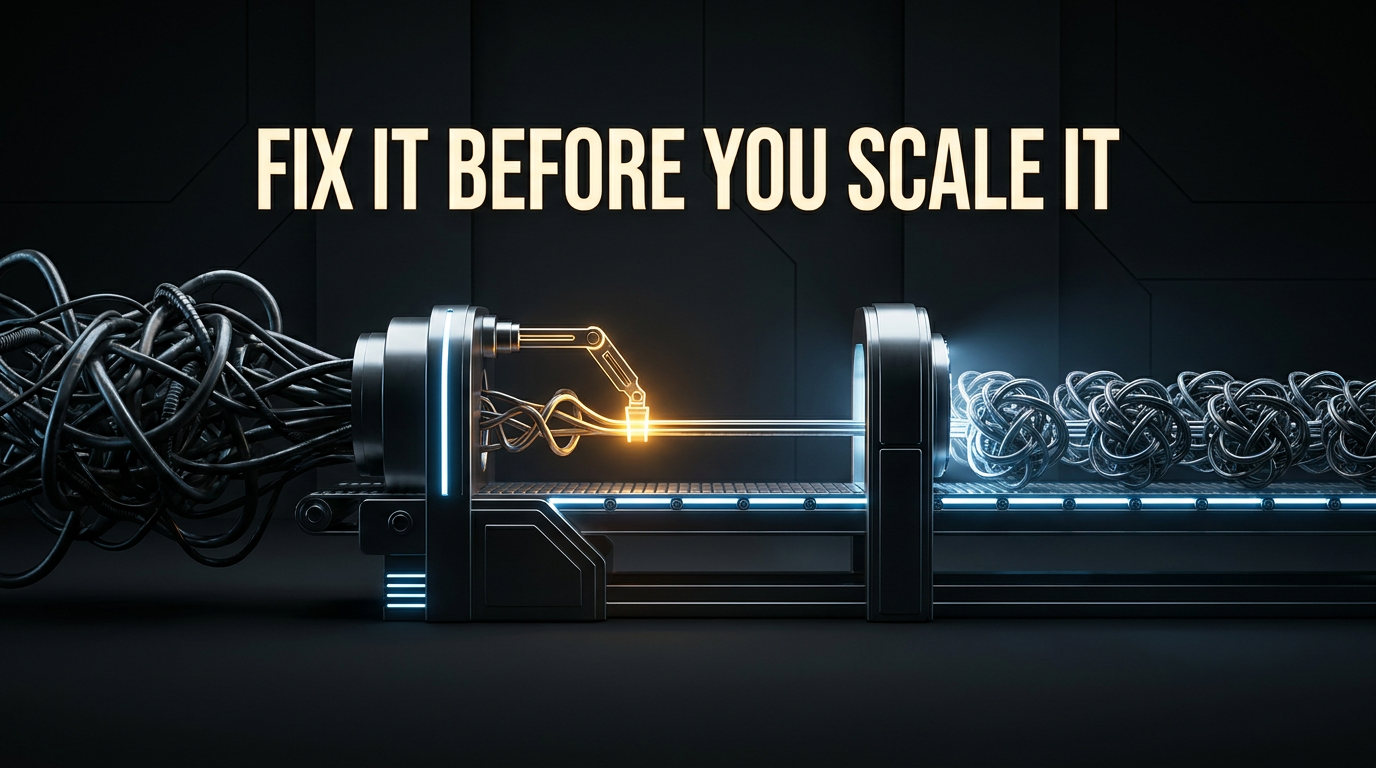
Good Enough Is the Most Expensive Process You Have
“Good enough” sounds practical. Responsible, even. The process works. The numbers are acceptable. Customers are not openly revolting. Employees have developed enough workarounds to keep things moving. Leadership knows the system is not ideal, but replacing or redesigning it would require time, money, and uncomfortable conversations. So the organization leaves it alone. That decision may look prudent on a spreadsheet. In practice, it is often one of the most expensive choices a leader can make.
A merely adequate process accumulates hidden costs through wasted employee time, inconsistent data, slow decisions, avoidable errors, customer frustration, and opportunities nobody can pursue because the team is too busy maintaining the machinery. The process is not failing dramatically enough to force action. It is simply consuming the organization a few hours, handoffs, and compromises at a time. That is why continuous process improvement is no longer an operational side project. It is an executive responsibility.
This article was developed from my conversation with Michael Toguchi, Chief Strategy Officer at eResources, about digital strategy, transformation, and the work of helping mission-driven organizations simplify complex operations. One idea from that conversation deserves considerably more executive attention: the most dangerous process may not be the one visibly failing. It may be the one everyone has agreed to tolerate.
The Real Cost of “Good Enough”
Leaders usually know where the spectacular failures are. Those problems generate complaints, missed deadlines, escalating costs, or customer losses. They attract attention because the damage is visible. “Good enough” processes are harder to confront because they continue producing an output. The grant gets reviewed. The student eventually receives an answer. The customer record lands in the correct system after someone copies it from three spreadsheets. The report reaches leadership after two people reconcile conflicting versions of the data.
The work gets done, but at a cost the organization rarely measures. This is operational debt. Like technical debt, it compounds. Every workaround becomes an unofficial step. Every unofficial step creates dependence on individual memory. Every additional tool produces another source of data. Eventually, the organization cannot easily distinguish between the process it designed and the survival tactics employees invented.
The absence of collapse is not proof of efficiency. It may simply mean capable people are compensating for weak systems. That distinction matters because leaders often interpret successful compensation as evidence that the underlying process works. They praise the team for going above and beyond while leaving untouched the conditions requiring that extra effort. Heroics become part of the operating model. That is not resilience. It is unmanaged risk wearing an employee-engagement T-shirt.
Technology Is an Amplifier, Not a Cure
The predictable response to process friction is to buy technology. Sometimes that is the right move. Frequently, it is the most convenient way to avoid diagnosing the real problem.
Toguchi described technology as the amplifier or implementation mechanism, rather than the starting point for transformation. That distinction is critical. If responsibilities are unclear, data is inconsistent, handoffs are redundant, or departments are working toward competing priorities, a new platform will not resolve the operating conflict. It will digitize it. As I said during our conversation, if technology enables a bad process, the organization can produce bad outputs much faster.
The first executive question should not be, “What platform do we need?” It should be, “Why does this work happen this way?” That question sounds elementary until people start answering it. One step exists because a previous system required it. Another was added after an isolated mistake seven years ago. A third protects a departmental preference rather than an enterprise need. Nobody owns the entire workflow, so nobody has the authority or incentive to simplify it. Then the organization automates all of it. Effective digital transformation reverses that sequence. Leaders clarify the outcome, examine the work, remove unnecessary friction, align accountability, and then choose technology that supports the redesigned process. The tool is the multiplier. It should not be expected to supply the strategy.
Time Is the ROI Leaders Keep Undervaluing
One of Toguchi’s most useful observations was that the return on process improvement is often employee time. Time can sound like a soft benefit compared with revenue, cost reduction, or growth. It is not. Time is the resource from which all three are produced. In one example, eResources worked with a disability center at a major university operating with legacy systems and an overextended team. Employees were spending significant time managing bureaucratic tasks and answering frustrated messages. Meanwhile, students needed support, and faculty needed faster communication.
The value of improving the workflow was not simply a cleaner system. It allowed case specialists to spend more time helping students with disabilities rather than managing preventable administrative friction. That example comes from a university, but the executive issue applies across industries. Consider what skilled employees are doing instead of the work they were hired to perform:
• Relationship managers reconcile data rather than strengthening customer relationships.
• Specialists chase approvals rather than applying their expertise.
• Leaders assemble reports rather than interpreting what the information means.
• Employees answer predictable status questions because the process provides no visibility.
Every hour redirected toward administrative recovery is an hour unavailable for customer value, innovation, analysis, growth, or mission delivery. This is why process improvement should not be framed exclusively as cost cutting. Cost matters, but the larger strategic opportunity is capacity. A better workflow can return capacity to the organization without requiring employees to work faster or leadership to add headcount. The executive question is not merely, “How much money will this save?” It is also, “What higher-value work becomes possible when we stop wasting this time?” If leadership cannot answer the second question, the transformation lacks a business purpose.
Silos Are an Operating Design Problem
Organizations often talk about silos as if they are unfortunate natural formations. They are not. They are the result of decisions about goals, incentives, systems, ownership, and communication. Departments adopt their own tools because enterprise decisions take too long. Teams create separate data structures because nobody established shared standards. Leaders optimize their individual functions because performance measures reward local outcomes. Eventually, each group can explain why its approach is rational, while the overall organization becomes slower and harder to manage.
Toguchi identified siloed information, data, processes, and teams as a recurring obstacle in transformation work. Solving that problem requires more than asking people to collaborate. Collaboration cannot consistently overcome structural misalignment. If one team’s success creates rework for another, the problem is not attitude. It is design. Executives must establish where integration is necessary, which outcomes take priority, and who owns decisions that cross functional boundaries. They must also confront competing key performance indicators.
A department can hit every one of its targets while making the customer’s experience worse or increasing downstream costs. Enterprise performance is not the sum of departments looking successful independently. Breaking down silos does not require forcing every team into identical methods. Specialization has value. The objective is to create enough consistency in data, handoffs, priorities, and accountability that specialized teams can operate as one business rather than neighboring businesses negotiating a treaty.
Small Wins Build Credibility, Not Just Momentum
Large transformation announcements get attention. Small operational wins earn trust. That trust matters because employees have seen transformations arrive before. They have attended the kickoff, learned the terminology, migrated the data, and watched leadership’s attention move elsewhere. When the next initiative appears, skepticism is not necessarily resistance. Sometimes it is pattern recognition. Toguchi emphasized the importance of champions, experimentation, and small wins. Rather than attempting to transform everything simultaneously, leaders can select a meaningful workflow, improve it, and demonstrate that the change produces a tangible benefit.
The right first win is not merely easy. It should be visible enough to matter and contained enough to manage. It might reduce manual data entry, shorten a response cycle, eliminate a recurring handoff, or give employees direct visibility into information they previously had to request. The result should be something people can feel in their work. That proof changes the conversation. Employees no longer have to accept an abstract promise that transformation will eventually make life better. They can see time returned, frustration reduced, or service improved. Confidence grows because the organization has demonstrated both competence and follow-through. Small wins are not an excuse for small ambition. They are how leaders build the organizational credibility required for larger change.
Experimentation Requires Air Cover
Leaders routinely say they want innovation. Far fewer create the conditions under which innovation can survive. Experimentation requires time, decision rights, and tolerance for outcomes that are neither obvious victories nor catastrophic failures. If employees are expected to maintain a full workload, adopt new tools, redesign processes, and avoid every mistake, leadership is not encouraging experimentation. It is assigning invisible overtime. Toguchi pointed to a particularly difficult category: the result that is not a home run and not a clear failure. It is just good enough.
These ambiguous outcomes require judgment. A pilot may improve one measure while creating friction elsewhere. A workflow may save time but expose a data-quality problem. A tool may perform adequately without addressing the strategic need that justified it. Leaders must decide whether to refine, expand, pause, or stop the experiment. Continuing indefinitely because the result is not terrible is how temporary solutions become permanent operating constraints.
Responsible experimentation therefore needs clear success measures before implementation. Those measures may include reduced processing time, fewer manual touches, better data consistency, faster decisions, improved service, or more employee capacity for mission-critical work. Not every experiment should succeed. Every experiment should produce useful information.
Continuous Process Improvement Starts With Leadership Behavior
Process optimization cannot be delegated entirely to operations, IT, or a transformation office. Those teams can facilitate the work, but leadership determines whether the organization will tell the truth about how it operates. Executives set the conditions through what they ask, fund, measure, and tolerate. They can begin by identifying one business-critical process that is currently considered acceptable but depends heavily on manual work, employee memory, duplicate data, or repeated exception handling. Then they should follow that process from beginning to end, across departments, rather than reviewing a polished procedure document. Talk to the people doing the work. Ask where they wait, re-enter information, seek clarification, maintain shadow systems, or compensate for missing data. Ask what they would stop doing if they were allowed to redesign the workflow around the outcome rather than its history. Then quantify the friction using evidence the organization already has: cycle time, backlog, error rates, repeated contacts, manual touches, delays, or hours consumed.
The purpose is not to manufacture a transformation business case. It is to expose the cost already being paid. From there, redesign before automating. Assign clear ownership. Establish the outcome that matters. Give a cross-functional team room to test a better approach, and decide in advance how leadership will evaluate the result. Most important, determine where the recovered capacity will go. If process improvement simply gives employees more room for low-value work, the organization has optimized activity rather than performance.
Stop Waiting for Failure to Grant Permission
Continuous process improvement does not mean changing everything constantly. That would create instability, exhaust employees, and replace operational debt with transformation fatigue. It means refusing to confuse familiarity with effectiveness. Some processes require stability because they support compliance, safety, financial control, or consistent service. Even then, stability should be intentional. Leaders must understand what cannot change, what can be tested safely, and what no longer serves the outcome.
The greater risk is allowing “the way we’ve always done it” to become an unexamined business strategy. Good enough is a form of slow-motion exposure. It consumes time quietly, hides inside functional silos, and survives because talented people keep rescuing it. By the time the process visibly fails, the organization may have already lost capacity, trust, decision speed, and room to maneuver. Choose one “good enough” process this quarter. Trace its real path, calculate the friction, and give a team permission to redesign it around the value it is supposed to create. Do not wait for failure to make the decision obvious. That is not leadership. That is expensive confirmation.