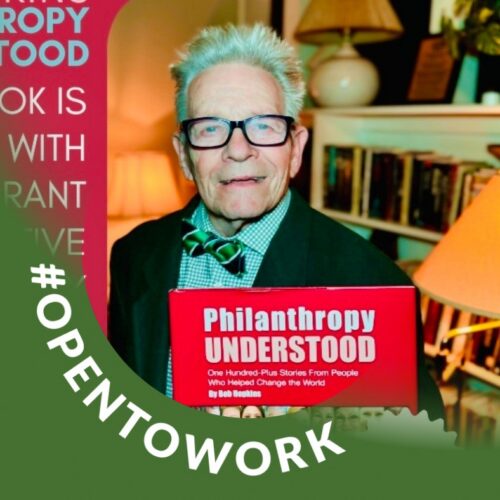
Money has long dominated the public image of philanthropy. Grand donations, named buildings, and headline-making gifts have shaped a belief that changing the world belongs to those with extraordinary wealth. Bob Hopkins has spent much of his life challenging that assumption.
The educator, author, and founder of Philanthropy United argues that philanthropy has never been about the size of a bank account. To him, it is a reflection of character. It is revealed in how people treat one another, how they show up in their communities, and how they choose to live each day.
His belief carries particular weight because he once shared the same misconception he now works to dismantle.
Hopkins entered the philanthropic world convinced that financial giving was the defining measure of generosity. As the founder and publisher of Philanthropy World magazine, he spent years spotlighting wealthy donors and charitable contributions. Eventually, he realized something was missing. Some of society’s most influential changemakers were absent from the conversation simply because they were not writing large checks. Meanwhile, countless people were improving lives through unheralded service and compassion.
Looking back, Hopkins sees that period as a turning point. His understanding of philanthropy expanded from wealth to humanity. Figures like Mother Teresa and Dr. Martin Luther King Jr. became examples of people whose contributions, to him, could never be measured in dollars. In his view, their impact came from who they were and how they served.
Determined to correct that narrative, Hopkins authored Philanthropy Misunderstood, followed by Philanthropy Understood, books that, he explains, celebrate individuals whose actions have strengthened communities without relying on financial power. Through more than one hundred stories, he sought to show readers that generosity belongs to everyone.
Every work he creates is forged from his own life’s journey.
As a child, Hopkins contracted polio during the height of the epidemic. Years later, he confronted substance abuse problems and chose a path of recovery that has now spanned nearly five decades. He credits those experiences to have shaped his understanding of resilience in the face of struggle and the importance of human connection. Recovery eventually led him to volunteer work, nonprofit leadership, and a career dedicated to helping others discover their own value. “People make good decisions about their lives when they feel good about who they are,” he says.
Research has increasingly linked volunteering and prosocial behavior with higher self-esteem, stronger social connections, and improved well-being. Hopkins has spent decades witnessing those outcomes firsthand. He recalls students whose confidence transformed after participating in simple acts of service. Picking up litter, helping a neighbor, or contributing to a community project often creates visceral changes socially and emotionally.
Those experiences have fueled his commitment to education. Throughout his career, Hopkins has taught nonprofit leadership and philanthropy, taking students on international service projects, and encouraging young people to see themselves as contributors rather than spectators. He believes service-learning can create lasting shifts in self-perception that traditional measures often overlook.
His work has carried him across various spaces, from classrooms and nonprofit organizations to communities around the world. Yet the lesson, he poses, remains remarkably simple. He says, “A philanthropist is not someone who waits until they have money. A philanthropist is someone who chooses kindness today.”
Hopkins often points to everyday examples: calling a friend who needs encouragement, offering a sincere compliment, helping a stranger, or taking responsibility for a shared space. The act, he notes, requires no recognition and no reward. It reflects a way of being.
“People ask me what they have to do to become a philanthropist,” Hopkins says. “They don’t have to do anything. They just have to be.”
Perhaps that is the question at the heart of his life’s work. What really defines philanthropy? Is it money donated? Is it time given? Or is it something deeper?
Hopkins tributes that answer to character. Philanthropy, according to him, is measured by what flows from humanity. The more people who embrace that idea, the more generous the world becomes.